
Why listeners choose Frusciante over shredders (skill ≠ music)
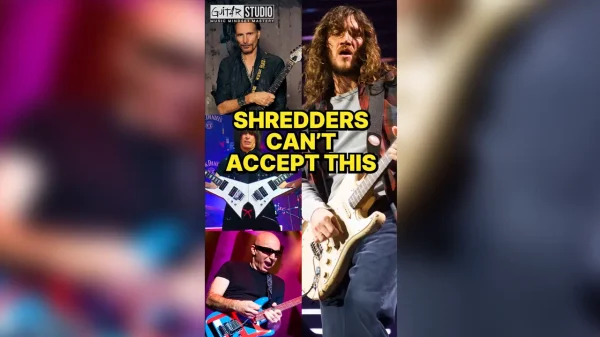
Here is a reality check many shredders still refuse to accept: most listeners do not care how difficult your guitar playing is. They care about what the music does to them. When I played music from Vai, Satriani, Malmsteen, Batio, Buckethead, and John Frusciante for listeners and my guitar students, they kept choosing Frusciante. Shred takes skill. The useful question is why listeners still choose something else.
Why do listeners choose Frusciante over shredders?
Listeners choose Frusciante over shredders because songs, memorable melodies, feel, and emotional connection matter more to them than guitar difficulty alone.
Skill is what the player can do; value is what the listener experiences. Frusciante connects through parts that serve the song, the mood, and the identity of the band.
Technique can strengthen that connection when it serves the music, but virtuosity by itself does not guarantee a broader audience. Shred still has value; it often reaches a different, more specialized audience.
Skill is real, but it is not the value
Skill is the input. Value is the output. This distinction separates what a player does from what a listener experiences.
Skill is:
- What you practiced.
- What you can execute.
- What you can control.
- What took years to build.
Value is:
- What the listener feels.
- What they remember.
- What they replay.
- What they connect with.
- What makes them want more.
These things can overlap, but they are not the same. Confusing them is where many guitarists get lost.
Technique matters, but it works best when it serves the music. For more on developing control, accuracy, and musical technique, explore the Guitar Technique & Skills section.
Two kinds of quality
Player-quality and listener-quality measure different things. That difference matters more than most guitarists want to admit.
Player-quality
This is the kind of quality musicians often obsess over:
- Difficulty.
- Speed.
- Precision.
- Complexity.
- Technique.
- Control.
- Virtuosity.
Listener-quality
This is what most listeners respond to:
- Feel.
- Emotion.
- Identity.
- Clarity.
- Tension and release.
- Connection.
- Memorability.
A guitarist may call something high quality because it is hard. A listener may call it high quality because it hits. Those are two different scoreboards, and the market is usually built on the second one.
The relationship between guitar technique and feel matters here: technical control becomes more valuable to listeners when it supports musical expression.
Why Frusciante wins with audiences
Frusciante is not picked because he is the most technical guitarist. He creates songs people remember, melodies people can sing, a vibe people feel instantly, identity inside a band people already connect with, and simplicity that communicates.
That is central to reaching listeners. They do not usually sit there measuring:
- Alternate picking difficulty.
- Advanced harmonic concepts.
- Technical rarity.
- Execution under pressure.
They respond to:
- Whether the part supports the song.
- Whether the emotion lands.
- Whether the melody sticks.
- Whether the overall identity feels alive.
Frusciante wins in that environment because he serves something bigger than guitar skill alone: the song, the mood, the chemistry, and the identity of the band.
Why shred often stays niche
Shred is often music designed to impress musicians. That creates a built-in ceiling: a smaller audience, a higher barrier to entry, more comparison, and less emotional accessibility. You are “selling meat to other butchers.”
That is harsh, but highly skilled music does not automatically mean broadly desired music.
Once your audience becomes mostly guitarists, a few things happen:
- The bar keeps moving.
- Comparison gets brutal.
- Originality pressure rises.
- Technical arms races replace emotional communication.
- The audience often becomes too narrow to scale easily.
That does not make shred worthless. It makes it more niche—a very different claim.
The brutal truth: your audience decides the scoreboard
Be clear about which goal you are pursuing.
If your goal is a mainstream audience, gigs with real demand, and a career that grows, you need:
- Songs.
- Hooks.
- Identity.
- Communication.
- Consistency.
If your goal is guitarist respect, technical mastery, and niche domination, shred can be perfect. But do not confuse those goals with broader audience appeal.
A lot of guitarists become frustrated because they train for one scoreboard and expect rewards from another.
They train for:
- Peer respect.
- Technical hierarchy.
- Guitarist approval.
But they expect:
- Broader audience response.
- Emotional loyalty.
- Scalable demand.
That mismatch creates bitterness fast. The market is often rewarding a different kind of value.
Music is not tricks. It is connection
Music is about connection and value: emotion, tension, release, vibe, and something people actually feel. It requires understanding the audience and communicating something real.
A lot of guitarists are still chasing:
- Harder licks.
- Rarer techniques.
- More complex phrasing.
- More advanced mechanics.
They overlook the bigger question: Does any of this make the music hit harder for the listener?
Sometimes it does. Often it does not. When it does not, the skill may still be impressive, but the musical value stays limited outside niche circles.
Why so many guitarists hate this conclusion
Because it threatens the ego. If the world rewards connection more than complexity, technical players have to confront something uncomfortable: being better on paper does not guarantee being more wanted.
That hurts when you have built your identity around skill as the main measure of worth. When listeners consistently choose a player like Frusciante, it can feel like the public is “wrong.”
But that reaction usually says more about the guitarist than the audience. The audience is not wrong for responding to what moves them. They are simply using a different standard.
This does not mean shred is worthless
Shred is not worthless. It is just niche more often, and the audience is different. You can absolutely be technical and still reach listeners when technique serves songs and emotion rather than ego.
The point is not “technique is bad.” The point is “technique is not the same as market value.” For more on that distinction, read why shredding is not bad.
Technique can become deeply powerful when it serves:
- Tension.
- Release.
- Identity.
- Hooks.
- Song structure.
- Emotional contrast.
But if technique mainly serves comparison, ego, or self-congratulation, the audience narrows fast.
A better question for guitarists
Who is your music for?
- If it is for listeners, write hooks and build songs.
- If it is for guitarists, accept the niche and build authority.
A lot of guitarists do not need more theory. They need more honesty about their goals. Ask:
- Who is this for?
- What do I want from this music?
- Which scoreboard am I actually trying to win?
- Does my music communicate outside musician circles?
- Am I building songs or just demonstrations?
That is where clarity starts. Progress should lead somewhere real. If you want more structure in your practice and a clearer direction, explore the Roadmap to Guitar Mastery and guitar training and coaching options. Keep the focus on building music that communicates.
Conclusion
Frusciante does not “win” because he is more technically advanced than shredders. He wins because the listener scoreboard rewards connection more than complexity.
Skill is real. Technique matters. Discipline matters. But if your goal is to move people, songs, feel, identity, hooks, and emotional communication usually matter more than virtuosity by itself.
That is why listeners choose Frusciante over shredders. Not because skill is fake, but because skill alone is not music.
FAQ
Does this mean shred is worthless?
No. Shred is not worthless. It is just niche more often, and the audience is different.
Can you be technical and still reach listeners?
Yes. Technique can absolutely work if it serves songs, emotion, and communication rather than ego or pure comparison.
Why do listeners choose Frusciante over shredders?
Because most listeners respond more strongly to feel, songs, melodies, identity, and emotional connection than to raw guitar difficulty.
What is the difference between skill and value in music?
Skill is the input; value is the output. Skill is what the player does, while value is what the listener experiences.
How do I know if my music communicates?
Play it for non-guitarists and watch their reaction in the first 10 seconds.
Should I write for listeners or for guitarists?
That depends on your goal. If you want broader audience growth, write hooks and build songs. If you want guitarist respect and niche authority, accept the niche and build within it.
If you want to develop technique without losing timing, feel, and musical purpose, explore our guitar training and coaching options for structured practice, feedback, and long-term progress.

Guitar Training Studio
Ready to Make Real Progress on Guitar?
Build better technique, timing and musicianship with structured guitar training, practical tools and personal coaching.
www.guitarstudio.be (Belgium)
www.guitartrainingstudio.com (International)
c/o Wouter Baustein
Driehoekstraat 1, BE-3891 Gingelom
+32.(0)476.666.300
info@guitarstudio.be
CoC: 0872.862.121
VAT: BE0872862121
IBAN: BE33-7350-0967-6746
BIC: KREDBEBBXXX
© 2000 – 2026 All Rights Reserved
Web apps & development by Baustein.digital