
- The 4 signature Hendrix chord ideas
- 1. The 7#9 Hendrix chord
- 2. Thumb-over major and minor voicings
- 3. The movable sus2 voicing
- 4. Bass note + moving double-stops
- How Hendrix blended chords and melody
- Can you play this with small hands?
- Hand, wrist and guitar position
- Neck, strings and action
- How to practice Hendrix-style chords
- What if thumb-over does not work?
The 4 Signature Jimi Hendrix Chord Ideas
When guitarists talk about a Jimi Hendrix chord, they usually mean the famous dominant 7#9 shape.
But that is only one part of his rhythm-guitar vocabulary.
Hendrix repeatedly used several chord and voicing concepts that allowed him to combine bass, harmony, rhythm and melody inside one guitar part.
Four ideas are especially useful to study:
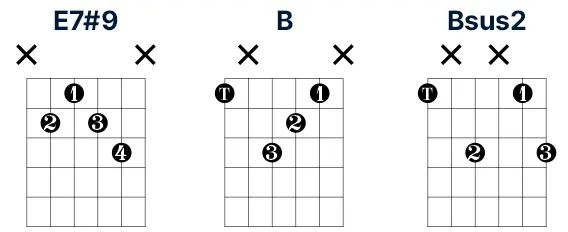
- The 7#9 chord — the classic “Hendrix chord.”
- Thumb-over major and minor voicings — the thumb handles the bass note while the other fingers remain free.
- Movable sus2 voicings — open shapes such as 3x5x35.
- Bass note + moving double-stops — the bass keeps ringing while melodic upper voices move above it.
The important lesson is therefore not only which chords Hendrix played, but how he made those chords move.
1. The 7#9: The Classic Hendrix Chord
The chord most strongly associated with Hendrix is the dominant 7#9.
A classic example is E7#9:
E7#9: x – 7 – 6 – 7 – 8 – x
Read from the low E string to the high E string.
The combination of the dominant chord's major third with the sharp ninth gives the voicing its tense, bluesy character.
It is a great chord to know, but it is not the secret to sounding like Hendrix.
The broader Hendrix sound comes from treating chords as moving musical structures instead of static blocks.
2. Thumb-Over Major and Minor Voicings
The second major Hendrix concept is the thumb-over chord grip.
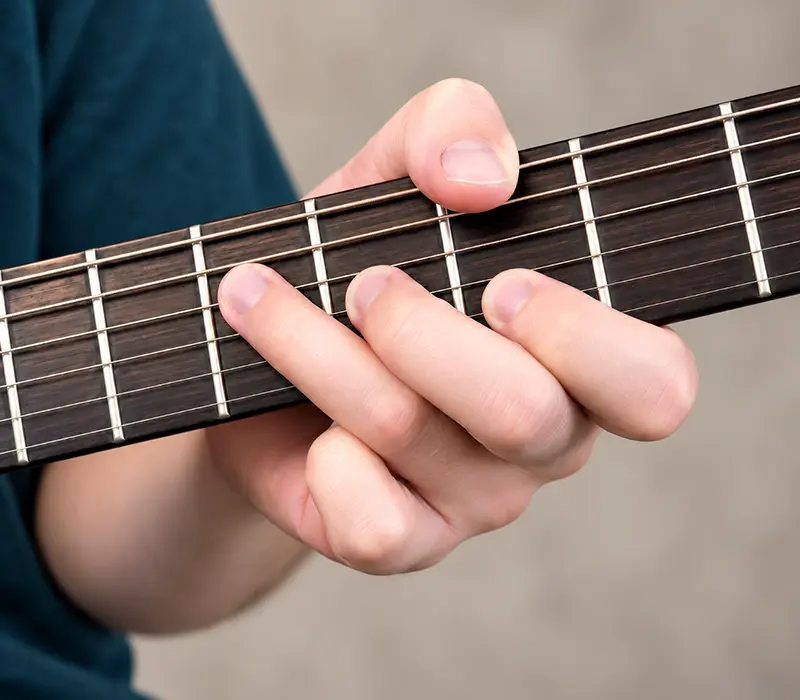
In a traditional barre chord, the index finger usually covers several strings. Hendrix often wrapped his thumb over the top of the neck and used it to fret the bass note on the low E string.
That means the index finger no longer has to hold a full six-string barre, leaving the other fingers much freer.
You can then add:
- hammer-ons;
- pull-offs;
- sus notes;
- small melodic fills;
- double-stops;
- selective muting.
The result is very different from playing:
chord → lick → chord → lick
Instead, bass, chord tones and melody become part of one continuous guitar part.
If your general fretting-hand mechanics still need work, first review left-hand guitar technique.
Why does the thumb make such a difference?
Because one finger takes over a job that would otherwise restrict a large part of the hand.
Once the thumb controls the bass note, the index, middle and ring fingers can move much more freely across the middle and higher strings.
That freedom is what makes many Hendrix-style chord embellishments possible.
3. The Movable Sus2 Voicing: 3x5x35
Another characteristic Hendrix-style sound comes from open sus2 voicings.
A particularly useful shape is:
3x5x35 = Gsus2
G – x – G – x – D – A
The thumb plays G on the low E string. The D string gives you another G, the B string gives D and the high E string gives A.
There is no third in the voicing, so the chord is neither clearly major nor minor.
That gives it an open, suspended quality that works beautifully when the guitar needs to leave space around the vocal or melody.
The shape is movable
You can move the entire structure along the neck:
1x3x13 = Fsus2
3x5x35 = Gsus2
5x7x57 = Asus2
This gives you one practical shape that creates several open suspended chord colors.
The muted strings are important. The x positions are part of the voicing, not accidental dead notes.
4. Keep the Bass Note Ringing While Double-Stops Move Above It
A fourth essential Hendrix concept is especially obvious in his chord-melody style playing.
The thumb holds a bass note while the other fingers play double-stops on the higher strings.
Those double-stops can then move through hammer-ons, pull-offs and slides while the bass continues underneath.
The basic idea:
Thumb = hold the bass note.
Other fingers = play moving double-stops and melodic upper voices.
You now hear several musical functions at once:
- a bass note;
- part of the chord;
- a melodic upper voice;
- rhythmic movement.
This is one reason Hendrix-style rhythm parts can sound so full even though only one guitarist is playing.
The upper voice does not need to move very far
You do not need a complicated lead line above the chord.
Sometimes only one note inside the double-stop changes.
You can:
- hold one note while hammering another;
- use a pull-off on one voice;
- slide the complete double-stop;
- move between two chord colors over the same bass note.
A very small movement can be enough to turn a static chord into an entire guitar arrangement.
The Real Hendrix Idea: Chords and Melody Become One
This is the principle connecting all four chord concepts.
A Hendrix chord is rarely just a shape that stays frozen for an entire bar.
Inside the same harmonic framework:
- a finger can be added;
- a note can be released;
- a hammer-on can connect two chord tones;
- a double-stop can move;
- the bass can remain static while the upper voice changes;
- a string can be deliberately muted;
- the rhythm can change while the harmony stays the same.
The chord shape is the starting point, not the finished guitar part.
If you are still building your basic chord vocabulary, see the Basic Guitar Chords guide.
Muting Is Part of the Hendrix Technique
Not every string has to ring in a Hendrix-style voicing.
In fact, many of these shapes only work because unwanted strings are deliberately muted.
Muting can come from:
- the underside of the thumb;
- the side of the index finger;
- a fretting finger lightly touching an adjacent string.
The thumb can therefore do two different jobs: fret a bass note or mute a bass string.
This allows the picking hand to strike several strings without every string becoming part of the chord.
Your right hand matters just as much as the fretting grip. If that side of your technique is still inconsistent, see right-hand guitar technique.
Can You Play Hendrix Chords With Small Hands?
Often, yes—but not every thumb-over shape is equally comfortable for every guitarist.
Technique matters, but anatomy matters too.
Players differ in:
- hand size;
- finger length;
- thumb length;
- finger proportions;
- wrist and joint mobility.
Some guitarists can wrap the thumb over the neck very naturally. Others may always find the same grip more difficult.
That does not automatically mean their technique is poor.
Not every hand is built for exactly the same guitar position.
Hand, Wrist, Arm and Guitar Position
Before deciding that your hands are too small, experiment with your complete playing position.
A small change in the angle of the neck can make a surprising difference to how easily your thumb reaches the low E string.
Pay attention to:
- guitar height;
- neck angle;
- left-elbow position;
- how far the wrist bends;
- how hard the entire hand is squeezing.
Do not drag the neck toward your hand with brute force.
The position should remain relaxed enough for the other fingers to move freely.
How Much Fretting Pressure Do You Really Need?
Many guitarists use far more pressure than necessary.
That becomes a serious problem with Hendrix-style chord embellishments because the fingers need to move independently.
Try this:
Fret one note and slowly reduce the pressure until it starts to buzz.
Then add only enough pressure for the note to become clean again.
Try to keep that same minimum pressure when playing chord shapes.
The harder you constantly squeeze, the more difficult hammer-ons, pull-offs and moving double-stops become.
Can the Guitar Make Hendrix Chords Easier?
Yes. Your guitar can make a noticeable difference.
Neck profile and width
A thinner or narrower neck can make it easier for some players to wrap the thumb over the neck.
That does not mean a thin neck is universally better. Some guitarists prefer a thicker neck because it gives the hand more support.
Comfort depends on your own anatomy.
Lighter strings
Lower string tension can make hammer-ons, bends, vibrato and larger movements inside a chord easier.
I personally often use a .009–.042 set on study guitars such as my Ibanez JS1000 or JEM.
If you change gauges, remember that string gauge also affects the total tension and setup of the guitar. See guitar string tension and setup for more detail.
Comfortable action
A correctly adjusted action can also help.
If the strings sit unnecessarily high above the fretboard, every chord requires more force than it should.
The goal is not automatically the lowest possible action. The goal is a setup that feels comfortable without excessive fret buzz.
How to Practice Hendrix-Style Chords Step by Step
1. Learn the four concepts separately
Do not try to combine everything immediately.
Start with:
- E7#9;
- one thumb-over major or minor voicing;
- the movable 3x5x35 sus2 shape;
- one bass note with a simple double-stop above it.
2. Practice the thumb as a bass finger
Wrap the thumb over the neck and fret only the low E string.
Make sure the note sounds clean without extreme wrist rotation.
3. Add the upper chord tones
Only then add the other fingers.
Play each string separately so you can hear exactly which notes are ringing and which strings are being muted.
4. Move one upper voice
Hold the bass note and change only one note above it.
Add a hammer-on or pull-off while the rest of the shape stays stable.
5. Add double-stops
Play two notes together on the higher strings while the thumb continues holding the bass.
Then move one of those two notes.
6. Keep the rhythm stable
The embellishments should not destroy the groove.
Practice with a metronome and make sure hammer-ons, slides and double-stops stay inside the pulse.
A Simple Hendrix Chord Exercise
Bar 1: play only the thumb-over chord.
Bar 2: add one hammer-on.
Bar 3: keep the bass note ringing and add a double-stop above it.
Bar 4: move one note of the double-stop with a slide or pull-off.
Repeat the four bars and use as little unnecessary movement as possible.
The goal is not to cram as many licks as possible into the chord.
The goal is to make the harmony move while the groove stays solid.
What If the Thumb-Over Grip Does Not Work for You?
Use another fingering.
You do not need to force your hand into an uncomfortable position to use Hendrix-style musical ideas.
You can apply the same principles with:
- traditional barre chords;
- triads;
- smaller chord fragments;
- alternative voicings;
- double-stops without a thumbed bass note;
- a bass note played by another finger or another instrument.
The exact fingering is less important than the musical principle.
Do Not Force the Hendrix Grip
Persistence matters, but persistence does not mean forcing your hand through pain or extreme discomfort.
If a particular thumb-over shape consistently feels wrong, change the wrist angle, neck position or guitar height. Simplify the chord if necessary.
The point of learning Hendrix technique is to gain more musical freedom—not to prove that you can reproduce somebody else's exact hand position.
What Really Makes Hendrix Chords Sound Like Hendrix?
Not one secret chord.
Not only E7#9.
And not simply putting your thumb over the neck.
The recognizable Hendrix approach comes from combining:
- open voicings;
- thumbed bass notes;
- sus chords;
- double-stops;
- hammer-ons and pull-offs;
- moving upper voices;
- controlled muting;
- strong rhythm and dynamics.
The most useful Hendrix lesson is that a chord does not have to be a static grip. It can become a small arrangement in which bass, harmony and melody all move together.
His expressive lead vocabulary follows the same principle: technique serves phrasing rather than existing for its own sake. For that side of the style, see Bend Mastery Essentials.
If you want to develop technique, coordination, rhythm and musical control as part of a complete system, explore our guitar training and coaching options.
