
Beginner Guitar Ear Training
Guitar Pitch Recognition: Higher or Lower Ear Training
Can you hear whether one musical note is higher or lower than another? Develop your relative pitch with simple listening and singing exercises designed for beginners. Learn to recognize pitch differences and train your musical ear with our free interactive tool.

Higher or Lower? Train Your Pitch Recognition
The first step in guitar ear training is surprisingly simple: learn to recognize whether one note sounds higher, lower, or the same compared to another note.
This is called relative pitch recognition. You don't need to know the names of the notes or have perfect pitch. You simply need to recognize how the pitch changes. Remember that pitch is not volume: a louder note isn't necessarily a higher note.
Interestingly, human hearing is not equally sensitive across the entire frequency range. The Fletcher-Munson curves illustrate how our perception of loudness changes with frequency. We are particularly sensitive to sounds in the mid-to-high frequency range, while very low and very high tones can be harder to hear clearly. Pitch discrimination can also vary across different registers, although loudness sensitivity and pitch recognition are not the same thing. For beginners, it's therefore sensible to start with notes in a comfortable middle register.

Pitch vs. Tone Color on Guitar
On the guitar, pitch is easy to explore. Play any note on a string. Move to a higher fret number (toward the guitar body) and the pitch rises. Move to a lower fret number (toward the headstock) and the pitch falls. Each fret changes the pitch by one semitone.
But here's something interesting: the same pitch can be played in different places on the guitar. The frequency remains the same, but the sound can have a noticeably different tone color (timbre). Try these two examples in standard tuning:
- 5th fret, 5th string = open 4th string (D). Both produce the same pitch, although their tone colors may sound slightly different.
- Open 1st string = 14th fret, 4th string (E). This is a more noticeable example. The pitch is identical, but the difference in tone color can be much more obvious.
One note, six different positions. On a 24-fret guitar in standard tuning, the same E4 note can be played on all six strings: open 1st string, 5th fret on the 2nd, 9th fret on the 3rd, 14th fret on the 4th, 19th fret on the 5th, and 24th fret on the 6th string. On a 22-fret guitar, five of these positions are available.
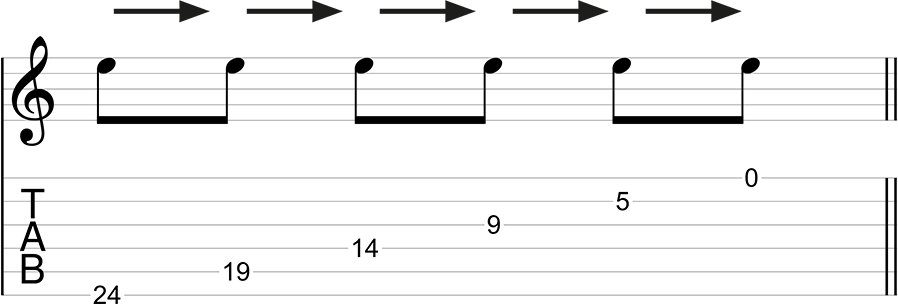
Play these E4 notes one after another. Although their fundamental frequency is the same, their tone colors can sound remarkably different. Different strings and playing positions produce different combinations of overtones. Same pitch, different timbre. Listen carefully and try not to confuse a change in tone color with a change in pitch.
How to Practice
- Listen to two notes. Concentrate on their pitch, not their volume or tone.
- Compare the sounds. Does the second note sound higher, lower, or the same as the first?
- Try singing the notes. Hum the first note, then the second. Notice whether your voice moves upward or downward, or stays on the same pitch.
- Repeat with different notes. Start with obvious differences. As your hearing improves, practice recognizing smaller pitch changes.
Practice with Melo·Arc
Our interactive Melo·Arc melody game lets you train pitch recognition without reading music or memorizing note names.
Start with the HI / LO mode. Listen to each new tone and decide whether the pitch moves higher, lower, or stays the same. Once you feel comfortable, try SORT to arrange tones from low to high, or SEQ to reconstruct short melodic patterns by ear.
The game uses simple visual challenges, so you can focus entirely on listening instead of worrying about music theory. A few focused minutes each day are an excellent starting point.
Ear training tip: Don't just guess which note is higher. Try to hear the movement internally and reproduce it with your voice. Singing helps you connect what you hear with what you can reproduce. You don't need a beautiful singing voice. You need to develop accurate pitch awareness.
Once you can comfortably recognize higher and lower notes, you're ready for the next challenge: learning to hear and sing major and minor thirds.
