Learn how to read guitar chord sheets and follow the chord progressions of your favorite songs. Understand bars, beats, 4/4 time signatures and chord changes, and discover how to interpret strumming symbols, repeat signs and song sections. With clear examples and practical exercises, you'll learn to read a complete guitar song chord chart and play through a song from beginning to end without losing your place.
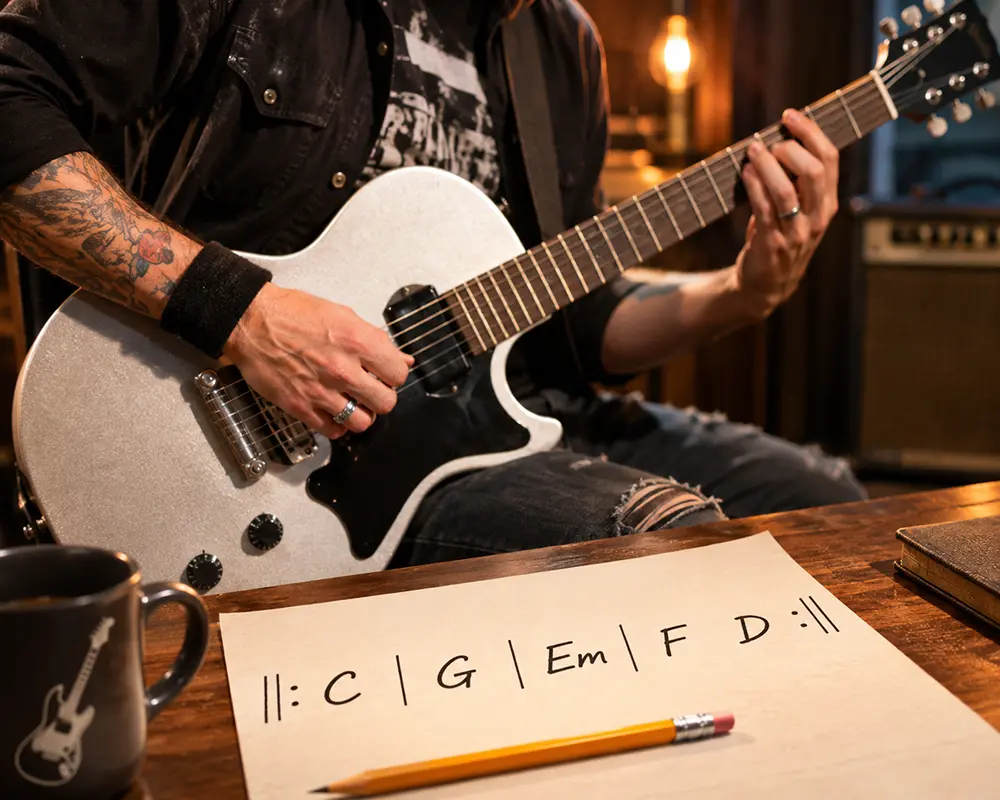
To read a guitar chord sheet, follow the chord symbols from left to right and pay attention to the bars, beats and chord changes. A chord sheet shows which chords to play, when to change them and how the song is structured. Unlike a guitar chord diagram, which shows where to place your fingers, a song chord chart helps you play through an entire song.
Vertical lines separate the music into bars (measures). In 4/4 time, each bar contains four beats. Count 1, 2, 3, 4 to maintain a steady rhythm.
Symbols such as C, G, Am and F identify the chords you need to play. Some bars contain one chord, while others contain two or more. The notation tells you when each chord change occurs.
Follow section labels such as Intro, Verse, Chorus and Bridge. Repeat signs and markings such as ×2 show which parts to play again.
Remember: reading a guitar chord sheet is not just about recognizing chord names. You also need to understand how long to play each chord, when to change and which sections repeat. Once you can count the beats and follow the bar lines, you'll be able to read and play complete song chord charts much more confidently.
A bar (measure) is a section of music separated by vertical bar lines. The time signature tells you how the beats are organized within each bar. A chord may last for an entire bar or change partway through it. The numbers indicate the counting, while the chord symbols show when to play or change chords.
Remember: Counting beats and strumming are two different things. In these exercises, you strike each chord once and let it ring until the next change. Later, you can add strumming patterns without changing the underlying timing.
A guitar chord sheet uses symbols such as C, G, Am, F or D7 to indicate which chords to play. Read them from left to right, following the bar lines. Each chord symbol represents a complete chord, not an individual note.
Sometimes you'll encounter a chord symbol containing a slash, such as D/F# or C/E. These are called slash chords. The symbol before the slash identifies the chord, while the note after the slash specifies the bass note. For example, D/F# means playing a D major chord with F# as the lowest note.
|| G | D/F# | F | Em ||
Four bars, one chord per bar. D/F# is one chord, not two separate chords.
Notice the difference between the two symbols: the vertical line (|) separates bars, while the slash (/) is part of the chord name. It does not indicate a new bar or a chord change.
Remember: A chord symbol tells you what chord to play. The bar lines and rhythmic notation tell you when to play it.
Some guitar chord sheets include strumming symbols that indicate how to play the rhythm. These symbols show strumming direction, skipped strokes and muted strums.
At Guitar Training Studio, we use the following symbols:
Traditional guitar notation often uses a Π-shaped symbol for downstrokes and a V-shaped symbol for upstrokes. I've never used that convention in my lessons because I find it unnecessarily confusing. Our symbols directly reflect the direction of the hand movement.
Here's a two-bar example using C, Am, G and D. The + signs mark the subdivisions between the beats.
Follow the strumming symbols while counting 1 + 2 + 3 + 4 +. Change from C to Am on beat 3 of the first bar, then from G to D on beat 3 of the second bar. Keep your strumming hand moving through the skipped strokes.
Guitar chord sheets use repeat signs to avoid writing the same chords and measures several times. These symbols tell you to repeat one beat, one bar, two bars or an entire passage.
A slash (/) can be used to repeat a beat without writing the same chord symbol again. In these simplified charts, each slash represents one beat played with the preceding chord.
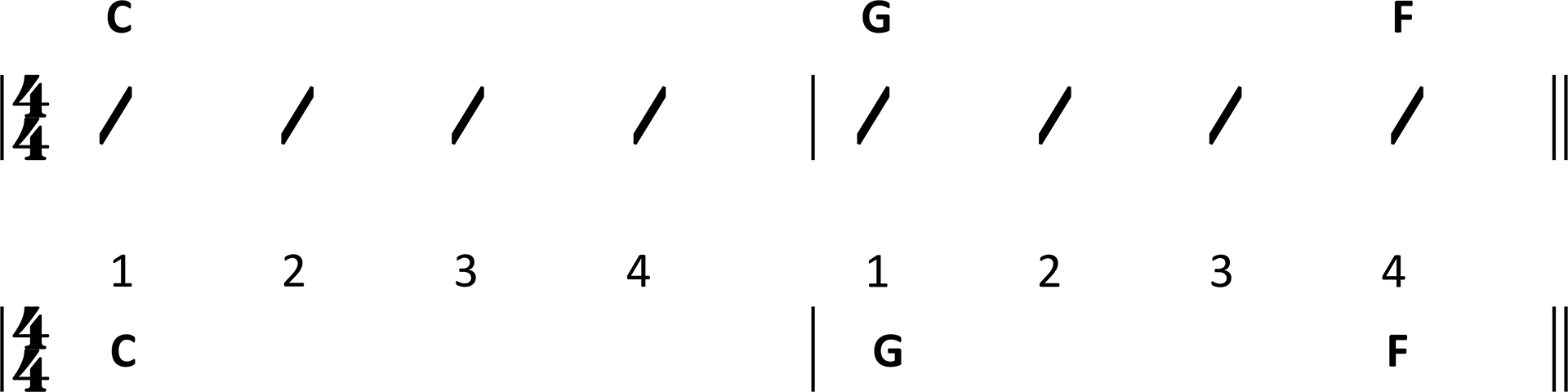
The one-bar repeat sign (%) tells you to repeat the entire previous measure. This includes all chord changes and their original timing.

A two-bar repeat sign tells you to repeat the previous two measures. Play both bars again in the same order, using the same chords and timing.

To repeat a complete passage, guitar chord charts use repeat barlines. The opening sign ||: marks the beginning of the passage, while the closing sign :|| marks its end. When you reach the closing sign, return to the opening sign and play the passage again. Without an additional number, the passage is played twice in total. If a marking such as 3× appears, play the entire passage three times in total.

Remember: Repeat signs determine what to play again. A slash inside a chord name, such as D/F#, is different from a rhythmic slash: it specifies the bass note, not a repetition.
A guitar chord sheet is usually divided into different song sections. These headings help you understand the arrangement and follow the correct playing order.
Here are the most common song sections you'll encounter:
Not every song contains all these sections. Some sections may appear several times, while others are omitted entirely. Simply follow the headings and repeat signs to play the song in the correct order.
Now let's put everything together with a real song example: Yungblud – Zombie. The song is 4 minutes and 6 seconds long, yet its entire chord arrangement fits into roughly a third of a page. This is what makes a well-organized guitar chord sheet so useful. Instead of writing every chord throughout the entire song, we use bar lines, repeat signs and section headings to keep everything short and easy to follow.
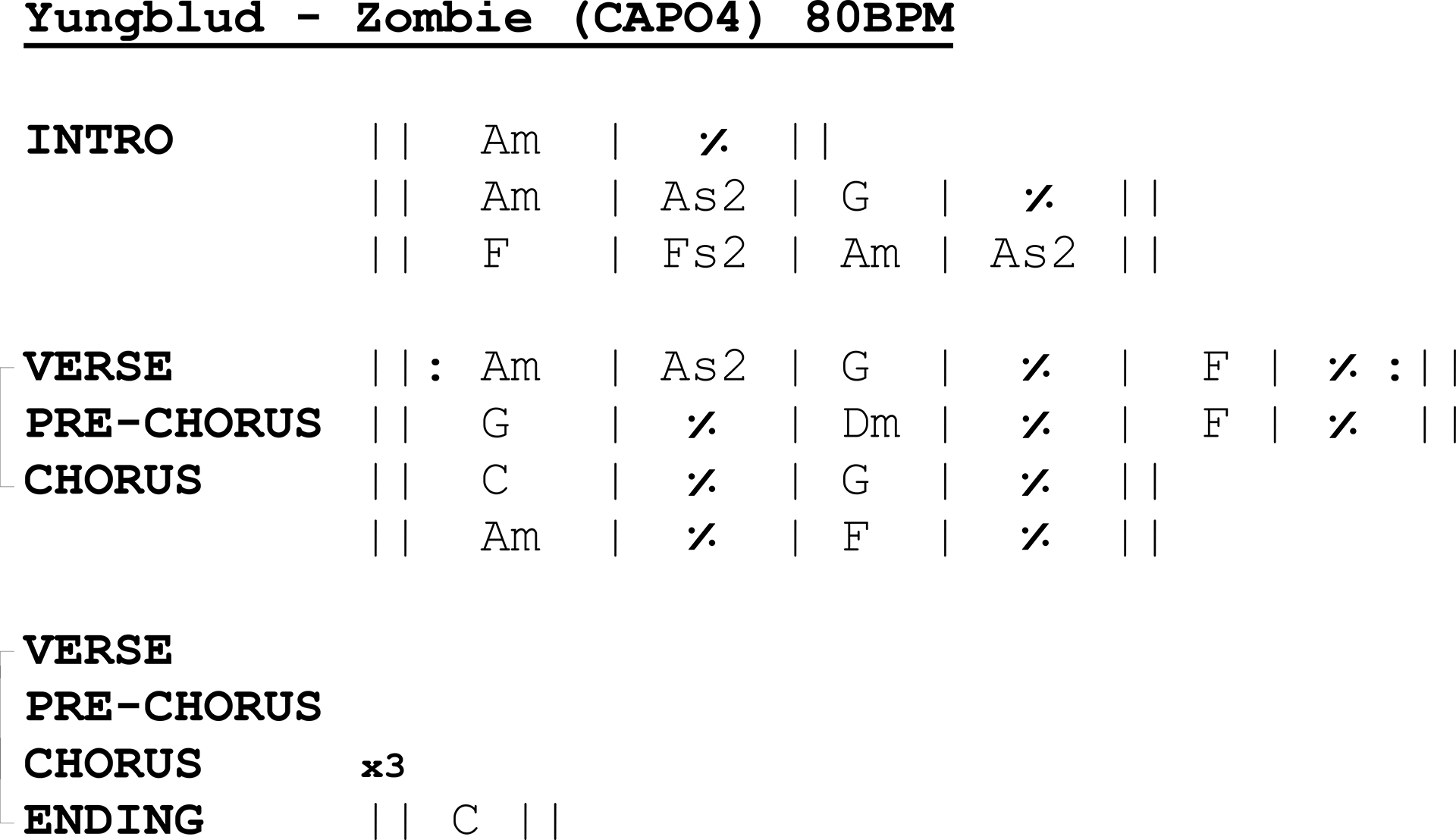
Here's how to read this chart:
About the chord abbreviations: I sometimes use shorter chord names to save space in my personal charts. For example, As2 is my shorthand for Asus2 (A suspended second), while Fs2 stands for Fsus2 (F suspended second). These are my own abbreviations, not the standard chord symbols.
Notice how the second half of the song requires almost no additional chord notation. Once you know the chord progressions, you only need the section names and repeat instructions to follow the arrangement.
That's the whole point of a chord sheet: a song lasting more than four minutes can be summarized on a fraction of a page, without writing the same chords over and over again. It's compact, practical and easy to follow once you understand the symbols.
Even when you recognize all the chords in a song, reading a guitar chord sheet can still be challenging. Most problems come from misunderstanding the timing, overlooking repeat signs or losing track of the song structure. Here are seven common mistakes and how to avoid them.
Just because a song is written in 4/4 time doesn't mean every chord lasts for four beats. A single measure may contain several chord changes. How to avoid it: Identify the bar lines and check how many chords appear in each measure. Pay attention to the timing of every chord change.
In our simplified chord charts, two chords in one measure normally share the bar equally. For example, in 4/4 time, | C G | means two beats of C followed by two beats of G. However, some chord sheets indicate a different distribution. C might last three beats while G lasts only one.
How to avoid it: Follow any beat counts, chord alignment or timing indications provided in the chart. When the timing is unclear, listen to the original recording.
A bar containing four beats doesn't necessarily require four strums. You might strum once and let the chord ring, play four downstrokes or use a more complex strumming pattern.
How to avoid it: First establish the beat and chord duration. Then apply the strumming pattern without changing the underlying count.
Confusing %, ×2, ||: and :|| can cause you to repeat the wrong bars or skip an entire passage. These markings don't all mean the same thing.
How to avoid it: Remember that % repeats the previous measure, while ||: and :|| mark a repeated passage. A marking such as ×2 means playing the indicated passage twice in total, while ×3 means three times.
Some guitarists concentrate so much on the chord names that they forget to follow the Verse, Pre-Chorus, Chorus, Bridge and Outro headings. This can lead to entering the wrong section after a repetition.
How to avoid it: Study the complete arrangement before playing. Follow the recording with your eyes on the chart, paying particular attention to transitions between sections.
A chord symbol such as D/F# is not the same thing as a standalone slash. D/F# means a D major chord with F-sharp in the bass. In our simplified chord sheets, a standalone / indicates that the previous chord continues for another beat.
How to avoid it: Read a slash inside a chord name as part of the chord symbol. Read standalone slashes according to the timing conventions of the chart.
Not all guitar chord sheets provide detailed timing information. Some simply place chord names above lyrics or list a progression without indicating the precise chord durations. Horizontal spacing alone may not be reliable.
How to avoid it: Understand the limitations of the chart you're using. When precise timing information is missing, listen to the recording to identify the chord changes, strumming rhythm and song structure.
Remember: Recognizing chord symbols is only the beginning. To read a guitar chord sheet correctly, you must also understand how long each chord lasts, where the changes occur and how the song sections connect. Focus on accurate timing and following the complete arrangement before adding more complicated strumming patterns.
Here are answers to some common questions about how to read guitar chord sheets, understand chord changes and follow song charts.
A guitar chord sheet is a simplified musical guide showing which chords to play throughout a song. It may include bar lines, chord symbols, rhythm indications, repeat signs and song sections such as verses and choruses. It helps guitarists follow an entire song without reading traditional sheet music.
A chord sheet shows which chords to play and how they fit into a song. A chord diagram shows where to place your fingers on the guitar fretboard to play an individual chord. Chord sheets explain the musical arrangement, while chord diagrams explain finger positions.
Look at the bar lines, beat counts and timing indications. In 4/4 time, one chord occupying an entire bar normally lasts four beats. In our simplified charts, two chords in the same bar normally receive two beats each, unless otherwise indicated. When the timing is unclear, listen to the recording to identify the chord changes.
No. In 4/4 time, each bar contains four quarter-note beats, but the number of strums can vary. You might play one strum and let the chord ring, strum four times or use a pattern containing several downstrokes and upstrokes. The time signature determines the meter, not the strumming pattern.
The % symbol commonly indicates a one-bar repeat. It tells you to repeat the entire previous measure, including its chords and rhythm. If that measure contains two chords, you repeat both chords with the same timing.
A marking such as ×2 generally means playing the indicated passage twice in total. For example, Verse ×2 tells you to play the complete verse twice before moving to the next section. Similarly, ×3 means three times in total.
A slash chord identifies a chord and its bass note. In D/F#, you play a D major chord with F-sharp as the lowest sounding note. The slash is part of the chord name and doesn't indicate a repetition. A standalone / in our simplified chord charts means that the preceding chord continues for another beat.
Yes. You don't need advanced music theory or the ability to read traditional notation. You do need some basic knowledge of chord symbols, beats and bar lines. Once you understand these, along with repeat signs and song sections, you can begin reading many beginner-friendly guitar chord charts.
Many chord sheets focus on chord progressions and song structure rather than detailed rhythm notation. They assume the guitarist will recognize the rhythm by listening to the recording or choose an appropriate strumming pattern. For precise rhythmic instructions, look for a more detailed chord chart or a transcription with rhythm notation.

Guitar Training Studio
Build better technique, timing and musicianship with structured guitar training, practical tools and personal coaching.
www.guitarstudio.be (Belgium)
www.guitartrainingstudio.com (International)
c/o Wouter Baustein
Driehoekstraat 1, BE-3891 Gingelom
+32.(0)476.666.300
info@guitarstudio.be
CoC: 0872.862.121
VAT: BE0872862121
IBAN: BE33-7350-0967-6746
BIC: KREDBEBBXXX
© 2000 – 2026 All Rights Reserved
Web apps & development by Baustein.digitalWe use cookies to enhance your experience and analyze traffic. You can accept all, decline, or adjust your settings. Some features may not work without consent.