
Rhythm Hearo: Rhythm Ear Training Tool
Train your ear to recognize rhythmic patterns. Listen, identify what you hear and build stronger timing, rhythmic awareness and musical memory.
Open Rhythm Hearo →What Is Rhythm Ear Training?
Rhythm ear training teaches you to recognize rhythmic patterns by sound. You listen to the timing and subdivision of a pattern, identify what you hear and gradually build stronger rhythmic awareness and memory.
Practice tip: start with simple patterns and clear subdivisions before moving to more complex rhythmic combinations.
How to Use Rhythm Hearo
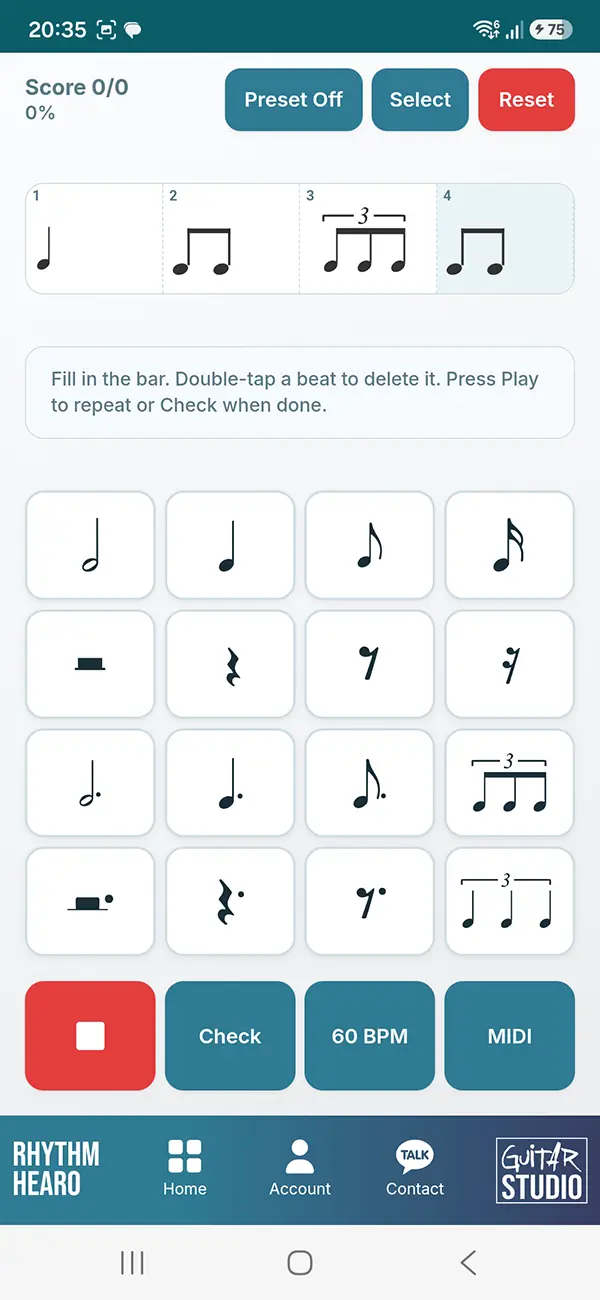
Listen to a rhythmic pattern, focus on the placement of the notes and rests, and identify the pattern you hear. Start simple and increase the difficulty as your rhythmic recognition improves.
Choose the Rhythm Symbols
Select the note values and rests you want to train. Start with a small selection and add more rhythmic possibilities as recognition improves.
Listen to the Pattern
Hear the complete rhythm before answering. Focus on where the attacks, spaces and subdivisions fall within the beat.
Count the Subdivision
Internally count the beat and subdivision instead of trying to remember the rhythm only as a vague sound.
Identify What You Heard
Choose the rhythmic pattern that matches the example and use the feedback to check your listening.
Repeat Difficult Patterns
Pay attention to the rhythms you confuse. Comparing similar patterns repeatedly helps make the differences easier to hear.
What Rhythm Hearo Trains
Rhythm Hearo trains you to recognize rhythmic patterns by ear and connect what you hear with pulse, subdivision and rhythmic structure.
You can use it to practice:
- recognizing rhythmic patterns by sound
- hearing note placement within the beat
- recognizing different note values and rests by ear
- hearing subdivisions more clearly
- distinguishing similar rhythmic patterns
- building rhythmic memory
- strengthening timing and pulse awareness
The goal is to make rhythm recognition increasingly automatic, so you can hear how a pattern is organized instead of relying only on visual notation.
Want to turn rhythm recognition into a game? Try BeatArc and test your rhythm skills in a more game-like format.
Why Rhythm Ear Training Matters
Rhythm ear training helps you understand how notes and rests are placed inside a beat instead of only reading rhythms from notation.
This is useful for playing by ear, learning riffs, transcribing music, improvising, recording and locking in with other musicians.
For guitarists, rhythm training is especially important because good timing depends on more than playing the correct notes. You also need to hear where each note belongs in the pulse.
Stronger rhythm recognition also improves subdivision awareness, rhythmic memory and your ability to follow grooves more accurately.
How to Recognize Rhythmic Patterns by Ear
Find the pulse first. Before trying to identify the exact rhythm, lock onto the underlying beat and keep it steady in your head or with your foot.
Listen for the subdivision. Notice whether the rhythm is mainly divided into quarters, eighth notes, sixteenth notes or another repeating subdivision.
Pay attention to the spaces. Rests are part of the rhythm too. Hearing where nothing happens can be just as important as hearing where the notes are played.
Count through the pattern. Counting helps you place each attack inside the beat and makes similar rhythms easier to compare.
Compare difficult patterns directly. If two rhythms sound almost the same, alternate between them and listen specifically for the beat or subdivision where they differ.
Common Rhythm Ear Training Mistakes
Guessing before finding the pulse. If you do not first feel the underlying beat, it becomes much harder to place the notes and rests correctly.
Listening only to the attacks. Rhythm is created by both sound and silence, so pay attention to the spaces between notes as well as the notes themselves.
Trying patterns that are too complex too soon. Start with simple subdivisions and clear rhythmic differences before moving to denser or more similar patterns.
Not counting. Counting helps connect what you hear with the actual position of each note inside the beat and makes difficult patterns easier to understand.
Practicing rhythm without feeling it physically. Tap your foot, nod your head or move with the pulse. Rhythm recognition becomes more reliable when listening and physical timing work together.
Rhythm Ear Training FAQ
What is rhythm ear training?
Rhythm ear training teaches you to recognize rhythmic patterns, subdivisions, note placement and rests by sound.
How do I get better at recognizing rhythms by ear?
Start with simple patterns, find the pulse first, count the subdivision and compare similar rhythms until the differences become clear.
Why is counting important in rhythm training?
Counting helps you place notes and rests accurately inside the beat instead of remembering a rhythm only as a general sound.
Should I tap my foot while doing rhythm ear training?
Yes. Keeping a physical pulse can make it easier to hear subdivisions and understand where each rhythmic event occurs.
Can guitarists use rhythm ear training?
Yes. Rhythm ear training helps guitarists recognize riffs, strumming patterns, rhythmic accents and the placement of notes inside a groove.
What should I listen for in a rhythmic pattern?
Listen for the pulse, subdivision, note attacks, rests and the exact positions where the pattern changes.
Explore More Guitar Training Tools
Train timing, rhythm, ear, fretboard knowledge, tuning, pitch and music theory with the interactive tools from Guitar Training Studio.
Explore All Tools →Take Your Guitar Playing To The Next Level!

Wouter Baustein
Music Producer, Music & Mindset Coach
If you like clear, practical guitar and music coaching instead of random YouTube tips, you need structure. My guitar books and coaching programs give you that structure, so you can finally make real progress and level up your playing.
www.guitarstudio.be (Belgium)
www.guitartrainingstudio.com (International)
c/o Wouter Baustein
Driehoekstraat 1, BE-3890 Gingelom
+32.(0)476.666.300
music@guitartrainingstudio.com
CoC: 0872.862.121
VAT: BE0872862121
IBAN: BE33-7350-0967-6746
BIC: KREDBEBBXXX
© 2000 – 2026 All Rights Reserved