
Simple but Powerful Guitar Parts: What Great Songwriters Get Right
Some of the most memorable guitar parts are not technically difficult. They work because the rhythm, repetition, dynamics, tone and space fit the song perfectly.
The players on this page are useful studies in musical economy. Their riffs, chord patterns and hooks show how a simple guitar idea can strengthen a melody, define a groove and give a song its identity without filling every available space.
Do Great Songs Need Complicated Guitar Parts?
No. Some of the most effective guitar parts are simple. What matters is how the part supports the song through rhythm, repetition, dynamics, tone and space.
Complexity is optional. A memorable musical idea played with the right feel can be far more powerful than a technically difficult part.
Why Simple Guitar Parts Can Be More Powerful
A guitar part does not become better simply because it contains more notes. In a strong song, the guitar has a job: support the groove, reinforce the melody, create contrast, add energy or introduce a hook people remember.
That is why simple parts often survive longer than complicated ones. A short rhythmic figure, a repeated chord shape or a carefully placed accent can become part of the identity of the entire song. The same principle appears in discussions about guitar technique versus feel: control matters, but the musical result matters more.
How to Study Songwriter-Guitarists
- Choose one player and one song. Do not analyse an entire career at once.
- Identify the core guitar idea. Is it mainly rhythm, a riff, a chord shape, dynamics, repetition or space?
- Reduce it to the principle. Strip away the exact notes and find the underlying reason the part works.
- Write a new part using that principle. The goal is to learn the songwriting idea without copying the original.
This approach turns listening into practical training. It also connects naturally with rhythm and riff playing, where the strength of a part often comes from placement and repetition rather than complexity.
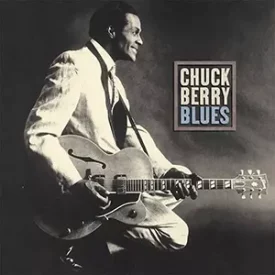
Chuck Berry – Blueprint of the Rock ’n’ Roll Riff
Chuck Berry helped establish a guitar vocabulary that could carry an entire song with a compact riff, a strong backbeat and immediately recognisable phrasing. The lesson is not that every rock guitarist should copy the same double-stop shapes. It is that a concise guitar idea can function as both rhythm part and hook.
Essential tracks: Johnny B. Goode, Roll Over Beethoven.
Try this: write a two-bar riff using only one chord position and one short melodic response. Repeat it until the groove feels convincing before adding anything else.
George Harrison – Melodic Hooks That Serve the Song
George Harrison is a useful example of guitar playing that supports the composition instead of competing with it. Many of his memorable parts are short, melodic and carefully placed around the vocal rather than continuously filling the arrangement.
Essential tracks: Something, Here Comes the Sun.
Try this: take a simple chord progression and write a three- or four-note guitar answer that appears only between vocal phrases. Leave more space than you normally would.
John Fogerty – Riffs You Can Whistle
John Fogerty’s strongest guitar ideas are direct, rhythmic and memorable. The riffs often feel inseparable from the song because they are simple enough to remember but strong enough to define the groove.
Essential tracks: Up Around the Bend, Fortunate Son.
Try this: write a riff you can sing back after hearing it once. If you cannot remember it without the guitar, simplify the rhythm or reduce the number of notes.
Johnny Cash – Boom-Chicka Simplicity
The classic Johnny Cash rhythm approach shows how a repetitive guitar pattern can become part of a song’s signature. The power comes from timing, consistency and the interaction between low notes and chord attacks.
Essential tracks: Folsom Prison Blues, I Walk the Line.
Try this: alternate a low bass note with a short chord attack and keep the pattern going for several minutes. Focus on making every repetition feel equally solid.
Bob Marley – Chords as Vocal Hooks
Reggae guitar often proves that small chord fragments and carefully placed offbeat accents can carry enormous rhythmic weight. The guitar does not need to play continuously; its strength comes from locking into the groove and leaving space around the vocal and rhythm section.
Essential tracks: Stir It Up, Could You Be Loved.
Try this: play short chord stabs on the offbeats and mute immediately after each attack. Keep the part light, precise and rhythmically consistent.
Keith Richards – Two Chords, Infinite Songs
Keith Richards demonstrates how much character can come from rhythm, voicing and articulation. Familiar harmony can sound distinctive when the guitar part has a specific groove, register and attack.
Essential tracks: Start Me Up, Brown Sugar.
Try this: limit yourself to two chord shapes and create interest only through rhythm, muting, accents and small voicing changes. Do not add extra chords just because the progression feels simple.
Pete Townshend – Power Chords as Storytelling
Pete Townshend often uses guitar parts to shape the energy of the arrangement. Repeated chords, suspended voicings, aggressive strumming and dynamic changes can make the same basic material feel intimate in one section and enormous in another.
Essential tracks: Pinball Wizard, Baba O’Riley.
Try this: play the same progression in a verse and chorus but change only the dynamics, attack and register. Notice how arrangement can create contrast without changing the harmony.
Prince – Funky Economy
Prince is a strong reminder that rhythm guitar can be technically precise without being harmonically crowded. Short chord fragments, muted attacks and tight syncopation can create more movement than large chord shapes played continuously.
Essential tracks: Kiss, 1999.
Try this: choose a small two- or three-note chord shape and build a one-bar funk pattern from attacks, rests and muted strokes. Let the rests become part of the riff.
Neil Young – Rough Edges, Real Emotion
Neil Young shows that a guitar part can be powerful without being polished to perfection. Repetition, dynamics and emotional commitment can matter more than technical neatness when they fit the song.
Essential tracks: Rockin’ in the Free World, Heart of Gold.
Try this: take a very simple progression and play it three ways: softly, aggressively and with large dynamic changes. Keep the chords the same and let the performance change the character.
Dave Grohl – Big Hooks in Big Choruses
Dave Grohl’s guitar writing often works because the riffs and chord movements are designed around the song’s energy. The parts are direct, repeatable and arranged to make choruses feel larger rather than to showcase guitar complexity.
Essential tracks: Everlong, Best of You.
Try this: write a verse part using a narrow register, then open the voicing or increase the rhythmic density for the chorus. Keep the harmonic material simple and create the lift through arrangement.
Kurt Cobain – Contrast and Brutal Honesty
Kurt Cobain’s guitar writing often relies on direct chord movement, repetition and strong contrasts between quieter and louder sections. The impact comes from the relationship between sections as much as from the riff itself.
Essential tracks: Smells Like Teen Spirit, Come as You Are.
Try this: write one four-bar idea and perform it twice: first with restraint, then with a much stronger attack and denser sound. Use the same notes and let the contrast create the arrangement.
Josh Homme – Repetitive Patterns, Weird Hooks
Josh Homme often creates memorable parts from repetition, unusual note choices and slightly crooked rhythmic placement. The riffs are frequently simple on paper but distinctive because of the groove and the way they sit against the drums.
Essential tracks: No One Knows, Go with the Flow.
Try this: create a short repeating riff with one unexpected note or accent. Keep everything else simple so the unusual element remains obvious. For more examples of this approach, see modern rock and alternative guitar innovators.
Matthew Bellamy – Simple Riffs, Epic Production
Matthew Bellamy often combines direct guitar figures with large-scale production, effects and arrangement. A riff does not need to contain many notes if the surrounding sound gives it weight and identity.
Essential tracks: Plug In Baby, Hysteria.
Try this: write a short one-string or two-string riff, then create two contrasting versions through dynamics, octave placement or effects rather than by adding notes.
How to Apply These Ideas to Your Own Songs
When a guitar part feels weak, adding more notes is rarely the first thing to try. Ask whether the rhythm is memorable, whether the part leaves enough space for the vocal, whether the dynamics change between sections and whether the hook is simple enough to recognise.
You can also deliberately compare simplicity with technical complexity. The article on when shredding helps and when it hurts makes the same broader point: technique is valuable when it strengthens the music rather than replacing the musical idea.
Likewise, strong songwriting depends heavily on time feel. If the riff itself is simple, small timing differences become more obvious. Rhythm Mastery is useful when you want to train subdivision, pulse and rhythmic control more systematically.
Conclusion
Great guitar songwriting is often an exercise in restraint. The strongest part may be a two-chord pattern, a short riff, a muted accent or a melodic answer that appears only once in each phrase.
The important question is not “How difficult is this part?” but “What does this part do for the song?” When the answer is clear, simplicity becomes a strength rather than a limitation.
For more practical articles on riffs, rhythm, phrasing and playing mechanics, explore Guitar Technique & Skills. If you want to develop these skills inside a structured practice system, see the guitar training and coaching options.
FAQ
Do great guitar parts need to be difficult?
No. A great guitar part needs to support the song. A simple riff, chord pattern or rhythmic figure can be more effective than a technically difficult part if it strengthens the groove, melody or emotion.
Why do simple guitar riffs often sound more memorable?
Simple riffs are easier to recognise and repeat. When the rhythm and note shape are strong, the listener can remember the idea quickly and associate it with the song.
How can guitarists learn songwriting from simple parts?
Study what the part is doing rather than only which notes are being played. Identify the rhythm, repetition, dynamics, chord shape or use of space, then write a new part using the same principle.
Does playing fewer notes make a guitar part better?
Not automatically. Fewer notes are useful when they create more clarity, groove or space. The goal is not minimalism for its own sake, but choosing only what the song needs.
How can I write a simple guitar part without sounding boring?
Use rhythm, articulation, dynamics, register, tone and repetition to create character. A simple harmonic idea can still sound distinctive when the timing and arrangement are strong.
Should a guitarist always play throughout the whole song?
No. Silence and space are part of arrangement. Leaving room for the vocal, drums, bass or another instrument can make the moments when the guitar returns much more effective.

Guitar Training Studio
Ready to Make Real Progress on Guitar?
Build better technique, timing and musicianship with structured guitar training, practical tools and personal coaching.
www.guitarstudio.be (Belgium)
www.guitartrainingstudio.com (International)
c/o Wouter Baustein
Driehoekstraat 1, BE-3891 Gingelom
+32.(0)476.666.300
info@guitarstudio.be
CoC: 0872.862.121
VAT: BE0872862121
IBAN: BE33-7350-0967-6746
BIC: KREDBEBBXXX
© 2000 – 2026 All Rights Reserved
Web apps & development by Baustein.digital