
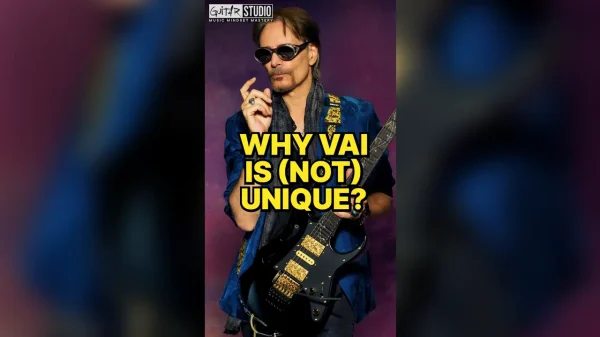
Why Steve Vai Isn’t Unique — And Why That’s Why He Won
Most musicians confuse two completely different things:
- creating something unique
- being seen as unique
Those are not the same thing.
Creating something truly unique can change the world. But being “unique” as a musician? That is often just ego talking.
Because here is the uncomfortable truth:
There are thousands of unknown guitarists who can outplay famous players.
So why did Steve Vai win?
Not because he was the only guitarist who could play at that level.
He won because he built something the market could recognize.
That is the real point.
What Makes Steve Vai Stand Out?
Steve Vai is not recognizable simply because of technical ability. His identity comes from the combination of skill, sound, style, image, catalog and long-term consistency. That recognizable position is what separates being highly skilled from being memorable.
Bottom line: exceptional technique can get attention, but a recognizable musical identity is what people remember.
Skill Is Common. Position Is Built.
Steve Vai is a monster player. No debate.
But technique alone does not explain:
- recognition
- demand
- legacy
- career leverage
The real differentiator is position.
Position is not just one thing. It is the combination of:
- your brand
- your sound
- your aesthetic
- your identity
- your catalog
- your story
- your lane
That is what makes someone recognizable in the real world.
Explore more articles about technique, control, expression and guitar playing in Guitar Technique & Skills.
The Difference Between “Unique” and “Positioned”
A guitarist can be technically rare and still be invisible.
That happens all the time.
Someone can be brilliant in a bedroom, on Instagram, or in a practice room and still mean nothing in the market. Technical ability by itself does not automatically create recognition.
A musician becomes “unique” in the eyes of the market when people can say:
- that is him
- that is his sound
- that is his lane
That is what Steve Vai built.
Not just a skill set.
A recognizable position.
Why This Matters More Than Most Musicians Admit
A lot of musicians still believe that being better automatically creates results.
It does not.
Being better helps.
Being great helps.
Being undeniable helps.
But the market still needs something clearer than raw ability.
It needs recognition.
If people cannot place you, describe you, remember you, or connect you to a lane, your skill has weak commercial gravity.
The relationship between technical ability and musical impact is also explored in Guitar Technique vs Feel.
That is why this article matters far beyond Steve Vai. It is really about identity, positioning, and why many musicians stay invisible even when their level is high.
How You Make Yourself Unique Without Pretending
This is where many people go wrong.
They hear “positioning” and immediately think of fake branding, gimmicks, or trying too hard.
That is not the point.
A useful way to think about positioning is through four elements: sound, output, presence, and consistency.
1. Sound
Not endless tone chasing.
A consistent sonic identity.
Something people start associating with you.
2. Output
A catalog that proves your lane over time.
Not one good clip.
Not one lucky post.
Proof.
3. Presence
How you show up visually, socially, and culturally.
People do not only hear artists. They register pattern, image, behaviour, and context.
4. Consistency
Most musicians never stay in one lane long enough to become known for it.
They keep changing direction before the market can attach them to anything.
That kills recognition.
Why Trying to Be Unique Usually Fails
Trying to be unique directly often creates the wrong result.
It becomes:
- gimmicks
- weirdness for attention
- forced branding
- random experiments with no lane
Real uniqueness is often a side effect of:
- deep focus
- consistent output
- a clear lane
- time
That is how a market starts to associate something with you.
Not because you loudly claimed to be unique.
Because you stayed in your lane long enough to become recognizable.
Steve Vai Is the Example, Not the Exception
Steve Vai works as an example because almost everyone in guitar knows who he is.
But the lesson is much bigger than one guitarist.
The real question is:
What are you building that people can identify as yours?
Not what can impress musicians for ten seconds.
Not what proves you practiced.
Not what shows you are advanced.
What are you building that creates recognition?
That is the real career question.
Technical playing itself is not the enemy. The problem starts when technique becomes the entire identity. That distinction is explored further in Why Shredding Is Not Bad.
The Market Remembers Lanes, Not Just Talent
This is the hard truth a lot of players avoid.
The market does not reward private talent.
It rewards visible, repeatable, recognizable value.
If you want to build the playing skills behind that identity, High-Performance Guitar Coaching focuses on structured development and application.
For a broader long-term development system, explore Roadmap To Guitar Mastery.
And if the bigger challenge is identity, mindset or direction rather than technique alone, Music & Mindset Mastery addresses that side of development.
You can also explore the broader Guitar Blog for more articles on playing, musicianship, development and music.
Because the real issue is not whether somebody is talented.
The real issue is whether somebody is building a position the world can recognize.
Action Block
Define your lane in one sentence:
“I make music for ________ who want ________.”
Then build one proof this week:
- one track
- one video
- one live performance
- one collaboration
That is how recognition starts.
Not with self-labeling.
With proof.
Conclusion
Steve Vai did not win because he was the only guitarist who could do it.
He won because he built a position that became undeniable.
That is the difference most musicians miss.
Skill is common.
Position is built.
So the real question is not whether you are unique.
The real question is whether you are building something people can actually recognize.
FAQ
Do I need a brand as a guitarist?
If you want a career, yes. Brand is not fake image-work. It is recognition, trust, and a clear lane people can remember.
Is technique still important?
Yes. Technique matters. But technique is a tool, not a market position. Position is what helps create recognition and demand.
How long does positioning take?
Usually longer than people want. That is why most musicians quit or change direction before the market can recognize them.
Is Steve Vai really not unique?
He is unique in the market sense because he built a recognizable lane. The point is that uniqueness is not only about playing ability.
Can a better guitarist still remain unknown?
Yes. Many technically better players stay invisible because they never build a clear identity, lane, catalog, or recognisable presence.
What should musicians focus on if they want to stand out?
They should focus on sound, output, presence, consistency, and long-term positioning instead of chasing random attention.
Transcript
Most people confuse two things: being unique versus making yourself unique. Creating something truly unique can change the world. But being “unique” as a musician? That’s not the point. Take Steve Vai. His level is insane — but there are thousands of unknown guitar players who can outplay him. What’s unique about Steve Vai isn’t his technique. It’s the position he built: the brand, the sound, the presence, the legacy — the lane he fought for. He didn’t become successful because he was a unique player. He became successful because he made himself unique. Learn the difference. Skill is common. Position is built.

Guitar Training Studio
Ready to Make Real Progress on Guitar?
Build better technique, timing and musicianship with structured guitar training, practical tools and personal coaching.
www.guitarstudio.be (Belgium)
www.guitartrainingstudio.com (International)
c/o Wouter Baustein
Driehoekstraat 1, BE-3891 Gingelom
+32.(0)476.666.300
info@guitarstudio.be
CoC: 0872.862.121
VAT: BE0872862121
IBAN: BE33-7350-0967-6746
BIC: KREDBEBBXXX
© 2000 – 2026 All Rights Reserved
Web apps & development by Baustein.digital