
R.E.M. – Losing My Religion Guitar Lesson: Chords & Strumming
Learn how to play Losing My Religion by R.E.M. on guitar. Discover the chords, complete chord chart, and song structure of this classic rock hit. Practise the strumming pattern, chord changes, and timing to play along with the entire song from beginning to end.

What Guitar Chords Do You Need for Losing My Religion by R.E.M.?
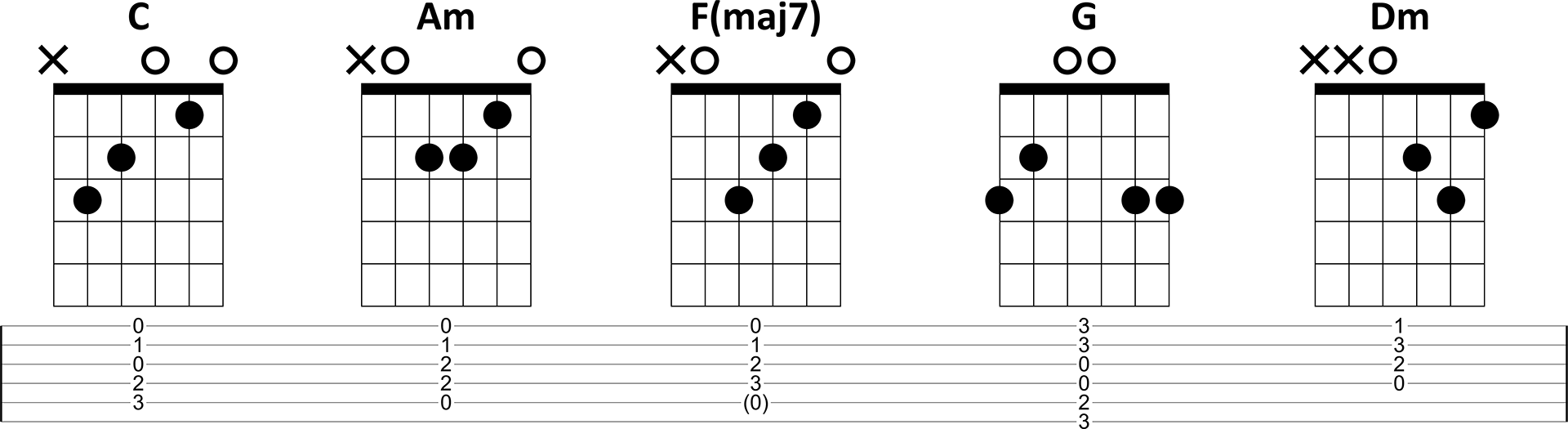
To play Losing My Religion by R.E.M. on guitar, you don't need a capo. The song is in A minor and mainly uses the chords Am, Em, Dm and G. You'll also need F and C. With these six chords, you can play an accessible guitar accompaniment for the entire song.
1. Play Without a Capo
Use standard guitar tuning: E–A–D–G–B–E. You can play the chords directly without transposing. The F chord may require some extra practice if you're not yet comfortable with barre chords.
2. Practise the Chord Changes
Look for fingers that can stay in the same position when changing between chords. Use these anchor fingers as a reference and only move the fingers that need to change. For example, when moving from Am to C, your index and middle fingers can stay in place. This helps you change chords faster and more smoothly, with fewer unnecessary movements.
3. Practise the Strumming Pattern
The song has a 4/4 time signature and a tempo of approximately 128 BPM. Start with one strum per measure before introducing a steady down-up strumming pattern. Keep your strumming hand moving continuously.
Remember: The challenge of playing Losing My Religion isn't just about learning the chords. It's also about mastering the chord changes, strumming pattern, and song structure. Follow the complete chord chart while listening to the original recording. Then practise playing the entire song from beginning to end without stopping or losing your place. For more guidance, read our lesson on guitar picking, strumming, and timing.
Song Info – Losing My Religion
Key: A minor
Time Signature: 4/4
Tempo: 128 BPM
Guitar: Acoustic or electric
Tuning: E–A–D–G–B–E (standard)
Capo: No
Tone/Effects: Clean
Losing My Religion – Guitar Chords
To play Losing My Religion, you'll need six chords: Am, Em, Dm, G, F and C. Play without a capo in standard tuning: E–A–D–G–B–E. Use the chord diagrams below as a reference while practising. When changing between chords, pay particular attention to anchor fingers that can remain in the same position.
Losing My Religion – Complete Guitar Chord Chart
Play Losing My Religion by R.E.M. using this complete guitar chord chart. Follow the different song sections and pay attention to the repetitions, chord changes, and measure divisions.
Time Signature: 4/4
Tempo: 128 BPM
How to Play Losing My Religion on Guitar
Losing My Religion by R.E.M. is an excellent song for practising chord changes, timing, and steady rhythm guitar accompaniment. You'll use six chords, but you'll also need to learn how to play two chords within a single measure and follow the different song sections accurately.
Listen and Follow the Chord Chart
Start by listening to the original recording while following the complete chord chart without playing your guitar. Count aloud in groups of four and try to follow the entire song from beginning to end. Pay attention to the transitions between the chorus, verse, interlude, and outro. Start with the Full Chart and only switch to Compact Chart view once you're familiar with the song structure. This way, you'll always know which section comes next and when to change chords.
Practise the Chord Changes
Start by practising the chords Am, Em, Dm, G, F and C individually, then play them in the order shown in the chord chart. Pay particular attention to which fingers can remain in the same position during a chord change. For example, when changing from Am to C, your index and middle fingers can stay in place. You only need to move your ring finger. These are called anchor fingers. By avoiding unnecessary movements, your chord changes become faster, more accurate, and smoother.
Also pay attention to the Dm to G transition. In the chorus, these two chords appear within the same measure. Practise this change separately before trying to play along with the entire song. For additional exercises, see our guide on improving guitar practice and chord changes.
Play Along With Simple Strums
Play the original recording and start with one downstroke at the beginning of each measure. Let the chords ring and focus on changing at the correct moment. Pay attention to measures containing two chords, such as | Dm G |. Here, play Dm on beat 1 and change to G on beat 3. Each chord therefore lasts for two beats.
Still struggling to follow the entire song? Reduce the playback speed in YouTube's settings. Then try playing through the complete song without stopping at a difficult chord change or losing track of the song structure.
Learn the Strumming Patterns in Two Stages
Now that you're familiar with the chord changes and song structure, we'll introduce two strumming patterns: one for the verse and another for the chorus. We'll start with a simplified version before developing more groove and timing.
Memorise the patterns on open strings first, without holding any chord shapes. Your strumming hand should continue moving up and down, even when you're not hitting the strings. In a 4/4 measure using eighth notes, you make eight movements: four downstrokes and four upstrokes. Your strumming hand acts like a metronome, helping you maintain consistent timing, groove, and drive.
↓ = downstroke, ↑ = upstroke, – = no strum, but your strumming hand keeps moving.
Stage 1 – The Basics
VERSE: Start with this simple strumming pattern. Repeat the same pattern in every measure of the verse and focus on maintaining steady timing.
Count:    1  +  2  +  3  +  4  +
Strums:   ↓  –  ↓  –  ↓  ↑  –  –
CHORUS: Use this strumming pattern in all measures containing just one chord. The additional upstrokes give the chorus a livelier groove.
Count:    1  +  2  +  3  +  4  +
Strums:   ↓  –  –  ↑  ↓  ↑  –  ↑
Exception – | Dm G |: This measure contains two chords. Simplify this measure to four downstrokes. Play Dm on beats 1 and 2, then G on beats 3 and 4. This gives you enough time to change between the chords.
Count:    1  +  2  +  3  +  4  +
Strums:   ↓  –  ↓  –  ↓  –  ↓  –
Chord:    Dm          G
Stage 2 – Add More Drive and Groove
Once you can comfortably accompany both song sections, you can start developing the strumming patterns further.
VERSE: Add an upstroke on the & of beat 4. This additional strum gives the rhythm more drive and creates a smooth transition into the next measure.
Count:    1  +  2  +  3  +  4  +
Strums:   ↓  –  ↓  –  ↓  ↑  –  ↑
CHORUS: The strumming pattern remains the same, but now try to maintain it throughout the | Dm G | measure. Start playing Dm on beat 1 and change to G on beat 3 without interrupting the strumming pattern.
Count:    1  +  2  +  3  +  4  +
Strums:   ↓  –  –  ↑  ↓  ↑  –  ↑
Chord:    Dm          G
This final exercise is more challenging because you need to control the strumming pattern and the chord change simultaneously. If you're not ready for this yet, continue using four downstrokes in the measure containing Dm and G.
Why do we simplify the strumming patterns? The original rhythmic patterns in Losing My Religion are quite complex and aren't ideal as a first exercise for beginners. That's why we deliberately use simplified guitar strumming patterns. This allows you to focus on chord changes, timing, and song structure first. Once you've mastered these fundamentals, you can gradually learn the more complex rhythms of the original recording.
Practise each pattern until you can play it smoothly and from memory, without looking at the example. Then apply it to one open chord before introducing the chord changes. For more guidance, read our lesson on guitar picking and strumming technique.
Add Dynamics and Accents
Once you've mastered the chords and strumming patterns, you can add more musical expression. Try playing the verses more gently and giving the choruses more energy. Add deliberate accents to your strumming so that your accompaniment doesn't sound equally loud from beginning to end.
Listen carefully to the dynamics of the original recording and try to follow the musical development. Make sure your timing remains steady, even when playing more softly or with greater intensity.
Play the Entire Song on Your Own
The final step is to play Losing My Religion without the original recording. Use a metronome or a simple drum pattern and follow the complete chord chart from the opening chorus to the outro.
Set the tempo to 128 BPM in a 4/4 time signature. Use Smart Click if you prefer practising with a metronome, or try GROOVR if you'd rather play along with a simple drum pattern. Choose a straight 4/4 groove in GROOVR.
Can't manage 128 BPM yet? Start at a slower tempo and gradually increase your speed. The goal is to play the entire song without stopping or losing your place, using accurate chord changes, a consistent strumming pattern, and steady timing.
6 Common Mistakes When Playing Losing My Religion on Guitar
Losing My Religion by R.E.M. may seem easy because of its familiar chords, but changing chords within a single measure, playing different strumming patterns, and keeping track of the repetitions all require extra attention. Avoid these six common mistakes when practising the song.
Starting With Syncopation and Difficult Strumming Patterns Too Soon
Many beginners immediately try to play the complete strumming pattern with all its upstrokes and syncopated rhythms. As a result, they lose their timing, miss chord changes, and lose track of the song structure. Solution: start with one downstroke per chord, usually at the beginning of each measure. When two chords occur within one measure, such as | Dm G |, play Dm on beat 1 and G on beat 3. First, learn to accompany the entire song using this simple approach. Then gradually introduce the strumming patterns and syncopation.
Lifting Every Finger During Chord Changes
Many beginners automatically lift all their fingers off the strings when changing to the next chord. This creates unnecessary movement and wastes valuable time. Solution: look for fingers that can stay in the same position. When changing from Am to C, your index and middle fingers can remain in place. You only need to move your ring finger. Use these anchor fingers to make your chord changes faster and more accurate.
Stopping Your Strumming Hand
Some guitarists stop moving their strumming hand whenever the pattern doesn't require a strum. This interrupts the natural movement and destroys the groove. Solution: keep your strumming hand moving continuously up and down. When playing eighth notes in 4/4, your hand makes eight movements per measure, even when you're not hitting the strings. Memorise the strumming pattern on open strings before introducing chord changes.
Losing Track of Repetitions and Song Structure
The verses and choruses return several times, sometimes with additional repetitions. Beginners can easily skip a passage or play it too many times. Solution: start by following the complete chord chart while listening to the recording. Pay close attention to the repeat markings x3 and x9. Only switch to the Compact Chart once you're familiar with the different song sections and their correct order.
Practising Only Individual Sections
You may be able to play each chord progression separately, but never practise the complete song from beginning to end. As a result, the transitions between different sections remain uncertain. Solution: practise difficult passages individually, but also play through the entire song regularly without stopping. Start at a slower tempo if necessary and focus on maintaining steady timing and smooth transitions between the different sections.
Playing Without Dynamics or Accents
When every strum has the same intensity, your accompaniment sounds flat and monotonous, even if you're playing the correct strumming pattern. Solution: play the verses more gently and give the choruses more energy. Experiment with softer and stronger strums, and add intentional rhythmic accents to your playing. Make sure your timing remains consistent when changing the volume or intensity of your strumming.
Frequently Asked Questions About Playing Losing My Religion on Guitar
Here you'll find answers to frequently asked questions about the chords, strumming patterns, and how to play Losing My Religion by R.E.M. on guitar.
What Guitar Chords Do You Need for Losing My Religion?
For this guitar arrangement, you'll need six chords: Am, Em, Dm, G, F and C. The verses mainly use Am, Em, Dm and G. The choruses primarily feature F, Dm, G and Am. The C chord appears in the interlude. With these six chords, you can accompany the entire song.
Do You Need a Capo to Play Losing My Religion?
No, you don't need a capo. You can play the chords directly in standard guitar tuning: E–A–D–G–B–E. Always check your tuning before you start practising.
What Are the Key, Time Signature, and Tempo of Losing My Religion?
Losing My Religion is in the key of A minor and has a 4/4 time signature. In this chord chart, we use 128 BPM as the practice tempo. If that's still too fast, start at a slower tempo and gradually increase the speed once you've mastered the chord changes and strumming pattern.
When Do You Change From Dm to G in the Chorus?
In the measure | Dm G |, you play both chords within the same four beats. Dm starts on beat 1 and G on beat 3. Each chord therefore lasts for two beats. Start by practising this measure with four downstrokes, one on each beat. This helps you learn to time the chord change correctly before adding the complete strumming pattern.
What Strumming Pattern Should You Use for Losing My Religion?
In this lesson, we use two simplified strumming patterns: one for the verse and another for the chorus. You'll learn them gradually in two stages. In the verse, you'll progressively add more upstrokes. In the chorus, start by practising the pattern in measures containing just one chord. For the measure with Dm and G, initially use four downstrokes. Later, try maintaining the complete chorus strumming pattern while changing between those chords.
Is Losing My Religion Suitable for Beginner Guitarists?
Yes, especially for beginners who already know a few open chords. The F chord and the change from Dm to G within a single measure may require some extra practice. Start with one strum per measure or per chord and learn the complete song structure first. Only then should you introduce the strumming patterns. The recognizable melody from the original recording is played on a mandolin, but you can easily accompany the song using guitar chords.

Guitar Training Studio
Ready to Make Real Progress on Guitar?
Build better technique, timing and musicianship with structured guitar training, practical tools and personal coaching.
www.guitarstudio.be (Belgium)
www.guitartrainingstudio.com (International)
c/o Wouter Baustein
Driehoekstraat 1, BE-3891 Gingelom
+32.(0)476.666.300
info@guitarstudio.be
CoC: 0872.862.121
VAT: BE0872862121
IBAN: BE33-7350-0967-6746
BIC: KREDBEBBXXX
© 2000 – 2026 All Rights Reserved
Web apps & development by Baustein.digital