Free Guitar Lesson · Red Hot Chili Peppers
Learn to play Californication by Red Hot Chili Peppers on guitar. In this free guitar lesson, you'll explore John Frusciante's iconic intro riff, the essential guitar chords, and the gentle, melodic picking technique that gives the song its distinctive sound. With clear guitar TAB, chord charts, and practical exercises, you'll learn the different guitar parts step by step. For more experienced players, we'll also cover the original guitar solo with separate TAB. The song is played in standard tuning, with no capo required.

Californication by Red Hot Chili Peppers is played in standard tuning, without a capo, at approximately 96 BPM in 4/4. John Frusciante's iconic intro features melodic picking around Am and F. The main accompaniment uses Am, F, C, G, Dm and Dsus2, while the guitar solo introduces F#m, D, Bm, A and E. This lesson includes chord diagrams, the complete chord chart, guitar TAB and solo TAB.
Artist: Red Hot Chili Peppers
Key: A minor / C major
Time Signature: 4/4
Tempo: 96 BPM
Guitar: Electric
Tuning: E–A–D–G–B–E (standard)
Capo: No
Sound/Effects: Clean, compressor, chorus, optional delay during the solo.
For a simplified guitar arrangement of Californication by Red Hot Chili Peppers, you'll mainly use five chord shapes: Am, F, C, G, and Dm. John Frusciante's iconic intro is built around Am and F, with the notes picked individually. The chorus mainly features C, G, Dm, and Am. The song is played in standard tuning, without a capo. Use the chord diagrams below as a reference while practicing. Focus on proper finger placement, clean chord changes, and a relaxed playing position. If you find the F chord difficult, you can substitute Fmaj7 in many parts of a simplified arrangement, although it produces a slightly different sound. Need a refresher on chord shapes? Check out our basic guitar chords reference.
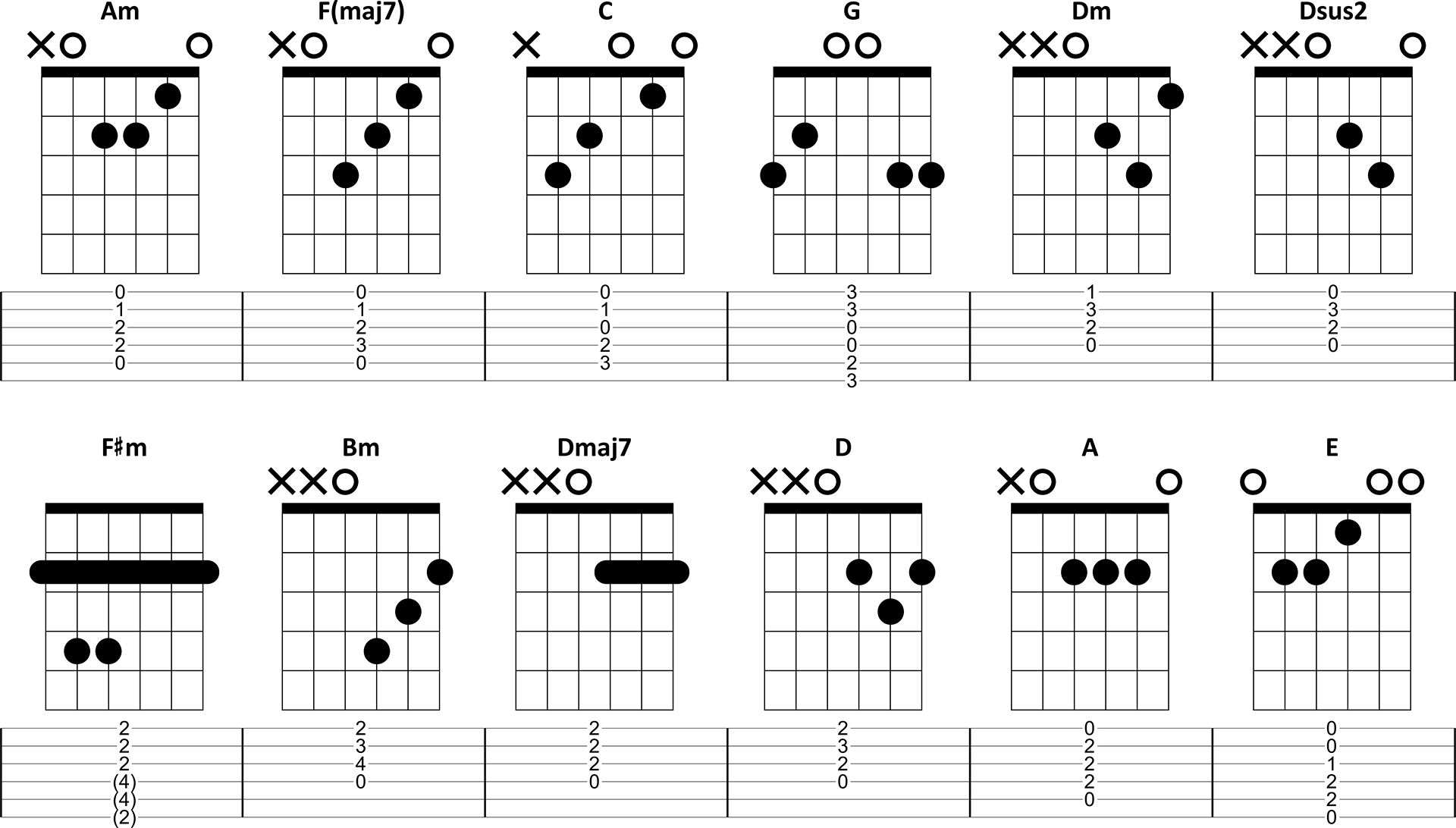
Below you'll find the complete chord chart for Californication by Red Hot Chili Peppers, including the song structure, repeats, and the separate chord progression used during the guitar solo.
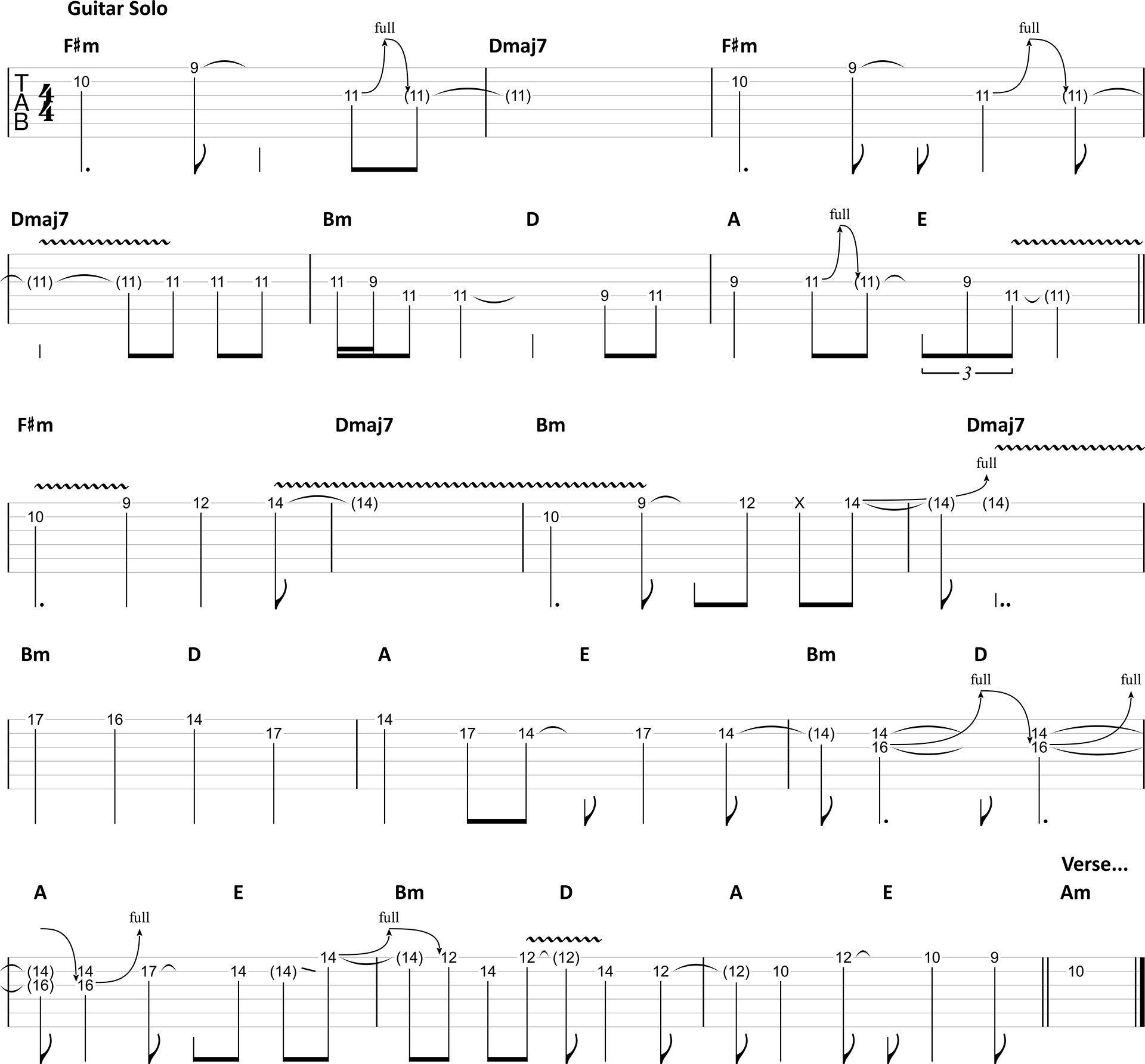
Below you'll find the guitar TAB for Californication by Red Hot Chili Peppers. John Frusciante's recognizable guitar part combines melodic picking, simple chord shapes, and a relaxed, steady rhythm. You'll also find a separate guitar solo TAB for players looking for an additional challenge.
Not completely familiar with guitar tablature? Each of the six lines represents a guitar string, while the numbers indicate which frets to play. If you're unsure about the fingering indications, check out our lesson on guitar finger numbers and fingering. The guide below also explains how to practice the different sections.
The famous intro riff is built around the chord shapes Am and F. Instead of strumming all the strings together, you pick individual notes. This creates the distinctive, melodic sound of the song.
Pay particular attention to finger placement, timing, and consistent picking. Let the notes ring naturally where appropriate, and avoid unnecessary tension in your fretting and picking hands. Practice the guitar part slowly before increasing the tempo.
Guitar tone: use a clear clean tone with very little distortion. Subtle reverb or light compression can help the notes sustain naturally. Make sure every picked note remains clearly audible.
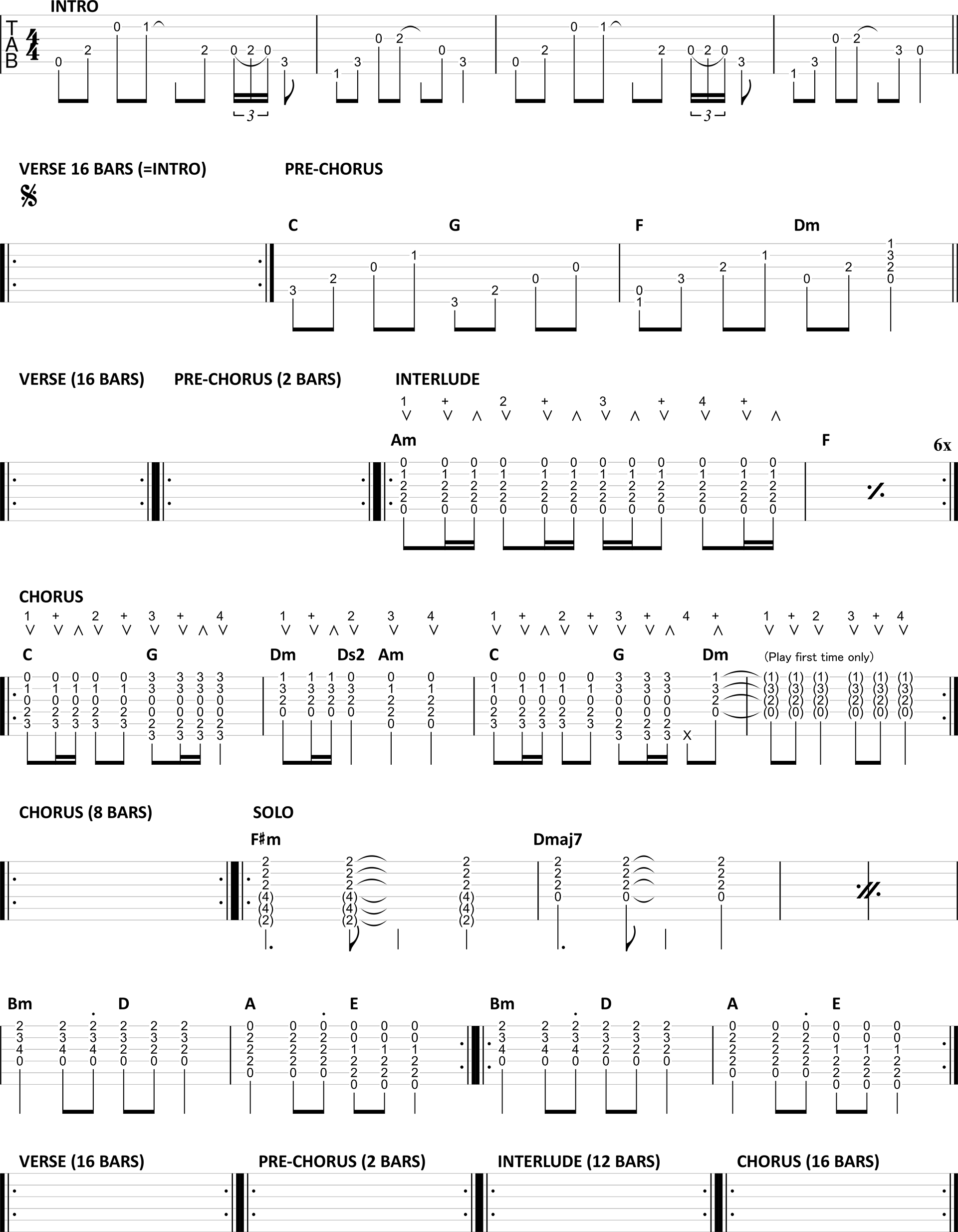
The intro is a great example of melodic picking. Play the notes individually and make sure each one sounds clear. You don't need to strum the complete chords throughout the riff. Focus on picking the correct strings in the right order.
The intro mainly uses notes from Am and F. Position your fingers as efficiently as possible and avoid unnecessary movements along the fretboard. If necessary, review our basic guitar chords reference.
John Frusciante uses his thumb to fret the F note on the first fret of the low E string during the intro. However, you can also play this note with your index finger. Choose the fingering that allows you to play the notes cleanly and comfortably.
Californication sounds relaxed, but it requires accurate timing. Practice in 4/4 time and count the beats evenly. Start at around 60 BPM and gradually increase the tempo to approximately 96 BPM. You can use our Smart Click metronome to keep a steady rhythm.
Pay attention to the duration of each note. Don't cut notes short when they're supposed to sustain. At the same time, avoid letting consecutive notes overlap when they shouldn't. This helps keep the melody clear and musical.
Identify the guitar passages that repeat throughout the song and practice them individually. Repeat signs such as ||: and :|| indicate that you should play a section again. Learn each individual part before connecting the sections into the complete song.
John Frusciante's guitar solo is a great example of how relatively few notes can create a powerful, memorable melody. The emphasis is on phrasing, articulation, timing, and expression, rather than extreme speed.
Practice the solo in short musical phrases. Listen carefully to the original recording and pay attention to how Frusciante attacks, sustains, and connects the notes. Only move up to the original tempo when you can play each phrase accurately and without tension.
Guitar tone: use a clean sound with compression and chorus. The tone ranges from clean to slightly crunchy — often described as a "dirty clean" tone. Avoid excessive distortion so that the melody and articulation remain clearly defined.
Practice tip: start with the recognizable Am–F intro and practice the individual notes slowly and accurately. Then work on the chord changes, picking, and timing of the remaining guitar parts. Gradually build up to 96 BPM. You can practice the guitar solo separately as an additional challenge. Musical accuracy and expression matter more than speed.
Californication by Red Hot Chili Peppers combines an iconic intro riff with melodic picking, simple guitar chords, and a relaxed rhythm. These five steps will help you learn the main guitar parts played by John Frusciante and gradually work up to the original tempo of 96 BPM.
First, learn the famous guitar intro, which is mainly built around the Am and F chord shapes. Instead of strumming complete chords, you pick individual notes using a gentle picking technique. Follow the guitar TAB to learn the correct notes and fret positions.
Practice the riff in short sections. Pay attention to the correct string order, fingering, and timing. Make sure every note sounds clear and avoid unnecessary movements with your picking hand. Repeat the intro until you can play it comfortably without interruptions.
For the guitar accompaniment, we'll use the chords Am, F, C, G, Dsus2, and Dm. The intro and large parts of the verses revolve around Am and F. The chorus mainly features C, G, Dm, Dsus2, and Am.
Practice the chord changes without a strumming pattern first. Make sure each chord sounds clean before moving on. If you find the F chord difficult, you can use Fmaj7 as an easier alternative in many parts of a simplified arrangement. Keep in mind that this slightly changes the sound.
For more information about chord shapes, check our basic guitar chords reference. You can also read our guitar FAQ for advice on improving your chord changes.
The guitar part in Californication may sound simple, but accurate timing and articulation are essential to its distinctive character. Pick the notes individually, using a controlled attack and a steady pulse.
Let notes ring naturally where appropriate, but avoid unwanted overlap between consecutive notes. Practice the difference between softer passages and stronger accents. This will help you develop better musical dynamics without having to play faster or harder.
Want to improve your picking technique? Check out our lesson on right-hand guitar technique, picking, and strumming.
The original tempo is approximately 96 BPM in 4/4 time. Start at around 60 BPM and practice the intro and chord changes with consistent timing. Increase the tempo by about 5 BPM whenever you can play a passage accurately and without tension.
Use our Smart Click metronome to practice at a steady tempo. Pay particular attention to the transitions between the different guitar parts. The goal isn't to reach 96 BPM as quickly as possible, but to play the song accurately and musically at any tempo.
Once you've mastered the intro, verses, and choruses individually, connect the different guitar parts into one complete performance. Follow the song structure and practice the transitions without stopping.
Then try playing the song without the original recording, using only a metronome or a simple drumbeat. This helps you check whether you can maintain the timing, chord changes, and song structure independently.
You can practice with Smart Click or use GROOVR to play along with a drumbeat. Gradually work up to 96 BPM in 4/4 time.
Comfortable playing the complete guitar accompaniment? As an additional challenge, you can learn John Frusciante's guitar solo. Divide the solo into short phrases and focus on phrasing, articulation, and expression. A musical performance matters more than speed.
Californication by Red Hot Chili Peppers sounds relaxed and relatively simple, but John Frusciante's distinctive guitar part requires accurate picking, solid timing, and musical control. Avoid these five common mistakes when practicing the song.
The recognizable intro is based on individually picked notes from the Am and F chord shapes. If you strum the complete chords instead of picking the correct strings, you lose the distinctive melodic character of the guitar part.
Practice each note individually and pay close attention to the order of the strings. Play slowly and make sure every note sounds clear. Use the Californication guitar TAB as a reference, and only increase the tempo once your picking becomes accurate and consistent.
When playing melodic picking patterns, you need to carefully control which notes are allowed to ring. If your fingers accidentally touch adjacent strings, notes may stop too early or fail to sound at all. On the other hand, unwanted ringing strings can make the melody less clear.
Place your fingers close behind the frets and use only as much pressure as necessary. Check the sound of every note individually. Clean articulation and controlled muting are more important than speed.
The F major chord can be challenging for beginners. That's why it's sometimes replaced with an easier Fmaj7 chord. This can be a practical solution for a simplified accompaniment, but the two chords are not exactly the same.
Fmaj7 contains an additional major seventh (E), giving it a different tonal color. Use this substitution deliberately and listen to whether it fits the passage you're playing. For the original picking part, follow the individual notes exactly as shown in the TAB.
If you need more practice with basic chord shapes, check out our lesson on basic guitar chords.
At 96 BPM, Californication isn't a particularly fast song. However, the intro can still sound inaccurate if you play notes too early or too late. Small timing mistakes are especially noticeable in slower guitar parts.
Start at around 60 BPM and practice with a steady pulse. Gradually increase the tempo once you can play the guitar part accurately and without tension. You can use our Smart Click metronome to develop consistent timing.
Also pay attention to your musical dynamics. Not every note needs to be picked with the same intensity. A controlled picking attack helps make the melody sound more natural and expressive.
When you play along with the original recording, small timing mistakes can be masked by the drums, bass guitar, and other instruments. The recording also provides constant cues for the song structure and transitions between sections.
Make sure you also practice without the original recording, using only a metronome or a simple drumbeat. Try playing the intro, verses, and choruses consecutively on your own. This will reveal whether you truly understand the timing and song structure.
Once you've mastered the complete accompaniment, you can move on to John Frusciante's guitar solo. Focus on phrasing, note duration, articulation, and expression. A musical performance is more important than simply playing as many notes as possible.
For a simplified arrangement of Californication by Red Hot Chili Peppers, you'll mainly use Am, F, C, G, and Dm. The iconic intro revolves around Am and F, while the chorus primarily uses C, G, Dm, and Am, with Dsus2 also appearing in the progression. Check the guitar chord diagrams for the correct finger positions.
The simplified chord accompaniment is suitable for beginners with some experience. The original intro requires more control because you need to pick individual notes with accurate technique. Good timing, clean notes, and smooth fingering are particularly important. The guitar solo provides an additional challenge for intermediate guitarists.
John Frusciante's famous intro is mainly built around Am and F chord shapes. You pick the notes individually instead of strumming complete chords. Start slowly and focus on the correct strings, fingering, and timing. Our Californication guitar TAB shows the notes and fret positions you need to practice the riff.
Yes, you can play a simplified chord accompaniment without barre chords. In many parts of the arrangement, you can replace the challenging F major chord with an open Fmaj7. This chord is easier to play, but it doesn't sound exactly the same: Fmaj7 contains an additional major seventh.
For the original intro, it's better to follow the individual notes shown in the TAB. You can't simply replace every F chord shape with Fmaj7 without changing the melody.
No. Californication is played in standard tuning (E–A–D–G–B–E), without a capo. You don't need to retune your guitar or use a capo to play the song. The main chord accompaniment is based around A minor / C major.
The recognizable intro and accompaniment feature a relatively bright, clean guitar tone. Use very little distortion and make sure the individual notes remain clearly audible. Subtle reverb, chorus, and light compression can help create a fuller sound.
For the guitar solo, you can use a slightly dirty clean or lightly overdriven tone for additional sustain and expression. You don't need a specific amplifier or effects pedals to learn the song.
Californication has a tempo of approximately 96 BPM in 4/4 time. Start practicing at around 60 BPM and gradually increase the tempo once you can play the guitar parts accurately and without tension.
Use our free Smart Click metronome or practice with a drumbeat using GROOVR. Also practice without the original recording to improve your timing and musical independence.
John Frusciante's guitar solo is technically less demanding in terms of speed than many classic rock solos, but it requires good control over phrasing, articulation, timing, and expression. The way you attack, sustain, and connect the notes is essential to its distinctive sound.
You don't need to learn the solo to play the chord accompaniment. Want to master the original lead part? Check out our Californication guitar solo TAB. Practice the solo in short phrases and gradually build up the tempo.

Guitar Training Studio
Build better technique, timing and musicianship with structured guitar training, practical tools and personal coaching.
www.guitarstudio.be (Belgium)
www.guitartrainingstudio.com (International)
c/o Wouter Baustein
Driehoekstraat 1, BE-3891 Gingelom
+32.(0)476.666.300
info@guitarstudio.be
CoC: 0872.862.121
VAT: BE0872862121
IBAN: BE33-7350-0967-6746
BIC: KREDBEBBXXX
© 2000 – 2026 All Rights Reserved
Web apps & development by Baustein.digitalWe use cookies to enhance your experience and analyze traffic. You can accept all, decline, or adjust your settings. Some features may not work without consent.