Learn to play All the Small Things by Blink-182 on electric guitar with our free guitar TAB and complete chord progression. Master the C5, F5 and G5 power chords, palm-muted verses, fast downstroke strumming and distinctive octave riffs that give this pop-punk classic its energetic sound. This step-by-step guitar lesson helps you develop accurate chord changes, tight eighth-note rhythms and the techniques needed to play the complete song.

To play All the Small Things by Blink-182, you'll mainly use the power chords C5, F5 and G5. The song is played without a capo, in standard tuning (E–A–D–G–B–E). The biggest challenge isn't the fingering, but combining fast chord changes, relentless downstrokes and palm muting at a tempo of 148 BPM.
Practice the C5, F5 and G5 power chord shapes. Move the entire shape as a single unit instead of repositioning each finger separately. This allows you to change chords faster and more accurately.
Play the rhythm guitar part using downstrokes only. Pay attention to the difference between muted and unmuted strums. In the last bar of the first line, play 1 unmuted strum, 4 palm-muted strums and 3 unmuted strums.
The guitar part begins with a pickup on the "and" of beat 3. The time signature is 4/4, and the tempo is 148 BPM. Start at a slower tempo and only increase your speed once you can play all the strums and chord changes accurately and consistently.
Remember: besides the rhythm guitar part, the song also features an octave lead part during the interludes. Our simplified guitar TAB includes the complete song structure, rhythmic notation, repeat markings and both guitar parts. First, listen to the original recording while following the entire TAB without playing your guitar.
Key: C major
Time Signature: 4/4
Tempo: 148 BPM
Guitar: Electric
Tuning: E–A–D–G–B–E (standard)
Capo: No
Tone/Effects: Distortion or overdrive
Below you'll find the simplified guitar TAB for All the Small Things by Blink-182. This song is an excellent exercise for learning power chords, palm muting and mechanical rhythm guitar playing. You'll practice fast chord changes, tight downstroke strumming and a melodic guitar part played in octaves.
The TAB also includes rhythmic notation, so you can see not only which frets and strings to play, but also when to strike the notes. Some song sections are shortened using repeat markings to keep the TAB clear and easy to follow.
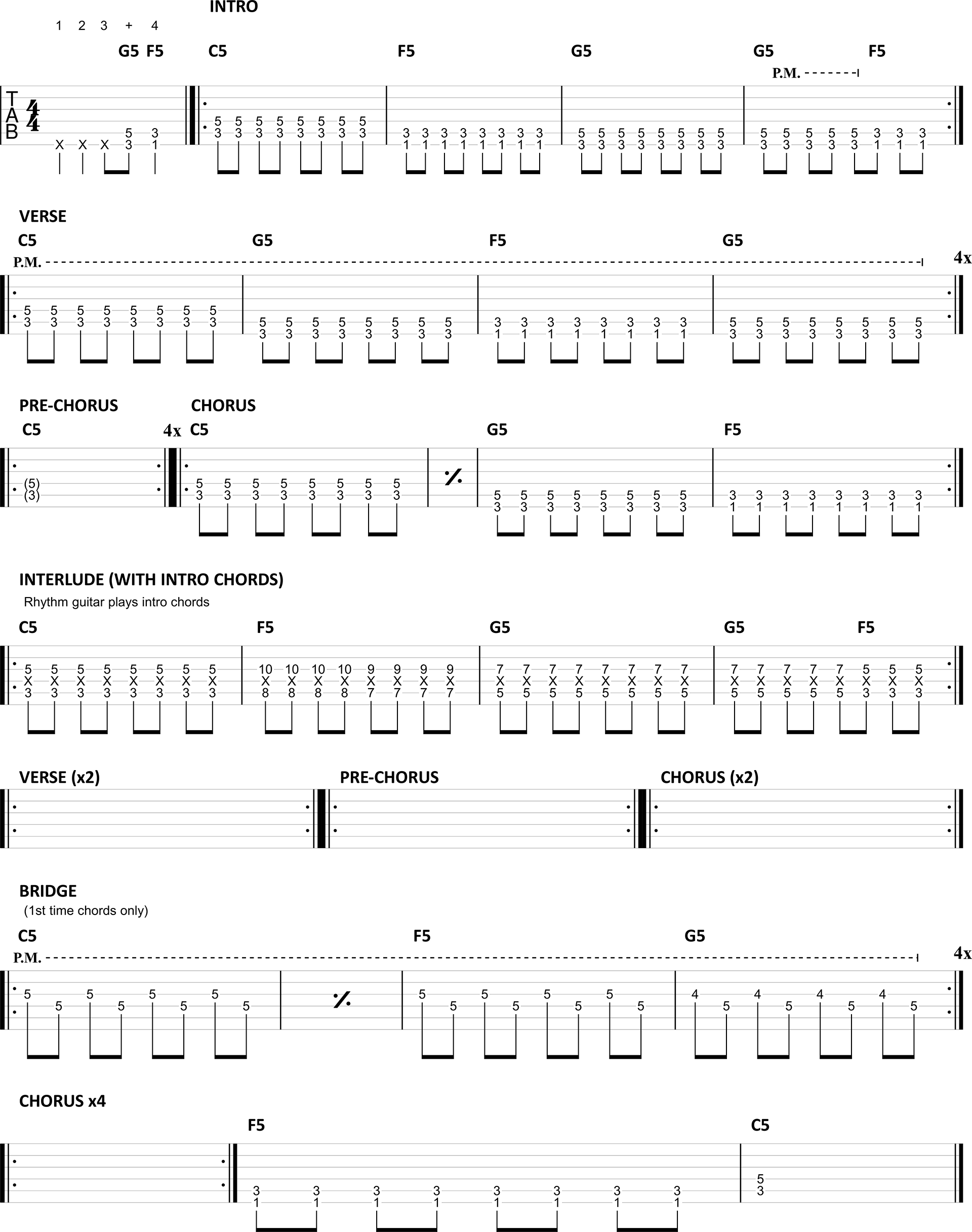
All the Small Things begins with a pickup. The first guitar note falls on the "and" of beat 3, between beats 3 and 4. When listening to the original recording, you won't hear a count-in beforehand. The song starts immediately with this pickup. Keep this in mind when playing along with the recording.
In the last bar of the first line, you alternate between regular strums and palm-muted strums. The sequence is one unmuted strum, four palm-muted strums, followed by three unmuted strums. That's eight strums in total, but they don't all have the same sound.
Let the first strum ring freely, mute the next four strums with the side of your picking hand, and allow the final three strums to ring freely again. Play all eight strums using downstrokes. Pay particular attention to the transition between muted and unmuted strums. This creates the correct rhythmic emphasis.
Practice tip: Play this bar slowly at first and count the strums: 1 unmuted – 4 palm-muted – 3 unmuted. Keep your timing consistent while applying and releasing the palm mute.
One of the most important techniques when playing power chords is to move the entire chord shape in one motion. Don't lift your fingers one at a time and then reposition them individually on the next chord. Keep the distance between your fingers consistent and move your entire hand position together.
For example, when changing from G5 to C5, move the entire chord shape to the correct string position. Practice this movement slowly without having to search for each finger position again. This will help you change power chords faster and more accurately.
For the rhythm guitar part of this song, we use downstrokes only. No alternate strumming, where you switch between downstrokes and upstrokes. Your picking hand always strikes the strings in the same direction, producing a powerful and consistent sound.
This is also known as mechanical rhythm guitar playing. Every strum should sound equally tight and controlled. Start at a slower tempo and make sure you can maintain a relaxed picking motion. Use palm muting wherever indicated in the TAB to create short, muted chords. Keep using the same consistent downstrokes throughout these passages.
During the interludes, you play a short octave lead part. Use your index and ring fingers for this technique. Your index finger plays the lower note, while your ring finger plays the higher note. There is one string between these two notes that must remain muted.
Mute the middle string using your index finger. You then strike three strings, but only two notes should be heard. The middle string remains muted. Practice this technique slowly and make sure both octave notes ring clearly. Then move the entire shape as a single unit to the next position.
Important: You strike three strings, but only two notes should sound. If you can hear the middle string, you need to improve the muting with your index finger.
The bridge is played four times, but pay attention to how the arrangement develops. During the first repetition, only the chords are played. The melodic guitar part hasn't entered yet. From the second repetition onward, the lead guitar part joins in.
First, learn the bridge chords and count all four repetitions correctly. Then add the melodic part at the right moment. This way, you'll learn not only the individual guitar parts, but also how to follow the complete song arrangement.
To keep the guitar TAB compact and easy to read, I haven't written out every repeated song section in full. Instead, I use markings such as Verse ×2, Pre-Chorus ×2 and Chorus ×2.
These markings mean that you should repeat the previously written verse, pre-chorus or chorus. For example, Chorus ×2 means you play the previously notated chorus twice. You don't need to search for individual chords or notes again: simply repeat the entire section as it was written earlier.
Note: This is a practical shorthand I use for this lesson, not an official standard guitar tablature notation. It saves space and makes it easier to understand the entire song structure at a glance.
The tempo of All the Small Things is 148 BPM. However, start at a slower tempo and focus first on correct fingering, smooth power chord changes and consistent downstrokes. Next, practice the octave melody and pay attention to the correct repetitions of the different song sections.
Only increase the tempo once you can play the parts comfortably and without mistakes. Pay extra attention to the pickup, rhythmic emphasis and mechanical strumming technique. The goal is to play the entire song at 148 BPM, with accurate chord changes and consistent rhythm guitar playing.
Remember: Speed isn't the most important thing. Tight timing, consistent downstrokes and moving power chords as a single shape are the foundations of this distinctive pop-punk guitar style.
These five steps will help you learn All the Small Things by Blink-182 in a structured way. Start by understanding the complete song structure, then work on efficient power chord changes, mechanical downstrokes and tight timing at 148 BPM.
First, listen to the original recording and follow the entire sheet music without playing your guitar. Use the complete guitar TAB and try to follow every bar from beginning to end without losing your place. Pay attention to the pickup, repeat markings and transitions between the different song sections. The goal is to reach the end of the TAB at exactly the same moment the original recording ends. Repeat this exercise until you can follow the entire song structure without getting lost.
Practice the power chords from the simplified guitar TAB at a slow tempo. Move each chord shape as a single unit instead of repositioning your fingers individually. Also pay attention to the pickup at the beginning of the song: the first guitar note falls on the "and" of beat 3.
The power chords in this TAB are written using two strings and played with your index and ring fingers. You can also play them on three strings by adding the root note one octave higher. To do this, place your pinky on the same fret as your ring finger, but on the next thinner string. Both versions are equally correct.
Play the rhythm guitar part using downstrokes only. Start slowly and make sure every strum sounds equally tight and controlled. Then add palm muting wherever it is indicated in the TAB. For more guidance on pick control, see our lesson on right-hand guitar technique.
Practice the octave melody from the interludes separately and make sure the middle string stays properly muted. Then play the different song sections in the correct order. Remember that the bridge is played four times and the melodic guitar part only enters on the second repetition.
Play the entire song without the original recording. Use Smart Click for a steady metronome beat, or GROOVR to practice along with a straight rock drum beat. Start at a comfortable tempo and gradually increase the speed until you reach 148 BPM in 4/4. Your goal is to play the complete song without stopping, maintaining tight timing, smooth power chord changes and the correct song structure.
All the Small Things by Blink-182 may seem easy because it uses power chords, but the tempo of 148 BPM, mechanical downstrokes and fast position changes require considerable control. Avoid these six common mistakes when practicing the song.
148 BPM is quite fast, especially when playing every rhythmic strum with downstrokes. Starting at the original tempo often causes tension and a loss of timing control. Solution: start at a slower tempo and only increase your speed once you can play the entire passage accurately and without tension.
During fast chord changes, beginners often lift and reposition their fingers individually. This wastes valuable time. Solution: maintain the relative positions of your fingers and move the entire power chord shape in one motion. Practice these position changes slowly until they become automatic. Also make sure unused strings don't ring unintentionally.
At a fast tempo, alternating between downstrokes and upstrokes may seem easier. However, the rhythm guitar arrangement in this lesson uses downstrokes only, including the palm-muted passages. This is essential for achieving the mechanical drive of the song. Alternate strumming would create an unwanted bouncing feel in the rhythm. Solution: practice consistent, mechanical downstrokes. Make every strum sound equally tight and keep your strumming hand relaxed. For more guidance, see our lesson on right-hand guitar technique.
During the octave lead part in the interludes, you strike three strings, but only two notes should be heard. If the middle string isn't muted properly, the melody will sound messy. Solution: use your index finger to mute the middle string while your index and ring fingers play the two octave notes. Check the muting slowly before moving the entire shape to the next position.
The song begins with a pickup on the "and" of beat 3. If you automatically start on beat 1, you'll immediately be out of sync with the original recording. Also pay attention to the repeat markings in the simplified guitar TAB. The percent sign (%) means repeat the previous bar, while markings such as ×2 indicate how many times to play a passage. Solution: learn the complete song structure and remember that the bridge is played four times, with the melodic guitar part entering on the second repetition.
When playing along with Blink-182, the vocals, drums and other instruments help you follow the song structure. As a result, you may not always notice inaccurate timing or sloppy chord changes. Solution: regularly practice the song without the original recording, using only a metronome or drumbeat. For example, use Smart Click to check your timing. This will help you learn to play the complete song independently with tight, consistent rhythm.
In our simplified arrangement of All the Small Things by Blink-182, you'll mainly use three power chords: C5, F5 and G5. You don't need to learn difficult barre chords. The most important thing is to move the entire power chord shape as a single unit, rather than repositioning each finger individually. Check the simplified guitar TAB for the finger positions and rhythmic notation.
Yes, especially for beginners who already know a few power chords. The chord shapes are relatively simple, but the tempo of 148 BPM and continuous downstrokes require a considerable amount of practice. Start slowly and learn the power chords and song structure first. You can then practice the octave lead part from the interludes separately.
No, you don't need a capo. All the Small Things is in C major, and our guitar arrangement uses standard tuning (E–A–D–G–B–E). You can play the entire simplified guitar part on a normally tuned electric guitar. Just make sure your guitar is properly tuned before practicing.
The first guitar note falls on the "and" of beat 3, between beats 3 and 4. This is called a pickup. When you start the original recording, there is no count-in beforehand: the song begins immediately with this short pickup. Pay close attention to this when playing along with the recording, so you enter at the correct point in the rhythm.
For the rhythm guitar part in this lesson, we use downstrokes only. This means you don't use alternate strumming with alternating downstrokes and upstrokes. Even during palm-muted passages, you maintain consistent downstrokes. This helps you develop the tight, mechanical rhythm guitar technique that is characteristic of pop-punk.
During the interludes, you play a melody in octaves. Use your index finger for the lower note and your ring finger for the higher note. Mute the string between these two notes with your index finger. As a result, you strum three strings, but only two notes should sound. Practice the muting technique first, then move the entire octave shape to the next position.
The percent sign (%) means you repeat the entire previous bar. Markings such as Verse ×2, Pre-Chorus ×2 and Chorus ×2 mean that you repeat the previously written section twice. These shortened repeat markings save space and keep the guitar TAB clear and easy to follow.
Pay particular attention to the bridge, which is played four times. During the first repetition, only the chords are played. The melodic guitar part enters from the second repetition onward. Follow the complete guitar TAB while listening to the original recording.
No, distortion isn't necessary to learn the song. You can practice all the power chords, rhythms and chord changes using a clean guitar tone. However, distortion helps create the powerful pop-punk sound associated with Blink-182.
When using distortion, pay extra attention to muting any unused strings. Unwanted string resonance and sloppy picking become more noticeable with distortion. Controlled strumming and proper muting will help keep your power chords sounding tight.
The tempo used in this lesson is 148 BPM in 4/4 time. Start at a speed where you can play the power chords and downstrokes accurately and without tension. Gradually increase the tempo, making sure every strum remains tight and consistent.
Don't practice exclusively with the original recording. First, follow the complete TAB while listening so you understand the song structure. Then practice the song independently with a metronome or drumbeat. For example, use Smart Click to check your timing. Your goal is to play the complete song without interruptions and reach the end of the TAB at exactly the right moment.

Guitar Training Studio
Build better technique, timing and musicianship with structured guitar training, practical tools and personal coaching.
www.guitarstudio.be (Belgium)
www.guitartrainingstudio.com (International)
c/o Wouter Baustein
Driehoekstraat 1, BE-3891 Gingelom
+32.(0)476.666.300
info@guitarstudio.be
CoC: 0872.862.121
VAT: BE0872862121
IBAN: BE33-7350-0967-6746
BIC: KREDBEBBXXX
© 2000 – 2026 All Rights Reserved
Web apps & development by Baustein.digitalWe use cookies to enhance your experience and analyze traffic. You can accept all, decline, or adjust your settings. Some features may not work without consent.