
Chord Hearo: Chord Ear Training Tool
Train your ear to recognize chord types by sound. Practice major, minor, diminished, augmented, suspended and power chords using guitar or piano sounds.
Open Chord Hearo →What Is Chord Ear Training?
Chord ear training teaches you to recognize different chord qualities by sound instead of relying on chord names, diagrams or notation. You listen to a chord, identify its character and learn to hear the differences more quickly and accurately.
Practice tip: focus first on the overall character of major and minor chords before adding more similar or complex chord types.
How to Use Chord Hearo
Listen to a chord, identify the chord quality and use the feedback to strengthen your recognition. Start with a small group of chord types and expand the exercise as your ear becomes more reliable.
Choose the Chord Types
Select the chord qualities you want to train. Begin with clear contrasts such as major and minor before adding more options.
Listen Carefully
Play the example and focus on the overall sound and character of the chord rather than trying to calculate individual notes.
Choose Your Answer
Identify the chord quality you think you heard and submit your answer without checking an instrument first.
Use the Feedback
If the answer is wrong, replay the sound and compare the correct chord quality with the one you chose.
Repeat and Expand
Once recognition becomes consistent, add more chord types and make the exercise gradually more difficult.
What Chord Hearo Trains
Chord Hearo trains you to recognize chord types by ear. Instead of treating chords only as guitar shapes, piano voicings or theoretical symbols, you learn to connect each chord quality with its actual sound.
You can train several common chord qualities and gradually increase the difficulty as your recognition improves:
- major and minor chords
- diminished and augmented chords
- suspended chords such as sus2 and sus4
- power chords
- piano and guitar sounds
- melodic and harmonic chord playback
Melodic playback lets you hear the chord tones one after another, while harmonic playback plays the notes together. Training both can help you connect individual chord tones with the overall harmonic sound.
Want to focus more closely on the relationships between individual notes? Train them with Interval Hearo.
The goal is not simply to memorize labels. With repeated chord ear training, major, minor, suspended, diminished and other chord qualities can become recognizable musical colors that you can identify in songs, progressions, songwriting, improvisation and transcription.
Why Chord Ear Training Matters
Chord ear training helps you connect theory with sound. Instead of only knowing that a chord is major, minor, suspended or diminished on paper, you begin to recognize that quality when you actually hear it.
This is useful when learning songs by ear, identifying chord progressions, transcribing music, improvising, arranging and writing your own music. The faster you recognize the harmonic character of a chord, the less you need to rely on trial and error.
For guitarists, this can also help bridge the gap between fretboard shapes and musical sound. A chord becomes more than a fingering pattern when you can hear its quality before or while you play it.
Regular training can also make it easier to hear when a chord changes, notice tension and resolution, and understand why certain progressions create a particular mood or harmonic direction.
How to Recognize Chord Qualities by Ear
Major chords often sound open, stable and bright. Minor chords usually have a darker or more introspective character. Learning to hear this basic contrast is a useful first step in chord recognition.
Diminished chords tend to sound tense and unstable, while augmented chords often feel unsettled or suspended because of their unusual interval structure.
Suspended chords such as sus2 and sus4 avoid the major or minor third, which gives them a more open and unresolved sound. Power chords have an even more neutral quality because they are built mainly from the root and fifth.
Do not try to memorize descriptive words too literally. The goal is to build your own reliable sound associations through repeated listening and comparison. Over time, each chord quality should become recognizable by its overall musical character.
Common Chord Ear Training Mistakes
Training too many chord types at once. If every answer still feels like a guess, reduce the exercise to two or three clearly different chord qualities and build from there.
Trying to analyze every note immediately. Chord recognition starts with hearing the overall quality. Individual chord tones become more useful once that basic sound is familiar.
Relying only on descriptive words. Labels such as bright, dark, tense or open can help, but they are only references. Repeated listening is what creates reliable recognition.
Always practicing the same sound or voicing. A chord quality can appear in different registers, inversions and instrument sounds. Broader listening helps you recognize the chord itself rather than one specific example.
Checking the answer too quickly. Give yourself time to listen again and make a real decision before revealing the answer. That active recall is an important part of ear training.
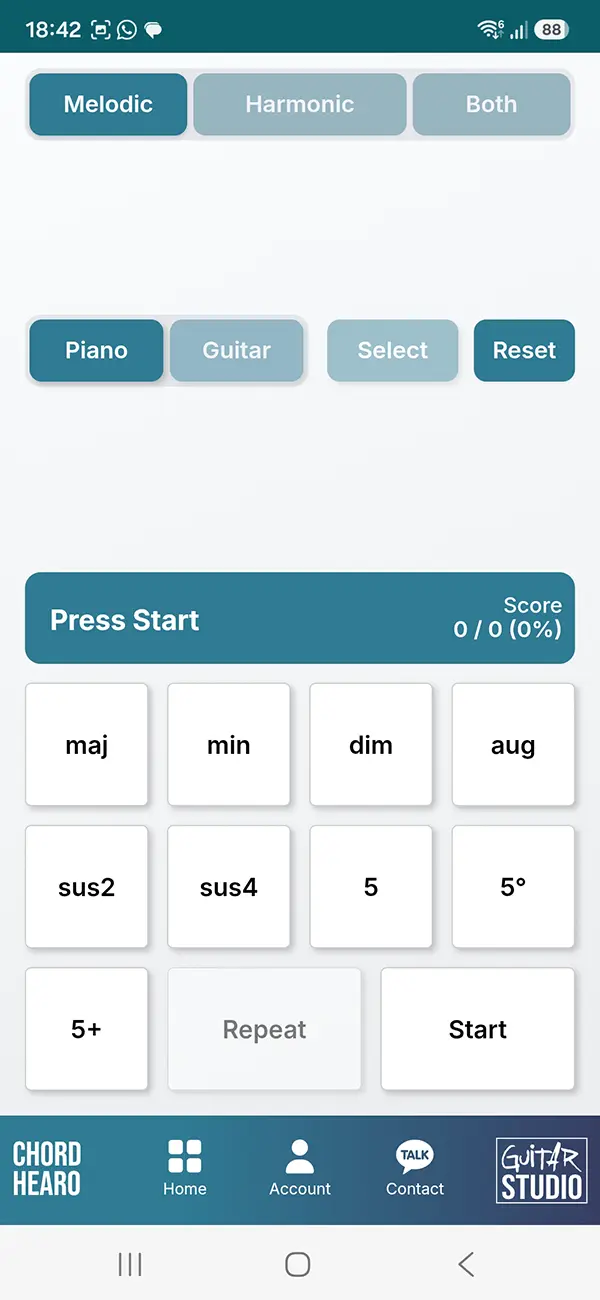
Chord Hearo inside the Guitar Training Studio app
Chord Ear Training FAQ
What is chord ear training?
Chord ear training teaches you to recognize chord qualities by sound, such as major, minor, diminished, augmented and suspended chords.
How do I get better at recognizing chords by ear?
Start with two or three clearly different chord qualities, listen repeatedly and compare the sounds before adding more options.
Should I learn major and minor chords first?
Yes. Major and minor provide a clear contrast and are a useful foundation before training suspended, diminished, augmented and other chord qualities.
Can guitarists use chord ear training?
Yes. Chord ear training helps guitarists connect fretboard shapes and chord names with the actual sound of each chord quality.
What is the difference between melodic and harmonic playback?
Melodic playback plays the chord tones one after another. Harmonic playback plays the notes together as a chord.
Why do some chords sound different on guitar and piano?
The chord quality can remain the same while instrument tone, register and voicing change the overall sound. Practicing with different sounds helps build more flexible recognition.
Explore More Guitar Training Tools
Train timing, rhythm, ear, fretboard knowledge, tuning, pitch and music theory with the interactive tools from Guitar Training Studio.
Explore All Tools →Take Your Guitar Playing To The Next Level!

Wouter Baustein
Music Producer, Music & Mindset Coach
If you like clear, practical guitar and music coaching instead of random YouTube tips, you need structure. My guitar books and coaching programs give you that structure, so you can finally make real progress and level up your playing.