
Interval Hearo: Interval Ear Training Tool
Train your ear to recognize the distance between notes. Practice ascending, descending, mixed and harmonic intervals using piano or guitar sounds.
Open Interval Hearo →What Is Interval Ear Training?
Interval ear training teaches you to recognize the distance between two notes by sound. You listen to the notes, identify the interval and build stronger melodic awareness through repeated comparison.
Practice tip: start with a small number of clearly different intervals before adding more similar ones.
How to Use Interval Hearo
Choose the intervals you want to train, listen carefully and identify the distance between the notes. Start with clear contrasts and add more intervals as your ear becomes more reliable.
Choose the Intervals
Select the interval types you want to practice. Begin with a small group before adding more similar-sounding intervals.
Select the Playback Mode
Practice ascending, descending, mixed or harmonic intervals depending on the listening skill you want to develop.
Choose Piano or Guitar
Switch between instrument sounds so you learn to recognize intervals beyond one specific tone or timbre.
Listen and Identify
Hear the notes carefully, decide which interval you recognize and submit your answer before checking the result.
Use the Feedback
Replay intervals you confuse and compare them directly. Add more interval types once your recognition becomes consistent.
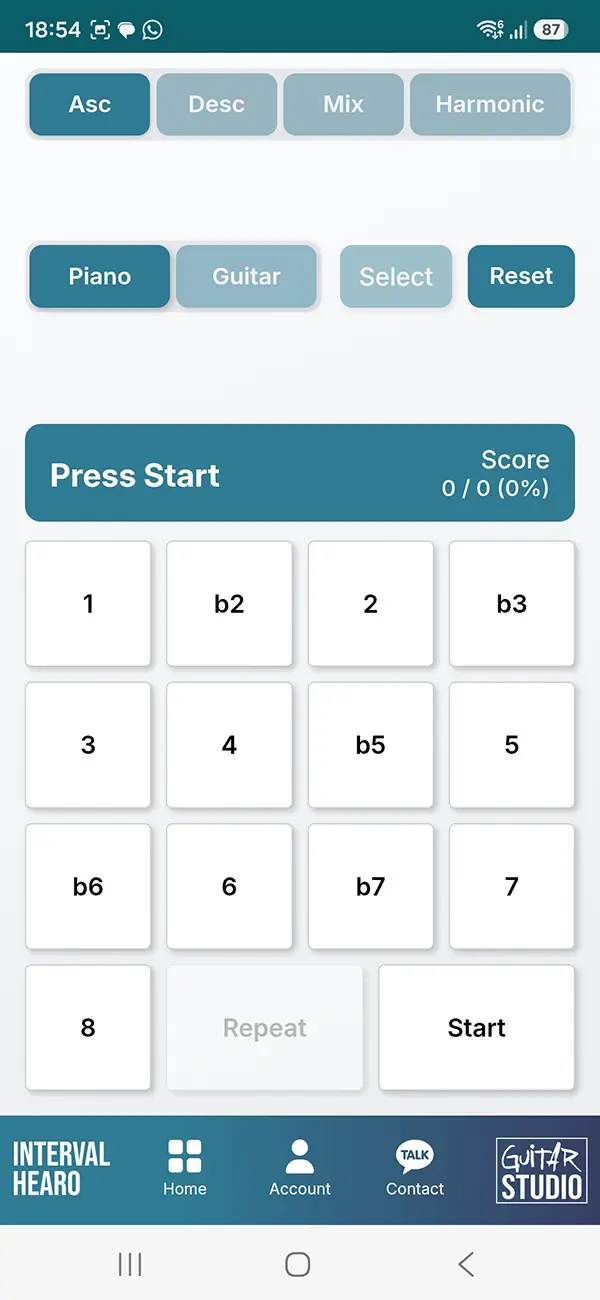
Interval Hearo inside the Guitar Training Studio app
What Interval Hearo Trains
Interval Hearo trains you to recognize musical intervals by ear. An interval is the distance between two notes, and learning to hear that distance helps connect melody, harmony and music theory with actual sound.
You can practice intervals in several ways:
- ascending intervals
- descending intervals
- mixed ascending and descending intervals
- harmonic intervals with both notes played together
- piano and guitar sounds
- major, minor, perfect, diminished and augmented intervals
Training different playback modes is important because the same interval can feel different when it moves upward, downward or is heard harmonically.
The goal is to make interval recognition increasingly automatic, so intervals become familiar musical sounds rather than abstract theoretical distances.
Why Interval Ear Training Matters
Interval ear training helps you understand the relationship between notes by sound instead of only by theory or fretboard position. That makes it easier to recognize melodic movement and hear how notes relate to each other.
This is useful when learning melodies by ear, transcribing solos, singing, improvising, composing and understanding harmony. The stronger your interval recognition becomes, the faster you can identify what is happening in real music.
For guitarists, interval training is especially useful because it connects fretboard distance with musical sound. Instead of seeing an interval only as a shape, you begin to hear what that shape actually means.
Regular interval practice can also improve pitch awareness, melodic memory and your ability to predict where a melody is likely to move next.
How to Recognize Intervals by Ear
Start with strong contrasts. A minor second sounds very different from a perfect fifth or octave. Training clearly different intervals first makes recognition easier.
Listen to the direction. The same interval can feel different when it moves upward or downward, so practice both ascending and descending examples instead of only one direction.
Compare intervals directly. If two intervals are easy to confuse, practice them next to each other. Direct comparison helps your ear notice the difference more clearly.
Use harmonic playback too. Hearing both notes together trains a different listening skill than melodic playback and is especially useful for harmony, chords and arrangement.
Want to take that harmonic listening further? Practice chord recognition with Chord Hearo.
Build your own sound associations. Song references can help at first, but the long-term goal is to recognize the interval itself without needing to recall a specific melody.
Common Interval Ear Training Mistakes
Training too many intervals at once. If every answer starts to feel like a guess, reduce the exercise to a smaller group and build recognition step by step.
Only practicing ascending intervals. Descending and harmonic intervals require different listening skills, so include all playback directions once the basics feel secure.
Relying only on song references. Familiar melodies can help you learn intervals, but try to move beyond them so you recognize the interval itself rather than recalling a song.
Using only one instrument sound. An interval remains the same even when the timbre changes. Practicing with piano and guitar sounds helps make recognition more flexible.
Checking the answer too quickly. Listen again and make a real decision before revealing the result. Active recall is more useful than immediately looking for confirmation.
Interval Ear Training FAQ
What is interval ear training?
Interval ear training teaches you to recognize the distance between two notes by sound instead of relying only on theory or notation.
How do I get better at recognizing intervals by ear?
Start with a small number of clearly different intervals, compare them directly and add more similar intervals only when recognition becomes reliable.
Should I practice ascending and descending intervals?
Yes. The same interval can feel different when it moves upward or downward, so practicing both directions helps build more flexible recognition.
What are harmonic intervals?
Harmonic intervals are two notes played at the same time. They train your ability to hear interval relationships inside harmony rather than melody.
Can guitarists use interval ear training?
Yes. Interval training helps guitarists connect fretboard shapes and distances with the actual sound of each interval.
Should I use song references to learn intervals?
Song references can help at first, but the long-term goal is to recognize the interval itself without needing to recall a specific melody.
Explore More Guitar Training Tools
Train timing, rhythm, ear, fretboard knowledge, tuning, pitch and music theory with the interactive tools from Guitar Training Studio.
Explore All Tools →Take Your Guitar Playing To The Next Level!

Wouter Baustein
Music Producer, Music & Mindset Coach
If you like clear, practical guitar and music coaching instead of random YouTube tips, you need structure. My guitar books and coaching programs give you that structure, so you can finally make real progress and level up your playing.