fb-pixel Skip to main content

Guitar Training Studio

Free Guitar Lesson · Green Day

Green Day – Basket Case Guitar Lesson with TAB

Learn to play Basket Case by Green Day on electric guitar with our free guitar TAB and complete chord progression. Master the power chords, fast downstrokes, palm muting, alternate strumming and chord anticipations that give this pop-punk classic its distinctive drive. This intermediate guitar lesson guides you step by step through the fast chord changes and challenging rhythm patterns.

Key E♭ major Time 4/4 Tempo 168 BPM Intermediate
Green Day Basket Case guitar lesson with power chords, palm muting, chord anticipations and free guitar TAB
Quick Answer

How Do You Play Basket Case by Green Day on Guitar?

To play Basket Case by Green Day, you need power chords and two fast pop-punk rhythm patterns featuring palm muting, downstrokes and alternate strumming. Our guitar TAB is written in E♭ major for standard tuning. The biggest challenge is combining fast chord changes, controlled palm muting and chord anticipations while maintaining tight timing at 168 BPM. This is an intermediate guitar song, not a beginner-level exercise.

1. Power Chords

The guitar part mainly consists of power chords. Practice the chord shapes and move your fingers as a single unit whenever possible. This helps you change chords quickly without having to rebuild your hand position each time.

2. Palm Muting and Strumming

Rhythm Pattern 1 combines fast downstrokes with palm muting. Releasing the palm mute allows certain chords to ring out more freely. Rhythm Pattern 2 uses alternate strumming for a more relaxed picking motion.

3. Rhythm and Tempo

Basket Case is in 4/4 time at 168 BPM. Both rhythm patterns feature chord anticipations, where the next chord is played an eighth note before the bar line. Start at 70 BPM and increase the tempo in 5 BPM steps as your accuracy improves.

Remember: the real difficulty of Basket Case isn't the power chords themselves, but the combination of speed, precise timing, chord anticipations and controlled palm muting. Our simplified guitar TAB shows the complete chord progression and song structure, with the rhythm patterns explained separately. Before playing, listen to the original recording and follow the entire TAB to understand the transitions and repeats.

Song Info – Basket Case

Key: E♭ major

Time Signature: 4/4

Tempo: 168 BPM

Guitar: Electric

Tuning: E–A–D–G–B–E (standard)

Capo: No

Tone/Effects: Distortion or overdrive

Basket Case – Simplified Guitar TAB and Chord Chart

Below you'll find the complete chord progression for Basket Case by Green Day, presented as a simplified guitar TAB. It shows which power chords to play, their positions on the fretboard, and the order of all song sections.

To keep the sheet music compact and easy to read, I haven't written out the strumming rhythm for every individual chord. Instead, you'll use two rhythm patterns, each lasting two bars. You can find them in the separate section on Basket Case strumming patterns.
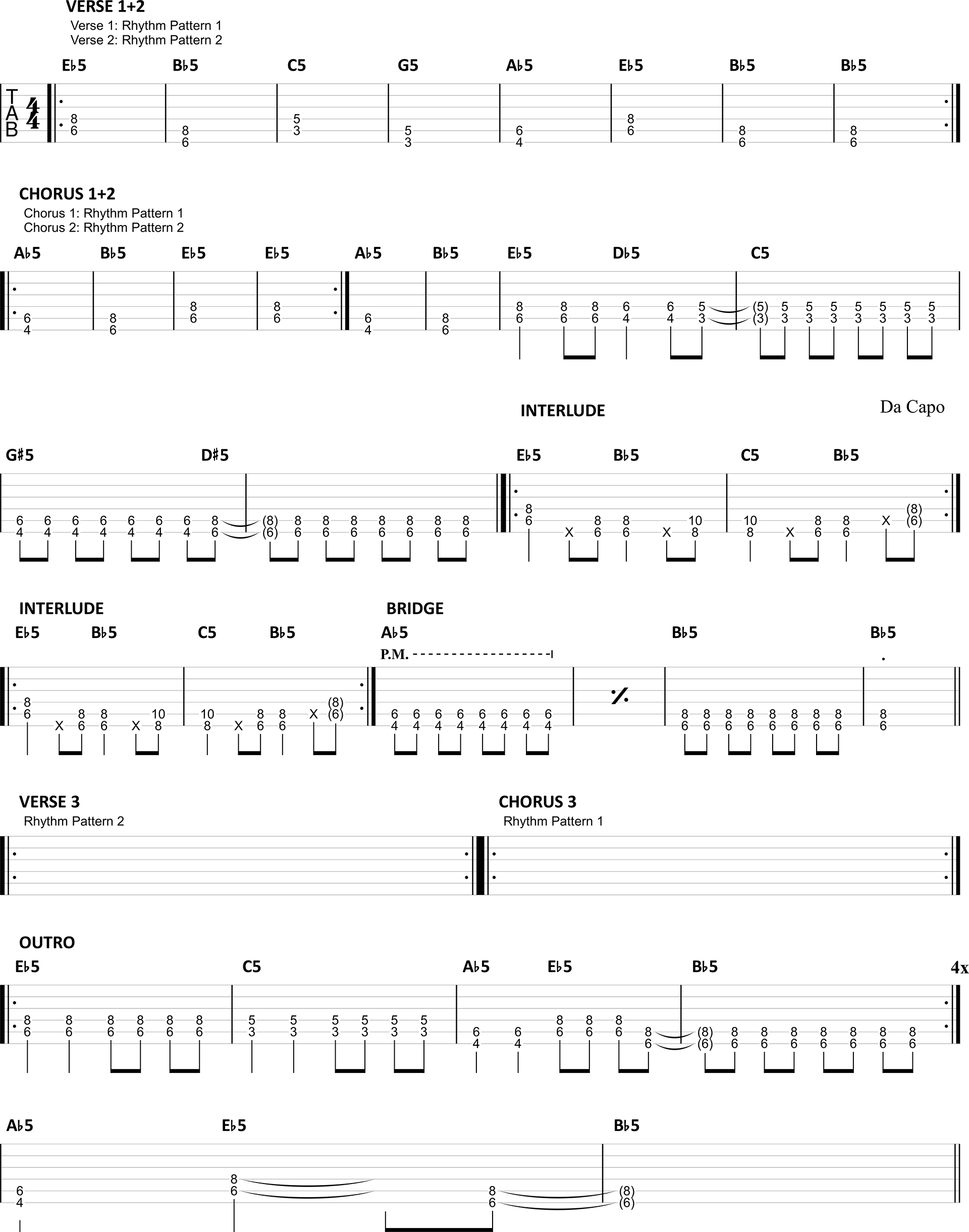
Green Day Basket Case simplified guitar TAB showing power chords, chord progression, song structure and repeat markings

1. Listen First and Follow the Entire Guitar TAB

First, listen to the original recording of Basket Case while following the complete guitar TAB, without playing your guitar. Follow the verses, choruses, interludes, bridge and outro, including all repeats and alternative endings. The goal is to follow the entire song without losing your place and reach the end of the TAB at exactly the same moment as the original recording ends.

2. How Do You Use the Two Rhythm Patterns?

The chord positions in the chart don't show the complete strumming rhythm. Instead, you'll use Rhythm Pattern 1 and Rhythm Pattern 2, each consisting of two bars. Whenever you see two consecutive full bars, apply the indicated rhythm pattern across those two bars, unless the rhythm is written out separately.

The appropriate pattern is indicated in the guitar TAB: Verse 1 and Chorus 1 use Rhythm Pattern 1, while Verse 2 and Chorus 2 use Rhythm Pattern 2. Always follow any exceptions marked in the TAB.

In sections with different rhythms, such as the end of the chorus and the interludes, the rhythm is written out directly in the TAB. The same applies to the bridge, where you follow the notated strums rather than automatically applying Rhythm Pattern 1 or Rhythm Pattern 2.

Important: Two consecutive full bars mean you should apply the corresponding two-bar rhythm pattern. If the rhythm is written out directly in the TAB, follow that notation instead.

3. Repeats and Alternative Chorus Endings

The chorus contains alternative endings marked 1–2, 3 and 4. This means you don't play the same ending every time. Instead, follow the ending corresponding to the current repeat. Pay close attention to the repeat signs and the transition into the interlude.

To save space, some song sections aren't written out again in full. For example, Verse ×2 means you play the previously notated verse twice. When you see Chorus, return to the chorus written earlier. This keeps the entire song structure clear and readable on a single page.

4. What Does Da Capo Mean?

The term Da Capo (D.C.) comes from Italian and literally means "from the head". In musical notation, it instructs you to return to the beginning of the sheet music. In Basket Case, go back to the start of the chord chart and continue following the song structure from there. Important: when you return to the beginning of the TAB, the rhythm pattern changes!

5. Learn the Chords First, Then Add the Rhythm

Once you can follow the complete song structure, practice the power chords and chord changes without strumming patterns. Move each power chord shape as a single unit whenever possible, and make sure any unused strings are properly muted.

Next, add the correct rhythm. In the following section, Basket Case – Strumming Patterns and Palm Muting, we'll look at both rhythm patterns, the strumming techniques and chord anticipations. This will help you combine the simplified chord chart with the rhythmic accompaniment at 168 BPM.

Basket Case – Strumming Patterns and Palm Muting

The rhythm guitar part in Basket Case by Green Day uses two different strumming patterns. Both consist of two bars in 4/4 time and are applied to the power chords shown in the chord chart.

The main difference is the strumming technique: Rhythm Pattern 1 uses downstrokes only, while Rhythm Pattern 2 uses alternate strumming. Both patterns also feature an important rhythmic technique called chord anticipation.
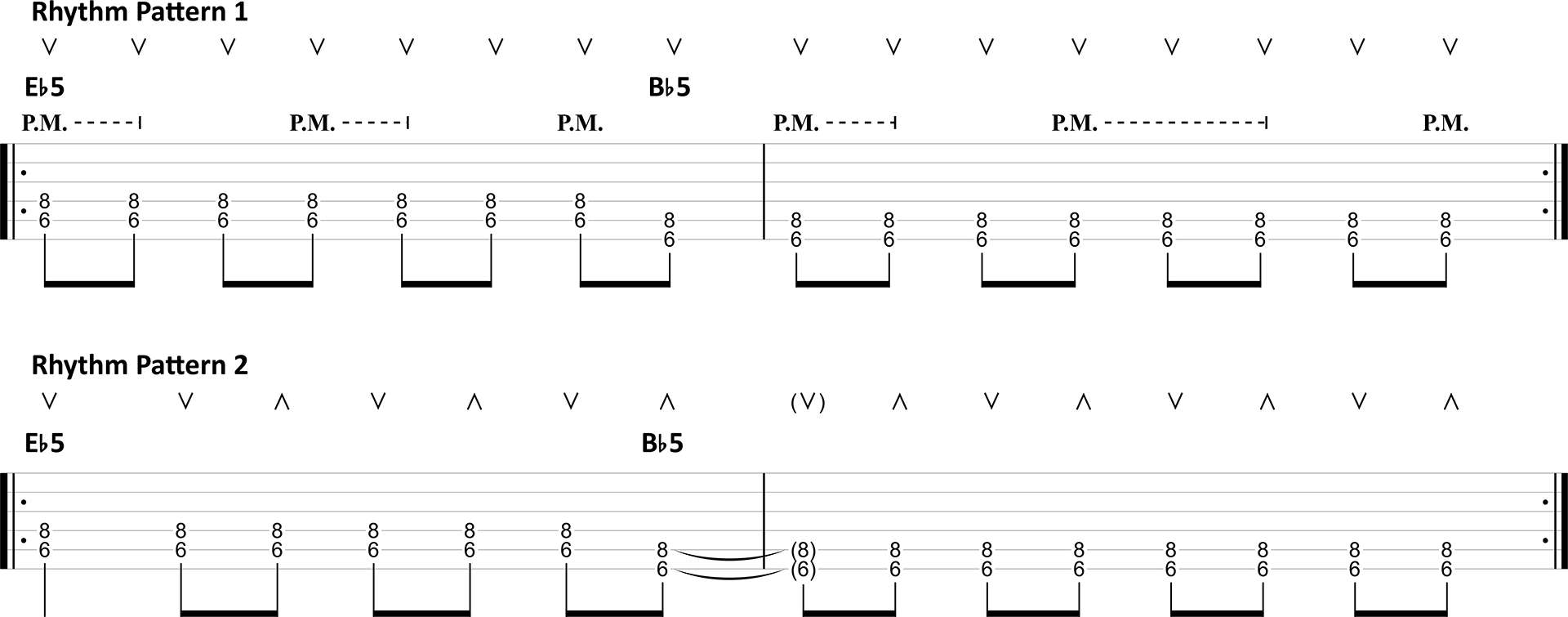
Green Day Basket Case guitar TAB showing two strumming patterns with palm muting, downstrokes, alternate strumming and chord anticipations

1. Rhythm Pattern 1 – Palm Muting and Downstrokes

In the first rhythm pattern, every strum is played with a downstroke. This may sound simple, but at the original tempo of 168 BPM, it is extremely demanding on your strumming hand. Don't try to play at full speed right away.

Use palm muting (P.M.) by resting the side of your strumming hand lightly against the strings near the bridge. This creates a short, muted sound when playing the power chords. At the indicated moments, release the palm mute so the chord sounds fuller and more powerful.

You don't need to strum those chords any harder. The contrast between muted and unmuted chords naturally creates emphasis in the rhythm. Make sure you release and reapply the palm mute precisely, without affecting your timing.

2. Rhythm Pattern 2 – Alternate Strumming and Tied Notes

The second rhythm pattern uses alternate strumming, combining downstrokes and upstrokes. This allows your strumming hand to stay relaxed and makes the movement feel more natural. Pay particular attention to the tied notes between the two bars. The chord is played on the last eighth note of the first bar and continues ringing into the beginning of the second bar. The note shown in parentheses is not strummed again.

Meanwhile, your strumming hand should continue moving in time. On the tied beat, make the usual strumming motion, but don't touch the strings. Then continue with the normal down-up movement. This helps you maintain consistent timing.

3. Chord Anticipation – The Most Important Rhythmic Detail

Both rhythm patterns use chord anticipation. This means that the chord belonging to the next bar is played one eighth note before the bar line. The chord change therefore happens slightly earlier than you might expect. This anticipation is essential to the characteristic drive of Basket Case. The drums also reinforce this rhythmic shift, creating extra emphasis at an unexpected moment.

Practice this transition carefully. Move to the next power chord at the correct moment, without waiting for the new bar to begin. At higher tempos, this becomes one of the most challenging aspects of the song.

Important: Chord anticipation means playing the next chord early. When the chord is tied across the bar line, let it continue ringing without strumming it again. Keep your strumming hand moving in time.

4. Combine the Patterns with the Guitar TAB

The simplified guitar TAB indicates which rhythm pattern to use. Verse 1 and Chorus 1 use Rhythm Pattern 1. Verse 2 and Chorus 2 use Rhythm Pattern 2, unless otherwise indicated.

Each pattern covers two complete bars. Whenever you see two consecutive full bars in the chord chart, apply the indicated rhythm pattern. For sections with different rhythms, such as the interludes, the end of the chorus and the bridge, follow the rhythm written directly in the TAB.

5. Start Slowly and Gradually Increase the Tempo

Start practicing both rhythm patterns at 70 BPM. First, make sure your strumming, palm muting, chord anticipations and chord changes are accurate. Then increase the tempo in 5 BPM steps.

Only move to the next tempo when you can play the pattern correctly and comfortably several times in a row. If your playing becomes sloppy, slow down and focus on accuracy again. Gradually work your way up to the original tempo of 168 BPM.

Use our free Smart Click Metronome to improve your timing. You can also practice with a drumbeat instead of just a metronome click using our Groovr Drum Pattern App .

With Rhythm Pattern 1, focus on fast, controlled downstrokes and precise palm muting. With Rhythm Pattern 2, concentrate on relaxed alternate strumming and allowing the tied notes to ring correctly. Chord anticipation must be rhythmically accurate in both patterns.

How to Play Basket Case on Guitar – Step by Step

With the guitar TAB and two rhythm patterns, you can learn Basket Case by Green Day step by step. Follow the practice sequence below and prioritize accuracy over speed.

Step 1 – Listen and Follow the Entire Guitar TAB

First, listen to the original recording while following the complete guitar TAB, without playing your guitar. Follow the verses, choruses, interludes, bridge and outro, including all repeats and alternative endings. The goal is to understand the entire song structure without losing your place. When the original recording ends, you should reach the end of the TAB at exactly the same moment. If you lose track, listen again until you can follow the entire song without any difficulty.

Step 2 – Learn the Power Chords and Chord Changes

Practice the power chords shown in the Basket Case guitar TAB: E♭5, B♭5, C5, G5, A♭5 and D♭5. Check your finger positioning and make sure any unused strings are properly muted. Next, practice the chord changes without adding the strumming patterns. Move the entire power chord shape as a single unit whenever possible, and focus on finding the correct fret positions quickly and accurately.

The power chords in this TAB are written using two strings and played with your index and ring fingers. You can also play them on three strings by adding the root note one octave higher. To do this, place your pinky on the same fret as your ring finger, but on the next thinner string. Both versions are equally correct.

Step 3 – Practice Both Rhythm Patterns Separately

Start with Rhythm Pattern 1: downstrokes only, with palm muting that you release at the indicated moments. Then practice Rhythm Pattern 2 using alternate strumming. Start at 70 BPM and pay particular attention to chord anticipations in both patterns: the next chord is played before the bar line. In Rhythm Pattern 2, you also need to let the tied notes ring correctly while keeping your strumming hand moving.

Step 4 – Combine the Rhythm Patterns with Chord Changes

Now combine the chord changes with the indicated rhythm pattern. Practice two complete bars at a time and repeat them until your chord changes and strumming are accurate. Pay particular attention to the chord anticipations: your fingers must be ready for the next chord before the bar line. Then practice the individual song sections and the transitions between them. In the interludes, bridge and alternative chorus endings, follow the rhythm written directly in the guitar TAB instead of automatically applying one of the two standard rhythm patterns.

Step 5 – Build Up the Tempo and Play the Entire Song

Once you've mastered the individual song sections, play them together without stopping. Start at a comfortable tempo and increase the speed in 5 BPM steps whenever you can play the song accurately and comfortably. Gradually work your way up to the original tempo of 168 BPM. Make sure your strumming hand stays relaxed, especially during the fast downstrokes. Finally, play along with the original Green Day recording. Listen carefully to the drums, follow the rhythmic anticipations and aim to play the entire song with tight timing and no interruptions.

6 Common Mistakes When Playing Basket Case on Guitar

Basket Case may look simple because it uses power chords, but the fast strumming and rhythmic anticipations make it much more challenging than you might expect. Here are six common mistakes to avoid when practicing this Green Day song.

1. Changing Chords Too Late

One of the most important mistakes to avoid is waiting until the next bar begins before changing chords. In both rhythm patterns, the next chord is played one eighth note before the bar line. This anticipation is essential to the characteristic drive of Basket Case. Practice the transition slowly and listen carefully to the drums, which reinforce this rhythmic shift.

2. Using the Wrong Strumming Technique

Rhythm Pattern 1 is played entirely with downstrokes, while Rhythm Pattern 2 uses alternate strumming. Playing both patterns with the same strumming technique removes an important difference in how they feel. Focus on controlled downstrokes in Rhythm Pattern 1 and maintain a consistent down-up motion in Rhythm Pattern 2.

3. Not Releasing the Palm Mute at the Right Moment

In Rhythm Pattern 1, some strums are palm-muted while others are played without muting. If you keep palm muting throughout the entire pattern, the rhythm will sound too flat. Release the pressure of your strumming hand at the indicated moments so the chord naturally sounds fuller. You don't need to strum harder. The contrast comes from alternating between muted and unmuted strums.

4. Strumming the Tied Notes Again

In Rhythm Pattern 2, a chord is played before the bar line and tied into the following bar. A common mistake is strumming that chord again on the first beat. Let the chord continue ringing without another strum, but keep your strumming hand moving in its normal down-up pattern. This helps you maintain accurate timing without interrupting the tied note.

5. Applying the Rhythm Patterns Everywhere

The simplified guitar TAB uses two rhythm patterns, each lasting two bars, but not every section follows the same pattern. In the alternative chorus endings, interludes and bridge, the strumming is written out separately. Always follow the rhythm shown directly in the TAB for these sections. Also pay attention to the repeat signs and alternative endings so you don't skip sections or repeat them at the wrong moment.

6. Practicing Too Fast and Building Up Tension

The original tempo of 168 BPM is demanding, especially with the continuous downstrokes in Rhythm Pattern 1. Trying to play at full speed immediately often leads to inaccurate chord changes and tension in your strumming hand. Start at 70 BPM and increase the tempo in 5 BPM steps once you can play the pattern correctly and comfortably several times in a row. If you feel tension or lose control, slow down again.

Frequently Asked Questions About Playing Basket Case on Guitar

1. Is Basket Case by Green Day Difficult to Play on Guitar?

Yes, Basket Case is a challenging song and definitely not a beginner-level guitar song. Although the power chords themselves are relatively simple, the fast tempo of 168 BPM, rapid downstrokes, palm muting and especially the chord anticipations make the song technically demanding. You need to play quickly while maintaining accurate chord changes and precise timing. This lesson is designed for intermediate guitarists who want to improve their rhythm guitar technique.

2. What Chords Do You Need to Play Basket Case?

This guitar arrangement uses six power chords: E♭5, B♭5, C5, G5, A♭5 and D♭5. Power chords consist of the root note and the perfect fifth, optionally including the root one octave higher. They're commonly used in punk rock because they sound powerful with distortion and can be moved easily along the fretboard.

3. What Key Is Basket Case In?

Basket Case is in E♭ major. The guitar TAB in this lesson is written directly in that key, so you don't need to transpose the chords into another key.

4. What Guitar Tuning Do You Use for Basket Case?

For the guitar TAB in this lesson, use standard tuning: E–A–D–G–B–E, from the lowest to the highest string. Green Day used guitars tuned down a half step on the original recording (E♭–A♭–D♭–G♭–B♭–E♭). Since our TAB is written directly in E♭ major, you can play the same sounding chords without retuning your guitar. No capo is required.

5. What Is the Tempo of Basket Case?

In this lesson, Basket Case is played at 168 BPM in 4/4 time. That's fast, especially when playing continuous eighth notes with downstrokes. Start practicing at 70 BPM and gradually increase the tempo in 5 BPM steps once you can play the rhythm accurately and comfortably.

6. Do You Have to Play Basket Case Entirely with Downstrokes?

No. In this lesson, Rhythm Pattern 1 uses downstrokes only, while Rhythm Pattern 2 uses alternate strumming, combining downstrokes and upstrokes. In sections where the rhythm is written out separately in the guitar TAB, follow the indicated strumming technique.

7. What Is Chord Anticipation in Basket Case?

Chord anticipation means playing the next chord slightly earlier than expected. In both Basket Case rhythm patterns, the chord belonging to the next bar is played on the final eighth note before the bar line. The drums also reinforce this rhythmic shift, making anticipation an important part of the song's distinctive rhythm.

8. How Do You Use the Two Rhythm Patterns with the Guitar TAB?

Both rhythm patterns are two bars long. Whenever two consecutive full bars appear in the chord chart, use the rhythm pattern indicated for that song section. Verse 1 and Chorus 1 use Rhythm Pattern 1, while Verse 2 and Chorus 2 use Rhythm Pattern 2. If the rhythm is written out directly in the guitar TAB, follow that notation instead.

9. What Does Da Capo Mean in the Basket Case TAB?

Da Capo (D.C.) is Italian for "from the beginning" and instructs you to return to the start of the sheet music. It's a standard repeat marking used to avoid writing out the same music multiple times.

Wouter Baustein - Guitar Coach

Guitar Training Studio

Ready to Make Real Progress on Guitar?

Build better technique, timing and musicianship with structured guitar training, practical tools and personal coaching.