
Guitar Technique vs Feel: Why Skill Alone Doesn’t Make You Sound Good
Guitar technique vs feel is one of the biggest blind spots in modern guitar culture.
Many players assume that speed, precision, and advanced mechanics automatically lead to better phrasing, stronger groove, and more musical authority. They do not.
Technique matters, but fast fingers alone do not create feel, groove, phrasing, or identity.
What is the difference between guitar technique and feel?
Guitar technique is your physical ability to execute notes and movements cleanly. Feel is how you use timing, touch, phrasing, articulation, and tone to make those notes sound musical.
Strong technique gives you control and options, but it does not automatically create groove or expression. A simple phrase can sound convincing when its timing, note length, and dynamics fit the music.
Develop both together: practise the mechanics, then study how players in your chosen style use space, accents, and touch. Technique supports feel; it does not replace it.
Technique is not the same as feel
This is the first thing many guitarists get wrong.
Technique is your physical ability to execute something. Feel is how musical time, touch, phrasing, articulation, and tone come together in a way that sounds alive.
Those are not the same thing.
You can have strong technical ability and still sound stiff. You can also hear players with much less obvious technique who sound instantly convincing because their touch, timing, and phrasing make musical sense.
That is why guitar technique vs feel is not a small detail. It is the difference between mechanical execution and musical language.
Style is a language, not a level
Style is a language.
That changes everything.
You do not unlock blues feel by becoming faster. You do not suddenly gain pocket by pushing your metronome higher. You do not reach expressive phrasing just because your alternate picking improved.
Every style has its own language:
timing,
articulation,
touch,
tone,
rhythmic placement,
and phrasing.
Those things are learned inside the style itself. They are not extra toppings you add once the technique is there.
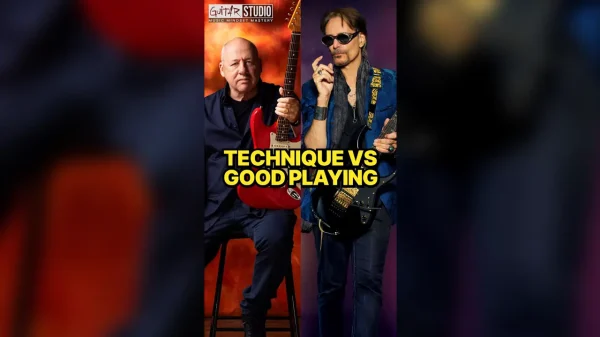
That is why a technically advanced player can still sound wrong in a style they never truly studied. Think of Steve Vai and Mark Knopfler: the issue is not who is “better,” but that their styles require different musical languages.
Why chasing technique alone fails
A lot of guitarists chase level-based progress because it feels measurable.
Faster tempos. Cleaner runs. Harder exercises. More difficult licks.
That creates the illusion of certainty.
But music does not reward difficulty in a simple way.
If you only chase technique, you often become more capable without becoming more convincing. Technique supports feel, but never replaces it.
That is the trap.
You become better at movement, but not necessarily better at meaning.
What feel is actually built from
Feel sounds vague until you break it down.
In practice, feel often comes from things like:
- where notes sit against the beat
- how notes are started and ended
- how silence is used
- how long notes are allowed to breathe
- how touch changes tone
- how phrases lean forward or pull back
That is where musical identity starts becoming audible.
And none of that is guaranteed just because your hands got better.
Why great players still sound different
This is where many guitarists confuse skill with universality.
They think a highly skilled player should be able to sound right in any context.
But that is not how music works.
A player can be exceptional and still not sound natural in another style, because the missing part is not raw technique. It is language, instinct, timing, phrasing, and cultural vocabulary inside that style.
That is why some players sound instantly believable in blues, funk, soul, country, or rock, while others sound like tourists passing through.
The difference is not usually hand speed.
It is fluency. The same distinction runs through Frusciante vs shredders: musical connection depends on how skill serves the song.
The guitar world often overvalues mechanics
This is also why guitar culture often gets stuck in the wrong scoreboard.
Inside guitarist circles, visible difficulty gets rewarded fast. Speed looks impressive. Complexity signals status. Clean execution gets respect.
But that does not automatically create musical impact.
This is the same broader problem behind Guitarist Music vs Listener Music: Know Your Audience and Why Guitarists Are the Hardest Audience to Sell Music To. Guitar culture often confuses internal admiration with real musical connection.
How to train feel instead of just technique
If you want more feel, you have to train things that technique culture often ignores.
Study one player deeply.
Not just their notes. Study:
how they enter notes,
how they leave notes,
how they place phrases,
how they use space,
how their tone reacts to touch,
and how their timing breathes.
Play shorter phrases and make them sound better instead of always making them harder.
Record yourself. Listen back. Ask whether it sounds alive or merely correct.
If it sounds clean but lifeless, the issue is probably not your fingers anymore.
It is the language.
A better way to think about progress
Technique is not useless. It is essential.
But its job is support. For more on building those skills, explore our guitar technique and skills articles.
Technique gives you access. Feel gives you meaning.
Technique gives you options. Feel makes those options believable.
Technique expands what you can do. Feel determines whether anyone cares.
That is also why pure difficulty can become a dead end. It often produces admiration without identity. That same split shows up in Why Shred Music Has Less Value, where technical achievement and musical value are clearly separated.
Conclusion
Guitar technique vs feel is not a battle between skill and emotion.
It is a question of order.
Technique should serve feel, style, timing, phrasing, and identity. Not replace them.
If you want to sound better, stop assuming that more difficulty automatically creates more music.
It does not.
Train the language, not just the mechanics.
That is when skill finally starts sounding like music.
If you want to develop technique, timing, feel and musical control as part of one structured system, explore our guitar training and coaching options for focused guidance and long-term progress.
FAQ
What is the difference between guitar technique and feel?
Guitar technique is your physical ability to execute notes and movements cleanly. Feel is how timing, touch, phrasing, articulation, and tone come together musically.
Can great technique make you sound good automatically?
No. Great technique helps, but it does not automatically create groove, phrasing, musical identity, or style awareness.
Why can a highly skilled guitarist still sound wrong in a style?
Because style is a language. A player can have strong mechanics and still lack the phrasing, timing, touch, and vocabulary that make a style sound believable.
How do you actually develop feel on guitar?
Study players deeply, focus on timing, note length, articulation, space, touch, and phrasing, and record yourself to hear whether your playing sounds alive or just mechanically correct.
Is speed important for feel?
Not directly. Speed is a technical ability. Feel comes more from rhythmic placement, phrasing, touch, and how notes sit inside the music.
Should guitarists train technique or feel first?
Both matter, but technique should be trained in service of musical language. Technique without feel often leads to clean but lifeless playing.

Guitar Training Studio
Ready to Make Real Progress on Guitar?
Build better technique, timing and musicianship with structured guitar training, practical tools and personal coaching.
www.guitarstudio.be (Belgium)
www.guitartrainingstudio.com (International)
c/o Wouter Baustein
Driehoekstraat 1, BE-3891 Gingelom
+32.(0)476.666.300
info@guitarstudio.be
CoC: 0872.862.121
VAT: BE0872862121
IBAN: BE33-7350-0967-6746
BIC: KREDBEBBXXX
© 2000 – 2026 All Rights Reserved
Web apps & development by Baustein.digital