
Rhythm & Timing – Beginner Guitar Lesson
How to Read Rhythm on Guitar – Quarter and Eighth Notes
Rhythm is the backbone of music. It gives structure, movement, and energy to everything you play. In this free guitar lesson, you'll learn how to read, count, and play rhythms using quarter notes and eighth notes in 4/4 time. Develop your sense of rhythm step by step with clear explanations, practical exercises, and a metronome.
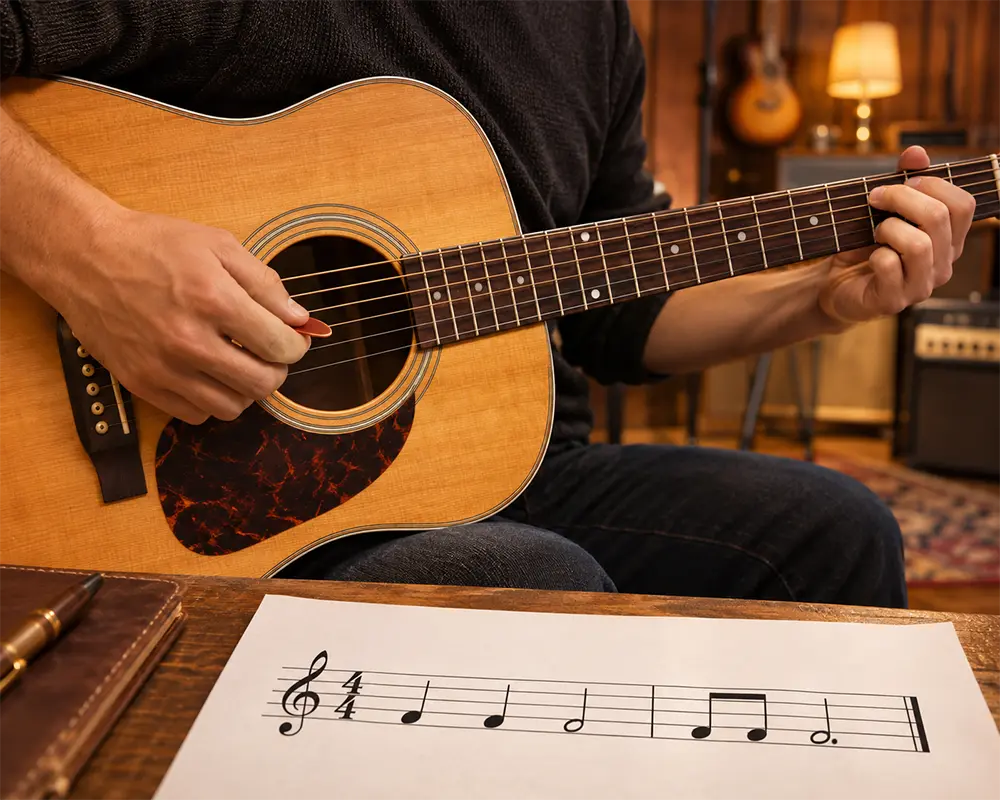
Why Is Rhythm Important in Music?
Imagine a band where everyone plays the correct notes, but nobody keeps the same tempo. The guitarist speeds up, the bassist falls behind, and the drummer tries to hold everything together. Even when every note is correct, the music sounds messy.
Good rhythm isn't just about what you play, but especially when you play it. Rhythm is the backbone of music. It gives structure, movement, and energy to everything you play. Without a solid rhythmic foundation, even beautiful melodies and chords lose their coherence.
1. A Steady Beat
You learn to feel and maintain a steady beat, even when the rhythmic pattern changes.
2. Better Timing
You play notes and chords at the right moment, without unintentionally speeding up or slowing down.
3. Tighter Playing Together
You learn to listen to other musicians and synchronize your playing with the drummer, bassist, or backing track.
Mastering rhythm involves more than simply following a metronome. It's also about feeling the beat, recognizing accents, and developing a natural musical flow. The better your sense of rhythm, the easier it becomes to learn new songs and rhythmic patterns.
Do You Need to Read Music to Learn Rhythm?
Many guitarists believe that learning to read standard music notation isn't necessary. However, there's an important difference between reading rhythm and reading pitch. To understand this distinction, think of music notation as a graph with two axes.
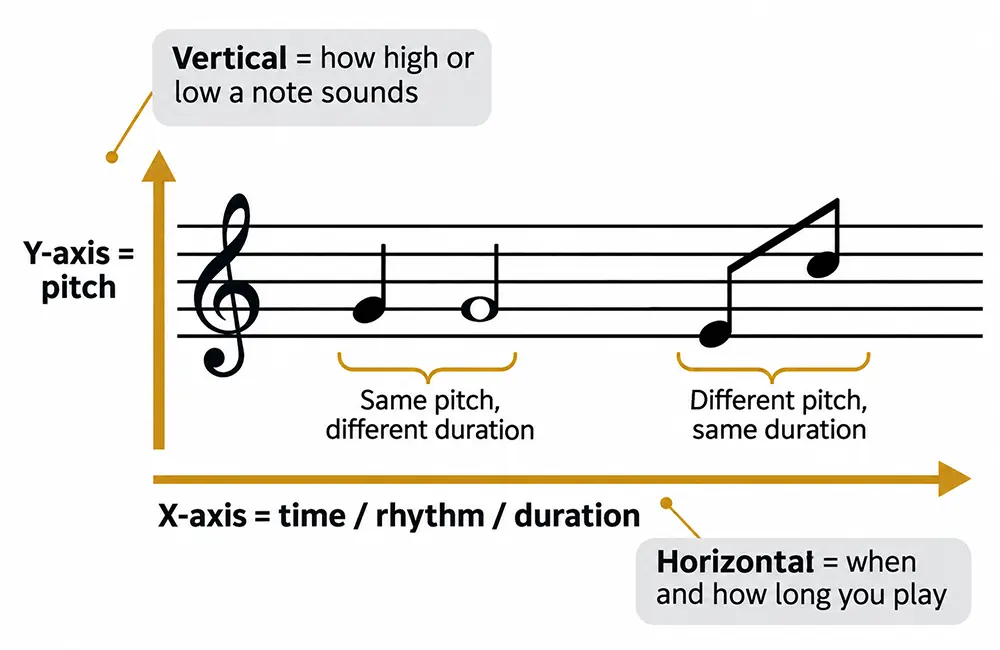
You don't need to know how to read pitches on a musical staff to start reading rhythm. We begin with time: when do you play a note, and how long does it last? The exact pitch you play isn't important for these exercises.
Remember: a wrong note played with perfect timing can sometimes sound better than a correct note played completely off the beat. You can know all the right chords, but if your timing is off, the music falls apart. That's why we start with rhythm.
Try It Yourself: Listen to a song you know well. Tap your foot or clap your hands along with the steady beat. Can you keep following that beat, even when the melody or guitar part changes? If so, you're already developing your sense of rhythm.
Understanding Beat, Tempo, and Time Signature
To understand rhythm, you need to distinguish between three fundamental concepts: beat, tempo, and time signature. They are closely related, but they don't mean the same thing.
The steady clicking of a metronome helps you understand these concepts. Each click represents one beat. The tempo determines how quickly those clicks occur, while the time signature tells you how the beats are grouped.

1. Beat
The beat is the steady pulse you feel or tap along to in music. Think of a metronome clicking: tick – tick – tick – tick. A beat is not a complete rhythmic pattern, but the underlying steady pulse that guides your playing.
2. Tempo
The tempo determines how quickly the beats follow one another. It is measured in BPM (beats per minute): the number of beats in one minute. At 60 BPM, you hear one beat every second, just like the second hand of a clock.
3. Time Signature
The time signature tells you how beats are grouped into measures. In 4/4 time, you count four beats per measure: 1 – 2 – 3 – 4. The vertical lines on a musical staff are called barlines. Between two barlines, you count four beats in 4/4 time.
What Does 4/4 Mean?
A time signature is written like a fraction, with a numerator and a denominator.

- Numerator (top number): indicates the number of beats per measure, between two barlines.
- Denominator (bottom number): identifies the note value representing one beat. The number 4 represents a quarter note.
4/4 therefore means 4 × 1/4 (four quarter-note beats) per measure.
What Does 4/4 at 60 BPM Mean?
A measure of 4/4 contains four beats. At 60 BPM, each beat lasts one second, just like the second hand of a clock. One complete measure therefore lasts four seconds.
Listening Examples: The 4/4 Time Signature
Listen to the intros of these well-known songs and try counting the four beats out loud: 1, 2, 3, 4.
- Lynyrd Skynyrd – Sweet Home Alabama: starts with a spoken count-in.
- The Beatles – I Saw Her Standing There: starts with a spoken count-in.
- Queens of the Stone Age – Little Sister: starts with four cowbell hits.
- Blur – Song 2: no count-in; the drums start directly on the first beat.
How to Read and Play Quarter and Eighth Notes in 4/4
Now that you understand what a beat, measure, and 4/4 time signature are, you're ready to learn two of the most important note values for beginners: quarter notes and eighth notes.
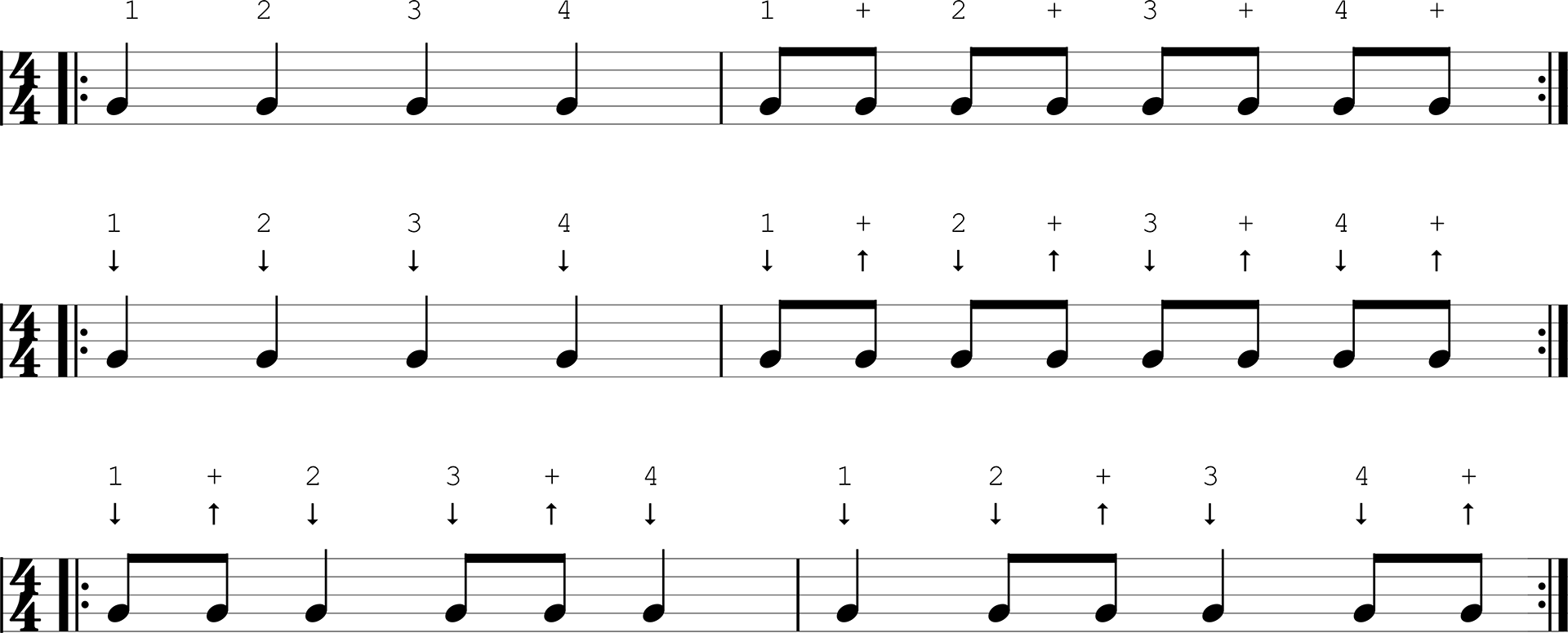
Always think in terms of beats. In 4/4 time, you count: 1 2 3 4. A quarter note lasts one beat. Two eighth notes divide that beat into two equal parts. You count: 1 and 2 and 3 and 4 and, or simply: 1 + 2 + 3 + 4 +.
Quarter Notes
A quarter note lasts one beat in 4/4 time. A single measure can therefore contain four quarter notes. We play one on beat 1, one on beat 2, one on beat 3, and one on beat 4. To practice this on guitar, we use four downstrokes: ↓ ↓ ↓ ↓.
Eighth Notes
An eighth note lasts half a beat in 4/4 time. Therefore, one measure can contain eight eighth notes. You count: 1 + 2 + 3 + 4 +. On guitar, we practice this with a downstroke on each number and an upstroke on each +: ↓ ↑ ↓ ↑ ↓ ↑ ↓ ↑.
The Total Note Values Must Always Add Up
The sum of all note values in one complete measure must equal the time signature indicated at the beginning of the musical staff or piece of music.
For example, in 4/4 time:
Four quarter notes: 4 × 1/4 = 4/4
Eight eighth notes: 8 × 1/8 = 4/4
You can also combine quarter notes and eighth notes, as long as the sum of their note values equals the indicated time signature.
To understand rhythm on guitar, we start by playing quarter notes on the beats and eighth notes both on and between the beats. By alternating downstrokes and upstrokes, you can immediately feel how each beat is divided.
Want to apply these movements to your guitar playing? Explore our lesson on right-hand picking and strumming basics.
Listening Examples: Quarter Notes and Eighth Notes
Listen to the intros of these songs. Try to identify the steady beat and count along in 4/4. Pay attention to the subdivisions between the beats.
- AC/DC – Back in Black: starts with eight hi-hat hits.
- U2 – Vertigo: starts with four drumstick clicks.
- Nathan Evans – Wellerman: starts with four kick drum hits.
- Taylor Swift – Cruel Summer: no count-in; the drums start directly on the first beat.
Guitar Rhythm Exercises: Read, Count, and Play
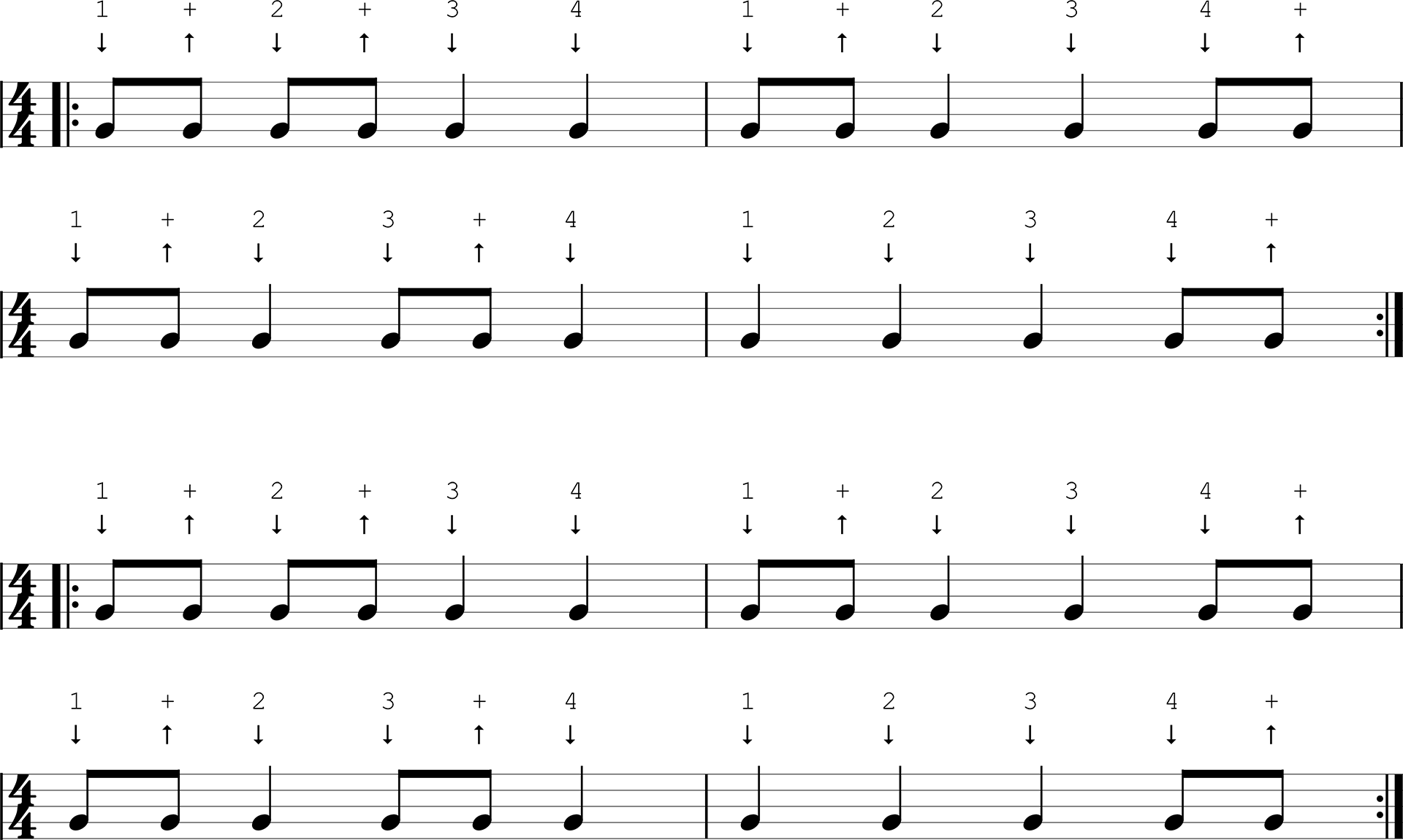
Now it's time to combine quarter notes and eighth notes into actual rhythm patterns. Simply use the open strings of your guitar. There's no need to finger any chords: we'll focus entirely on timing and the movement of your strumming arm.
Below you'll find two exercises, each containing four measures. The numbers represent the beats, while the + signs fall exactly halfway between two beats. The arrows show when to play a downstroke (↓) or an upstroke (↑).
How to Practice These Rhythms Effectively
- Read and count first. Look at the rhythm pattern and count aloud: 1 + 2 + 3 + 4 +. Don't play yet. Make sure you understand exactly where each note falls.
- Use a metronome at 60 BPM. Each click represents one quarter-note beat: 1, 2, 3, or 4. The + always falls exactly halfway between two clicks.
- Play the open strings. Use a downstroke on the numbers and an upstroke on the plus signs wherever an eighth note is written. Keep counting aloud as you play. Having trouble with the movement? Review our lesson on basic picking and strumming techniques.
- Repeat and listen. Play each exercise several times without stopping. Start slowly and only increase the tempo when you can play everything evenly and without mistakes.
Important: Keep your strumming arm moving steadily down and up. Your downstroke coincides with the metronome click, while the upward movement happens between two clicks. If there is no eighth note on the +, your arm still moves upward without striking the strings. This helps you maintain steady timing, even when the rhythm pattern changes.
