
Free Guitar Lesson · Warm-Up · Left Hand
Left Hand Guitar Warm-Up: 4 Finger Exercises for Control and Independence
These left hand guitar warm-up exercises help you develop finger control, finger independence, coordination, fine motor skills, and muscle memory. The exercises are designed to improve the accuracy, relaxation, and efficiency of your fretting-hand movements.
In this free guitar lesson, you'll learn a practical 5-minute warm-up routine at 60 BPM, featuring chromatic finger placement, single finger control, finger pair control, and a control combo. It's an ideal way to prepare your fretting hand for daily practice, technique training, or rehearsals.
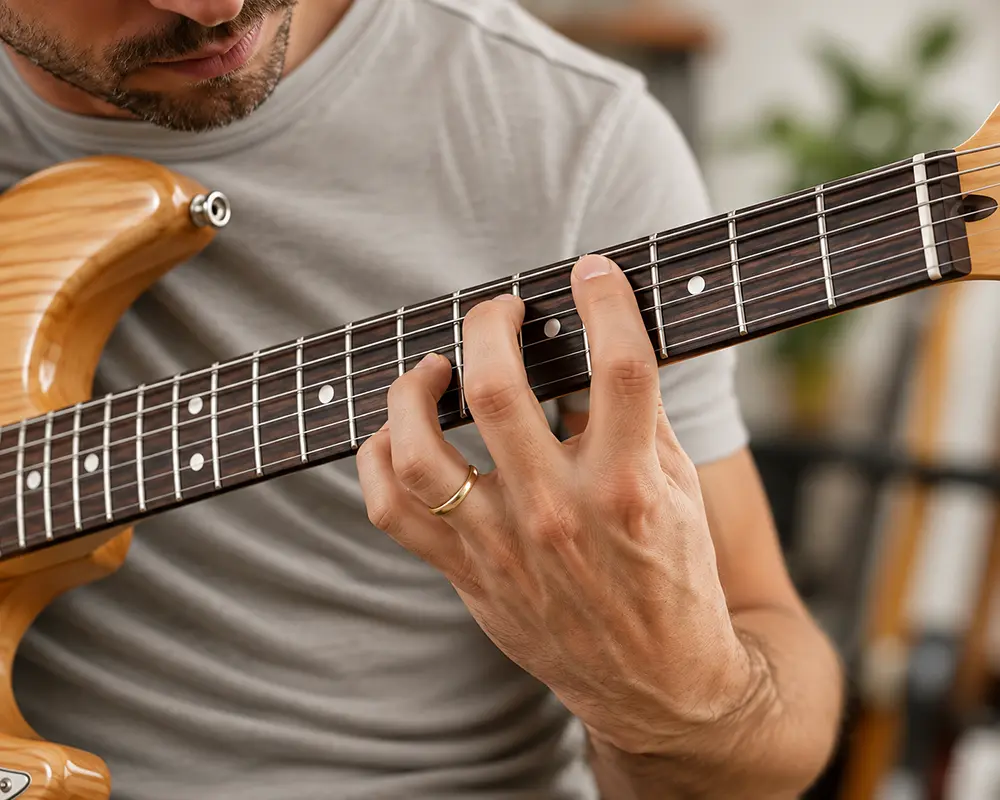
Left-Hand Guitar Warm-Up: 4 Finger Control Exercises
These left-hand guitar warm-up exercises help you develop finger independence, fine motor skills, and controlled movements. Instead of focusing on speed or strength, you'll concentrate on moving individual fingers with as little unnecessary movement as possible.
The following workout consists of four exercises and takes approximately 5 minutes. You'll start with a chromatic finger pattern, followed by individual finger movements, finger pairs, and a combination exercise.
Use a metronome set to 60 BPM. The workout uses straight eighth notes: two eighth notes per beat. You can also use our Smart Click metronome. Follow the demonstration video for the exact finger movements and timing.
GuitarWorkout – Warmups 1.1.1: Finger Control · 60 BPM · 5 Min.
Important: This workout focuses entirely on your fretting hand (the left hand for right-handed guitarists). You don't need to pick the strings. In the first exercise, the notes are picked only to make the pattern easier to hear. The focus is on small, relaxed, and accurate finger movements.
1. Chromatic Finger Placement: 1–2–3–4–3–2–1
We'll start with a simple chromatic fretting-hand exercise. The goal is to place your fingers accurately on the strings without unnecessary movements.
- Place your index finger (finger 1) on the first fret position of the pattern.
- Add your middle finger, ring finger, and pinky one at a time: 1–2–3–4.
- As you add each new finger, keep the previously placed fingers on the string.
- Move back through 3–2–1 by lifting your fingers one at a time in a controlled manner.
- Repeat the pattern on the next string. Continue across all six strings.
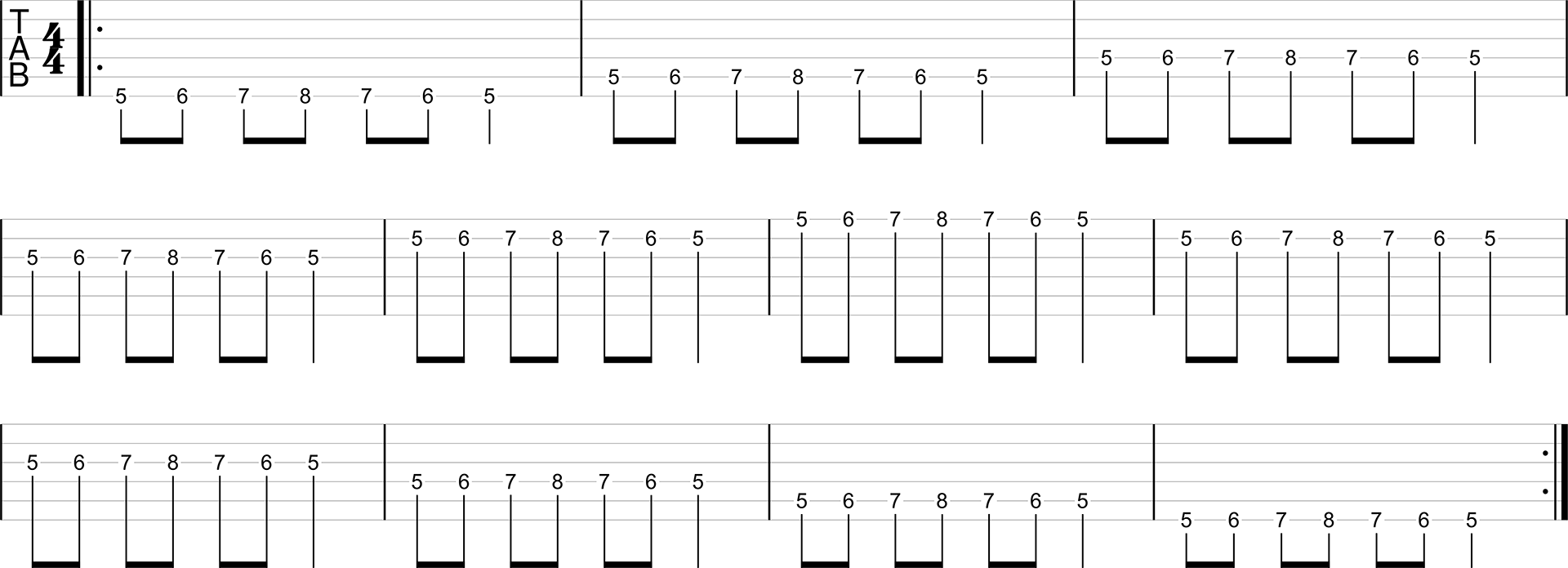
Remember: Don't lift all your fingers when moving up through the pattern. Keep the previous fingers in place and add only one new finger. On the way back down, lift your fingers one at a time.
1 = Index finger · 2 = Middle finger · 3 = Ring finger · 4 = Pinky
Place all four fingers on frets 5–6–7–8 of the same string. You'll use this position for the following finger control exercises. Your picking hand doesn't need to play.
Not familiar with guitar finger numbers? Read our lesson on guitar finger numbering.
2. Finger Independence: One Finger at a Time
This exercise focuses on finger independence and fine motor control. You'll move one finger at a time while keeping the other three in their original positions.
- Place all four fingers on frets 5–6–7–8.
- Lift finger 1 slightly and place it back down with control.
- Repeat the same movement with fingers 2, 3, and 4.
- Try to keep the other fingers in place during each movement.
Focus on minimal movement. Lift the active finger only a short distance from the string before placing it back down. Keep the other fingers in place. Avoid moving your entire hand just to lift one finger.
3. Finger Pair Control: Moving Two Fingers Together
This exercise develops control over different finger combinations. Instead of moving one finger, you'll now move two fingers at the same time.
Keep the other two fingers in their original fret positions. Use the same starting position on frets 5–6–7–8.
- Start with fingers 1–2. Lift both fingers together and place them back down.
- Repeat with 2–3 and 3–4.
- Next, practice the combinations 1–4, 1–3, and 2–4.
- Make sure the remaining fingers don't move unnecessarily.
Remember: Some finger combinations are harder to control than others. The ring finger and pinky naturally have limited independence. Don't force unnatural movements. A small, relaxed movement is all you need.
4. Control Combo: Individual Fingers and Finger Pairs
The final exercise combines Single Finger Control and Finger Pair Control. You'll alternate between moving one finger and moving two fingers together.
- Keep all four fingers in their starting positions on frets 5–6–7–8.
- Perform the individual finger movements and finger pair combinations as shown in the video.
- Make sure only the indicated fingers move.
- Keep the remaining fingers in place and maintain small, relaxed movements.
This combination exercise requires additional attention to motor control, coordination, and muscle memory. Try to perform each movement smoothly without building unnecessary tension.
Tip: Follow the finger indications in the GuitarWorkout video. Made a mistake? Simply rejoin the exercise. This is practice, not a performance.
What Should You Focus On During This Left-Hand Warm-Up?
- Keep movements minimal. Small, controlled finger movements are more important than large ones.
- Keep your hand relaxed. Avoid using unnecessary force to keep your fingers in place.
- Control the other fingers. Move only the fingers required for each exercise.
- Don't focus on speed. This 60 BPM workout is designed to improve finger control.
- Don't force any movement. Some finger movements may feel unfamiliar at first. Stay within a comfortable range of motion and stop if you experience pain.
By regularly practicing finger independence and fretting-hand coordination, you'll develop more conscious control over your movements. This creates a solid foundation for more advanced guitar techniques.
