
Guitar Ear Training – Lesson 2
How to Hear and Sing Major and Minor Thirds
Can you hear the difference between a major third and a minor third? Learn to recognize and sing these essential musical intervals using familiar melodies, practical guitar exercises, and Interval Hearo. Develop your relative pitch and take the next step in your ear training.

Recognizing Major and Minor Thirds by Ear
Knowing the distance between notes is useful, but ear training is about recognizing their sound. Major and minor thirds have different musical characteristics. Learning to hear and sing them will also help you recognize major and minor chords.
Major Third (3) – 4 Semitones
A major third often has a bright, uplifting character. It spans 4 semitones.
Remember: Frère Jacques (Brother John). Sing the first three notes of this familiar melody. The distance between the first and third notes is a major third. For example: C – D – E. The interval from C to E is your major third (3).
On your guitar, play any note and move 4 frets higher on the same string. For example, C on the 8th fret of the low E string becomes E on the 12th fret.
Minor Third (♭3) – 3 Semitones
A minor third often has a darker, more melancholic character. It spans 3 semitones.
Remember: Seven Nation Army by The White Stripes. Think of the opening guitar riff. The first note is repeated before jumping upward from E to G. That upward jump is a minor third (♭3).
On your guitar, play any note and move 3 frets higher on the same string. For example, E on the open low E string becomes G on the 3rd fret.
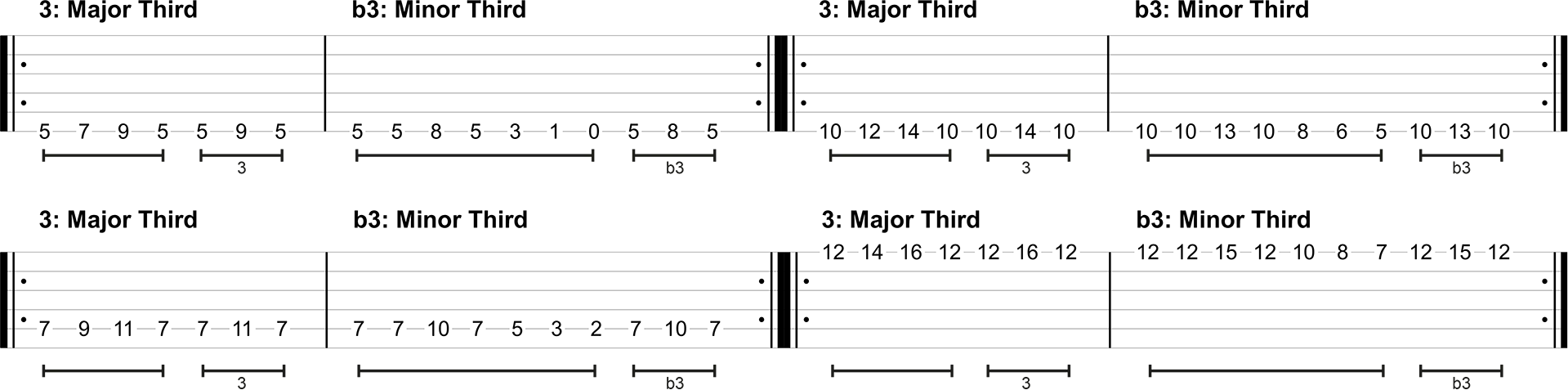
The TAB above illustrates both intervals using familiar melodic patterns in different positions on the guitar. Notice that the major third spans four frets, while the minor third spans three. Listen to the examples, then try singing them yourself.
Practice 1: Recognize Major and Minor Thirds
- Remember the major third. Sing the beginning of Frère Jacques. Isolate the first and third notes, skipping the middle note. Sing those two pitches directly.
- Remember the minor third. Sing the opening of Seven Nation Army. Focus on the first upward jump and sing those two pitches directly.
- Compare both intervals. Try singing a major third and a minor third from the same starting note. Listen carefully to the difference. The major third is one semitone wider than the minor third.
- Test your recognition. Listen to an unfamiliar major or minor third. Try identifying the interval before checking your answer. Sing the two notes and compare them with your song references if necessary.
Practice 2: Sing a Third and Check It on Your Guitar
Recognizing an interval is one thing. Being able to sing it yourself is just as important. This exercise trains your ability to imagine a musical interval and reproduce it accurately using your own voice.
- Choose a random starting note. Play a comfortable note on your guitar and remember its pitch. Put your guitar aside.
- Sing a major third (3). Sing your starting note, then sing a major third above it. Use Frère Jacques as your mental reference if necessary.
- Check your answer. Pick up your guitar and play the starting note again. Move 4 frets higher on the same string. Does that note match the pitch you just sang?
- Repeat with a minor third (♭3). Choose another starting note, put your guitar aside, and sing a minor third above it. Think of Seven Nation Army if you need a reference. Check your answer by moving 3 frets higher on the same string.
- Practice from different notes. Alternate between major and minor thirds. Gradually stop relying on the familiar melodies and try to hear each interval in your imagination before singing it.
Important: Use your guitar to establish the starting note and to check your singing afterward. Don't use it to find the correct interval before singing. The goal is to develop your ears and musical imagination, not just your fretboard memory.
Practice with Interval Hearo
Use our Interval Hearo ear training tool to practice recognizing intervals without relying on written music.
Select only Major Third (M3) and Minor Third (m3) and start with ascending intervals. Listen carefully to both notes before choosing your answer. Try singing the interval before checking the result.
Use different instrument sounds when available. This helps you recognize the interval itself, rather than relying on a particular guitar tone.
Practice regularly, even if it's only five focused minutes a day. Alternate between recognizing intervals in Interval Hearo and producing them yourself with the singing exercise.
Ear training tip: Familiar melodies are useful reference points when you're starting. Eventually, aim to recognize and sing major and minor thirds from any starting note without mentally playing an entire melody first.
Once you can hear and sing major and minor thirds, you're ready for the next step: recognizing the difference between major and minor chords.
