
Notes Per Second Calculator
Calculate playing speed from tempo and note value. Use it to compare BPM, notes per second and rhythmic subdivisions for guitar speed practice, picking exercises and metronome training.
How Do You Calculate Notes Per Second?
Use this formula: Notes Per Second = BPM × Notes Per Beat ÷ 60.
For example, 120 BPM in 16th notes means 4 notes per beat: 120 × 4 ÷ 60 = 8 notes per second.
To convert notes per second back to BPM, reverse the formula: BPM = Notes Per Second × 60 ÷ Notes Per Beat.
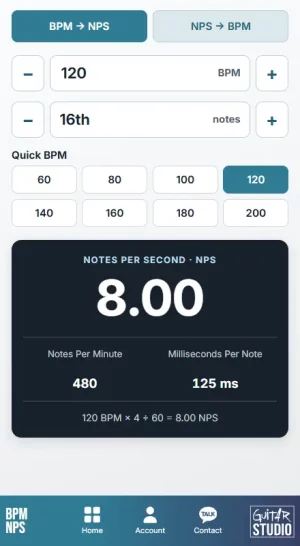
Convert BPM to NPS — or NPS Back to BPM
Enter your tempo or playing speed, choose the rhythmic subdivision, and the calculator does the conversion instantly.
Prefer the compact app version? Open the NPS Calculator in the GTS App.
Notes Per Second Chart
This table shows how many notes per second you play at common tempos using different rhythmic subdivisions.
| BPM | 8th Notes | 8th-Note Triplets | 16th Notes | 16th-Note Sextuplets | 32nd Notes |
|---|---|---|---|---|---|
| 60 | 2.00 | 3.00 | 4.00 | 6.00 | 8.00 |
| 80 | 2.67 | 4.00 | 5.33 | 8.00 | 10.67 |
| 100 | 3.33 | 5.00 | 6.67 | 10.00 | 13.33 |
| 120 | 4.00 | 6.00 | 8.00 | 12.00 | 16.00 |
| 140 | 4.67 | 7.00 | 9.33 | 14.00 | 18.67 |
| 160 | 5.33 | 8.00 | 10.67 | 16.00 | 21.33 |
| 180 | 6.00 | 9.00 | 12.00 | 18.00 | 24.00 |
| 200 | 6.67 | 10.00 | 13.33 | 20.00 | 26.67 |
Values are shown in notes per second (NPS). For example, 16th notes at 150 BPM equal 10 notes per second.
BPM vs Notes Per Second: What’s the Difference?
BPM tells you how fast the beat is moving. Notes per second (NPS) tells you how many individual notes you are actually playing each second.
The two values are related, but they are not the same thing. A guitarist playing at 120 BPM could be playing quarter notes, 8th notes, 16th notes or sextuplets, and each subdivision produces a different notes-per-second value.
Example: 120 BPM
At 120 BPM:
- Quarter notes = 2 notes per second
- 8th notes = 4 notes per second
- 8th-note triplets = 6 notes per second
- 16th notes = 8 notes per second
- 16th-note sextuplets = 12 notes per second
- 32nd notes = 16 notes per second
That is why saying you can play at “120 BPM” does not describe your actual playing speed unless the note value or subdivision is also specified.
Why Guitarists Use Notes Per Second
Notes per second can be useful when comparing technical speed across different tempos and subdivisions. For example:
- 16th notes at 150 BPM = 10 NPS
- 8th-note triplets at 200 BPM = 10 NPS
The rhythmic context is different, but the number of notes played each second is the same.
For practice, however, BPM and subdivision are usually more useful than NPS alone because they keep the notes connected to rhythm and timing rather than treating speed as an isolated number.
Use Smart Click to practise the tempo, or convert tempo values to milliseconds with the BPM to MS Calculator.
If you want to know how long a complete song, exercise or section will last at that tempo, use the Song Duration Calculator to convert BPM, bars and time signature into total playing time.
How Fast Is 10 Notes Per Second on Guitar?
Playing 10 notes per second means exactly that: ten separate notes are played within one second. What BPM that represents depends on the rhythmic subdivision.
For example, 10 NPS can equal:
- 150 BPM in 16th notes
- 100 BPM in 16th-note sextuplets
- 200 BPM in 8th-note triplets
The physical speed is the same in each example, but the rhythmic structure is different. That is why NPS is useful for comparing raw note speed, while BPM plus subdivision is better for actual practice.
How Fast Is 12 Notes Per Second?
Twelve notes per second equals:
- 180 BPM in 16th notes
- 120 BPM in 16th-note sextuplets
- 240 BPM in 8th-note triplets
How Fast Is 15 Notes Per Second?
Fifteen notes per second equals:
- 225 BPM in 16th notes
- 150 BPM in 16th-note sextuplets
- 300 BPM in 8th-note triplets
Is 10 Notes Per Second Fast on Guitar?
That depends on the technique, phrase and how cleanly the notes are played. A controlled 10 NPS passage with accurate timing, articulation and synchronization is more useful than a faster passage that is uneven or tense.
For technical practice, use NPS as a reference rather than a target by itself. The goal is to increase speed while keeping the movement relaxed, the timing stable and every note clear.
Use Smart Click to practise the exact BPM and subdivision you want to improve.
Notes Per Second Calculator FAQ
How do you calculate notes per second from BPM?
Use the formula: Notes Per Second = BPM × Notes Per Beat ÷ 60. For example, 120 BPM in 16th notes equals 120 × 4 ÷ 60 = 8 notes per second.
How do you convert notes per second back to BPM?
Use the reverse formula: BPM = Notes Per Second × 60 ÷ Notes Per Beat. For example, 10 NPS in 16th notes equals 10 × 60 ÷ 4 = 150 BPM.
How many notes per second are 16th notes at 120 BPM?
16th notes contain four notes per beat. At 120 BPM, that equals 8 notes per second.
How many notes per second are 16th notes at 150 BPM?
16th notes at 150 BPM equal 10 notes per second.
How many notes per second are 16th notes at 180 BPM?
16th notes at 180 BPM equal 12 notes per second.
How many notes per second are sextuplets at 120 BPM?
16th-note sextuplets contain six notes per beat. At 120 BPM, that equals 12 notes per second.
Is BPM the same as notes per second?
No. BPM measures the speed of the beat, while notes per second measures how many notes are played each second. You need both BPM and the rhythmic subdivision to determine the actual note rate.
Is notes per second useful for guitar practice?
Yes, especially for comparing technical speed across different tempos and subdivisions. For actual practice, however, BPM plus rhythmic subdivision is usually more useful because it keeps speed connected to timing and rhythm.
What is a good notes-per-second speed on guitar?
There is no single target that applies to every guitarist. A useful speed is one you can play with clean articulation, accurate timing, relaxed movement and good synchronization.
Can I use this calculator for instruments other than guitar?
Yes. The calculation is purely rhythmic, so it works for any instrument where you want to convert between BPM, subdivision and notes per second.
Use Notes Per Second as a Practice Reference
Notes per second is a useful way to compare playing speed, but speed only matters when the notes remain clean, controlled and rhythmically accurate.
Use the calculator to translate between BPM and NPS, then practise the actual rhythmic subdivision with a metronome. Increase the tempo gradually while keeping both hands relaxed and synchronized.
Continue your practice with Smart Click or explore more Guitar Training Tools.

Guitar Training Studio
Ready to Make Real Progress on Guitar?
Build better technique, timing and musicianship with structured guitar training, practical tools and personal coaching.