
Scale Hearo: Scale & Mode Ear Trainer
Train your ear to recognize scales and modes by sound. Practice ascending, descending or complete scale patterns using piano or guitar sounds.
Open Scale Hearo →What Is Scale Ear Training?
Scale ear training teaches you to recognize the sound and character of different scales and modes. You listen to a scale, identify its tonal quality and learn to hear how its interval pattern creates a specific musical color.
Practice tip: start with clearly different sounds, such as major and natural minor, before adding modes with more subtle differences.
How to Use Scale Hearo
Choose the scales or modes you want to train, listen carefully and identify the sound you hear. Start with strong contrasts and add more similar scales as your recognition becomes more reliable.
Choose the Scales or Modes
Select only the scale types you want to practice. Begin with two or three contrasting sounds before adding more subtle modal differences.
Select the Playback Direction
Practice scales ascending, descending or in both directions so you learn to recognize the scale sound from different perspectives.
Choose a Fixed or Random Starting Note
Use a fixed starting note when learning a new scale sound, or switch to random starting notes to recognize the scale independently of pitch.
Choose DoReMi or ABC
Select the note display that matches the way you prefer to read and think about pitch: solfege or letter names.
Choose Piano or Guitar
Switch between instrument sounds so your recognition is based on the scale itself rather than one specific timbre.
Listen and Identify
Hear the complete scale carefully, focus on its tonal character and choose the scale or mode you think you heard.
Compare and Repeat
Replay scales you confuse and compare them directly. Add more scale types once the differences become easier to hear.
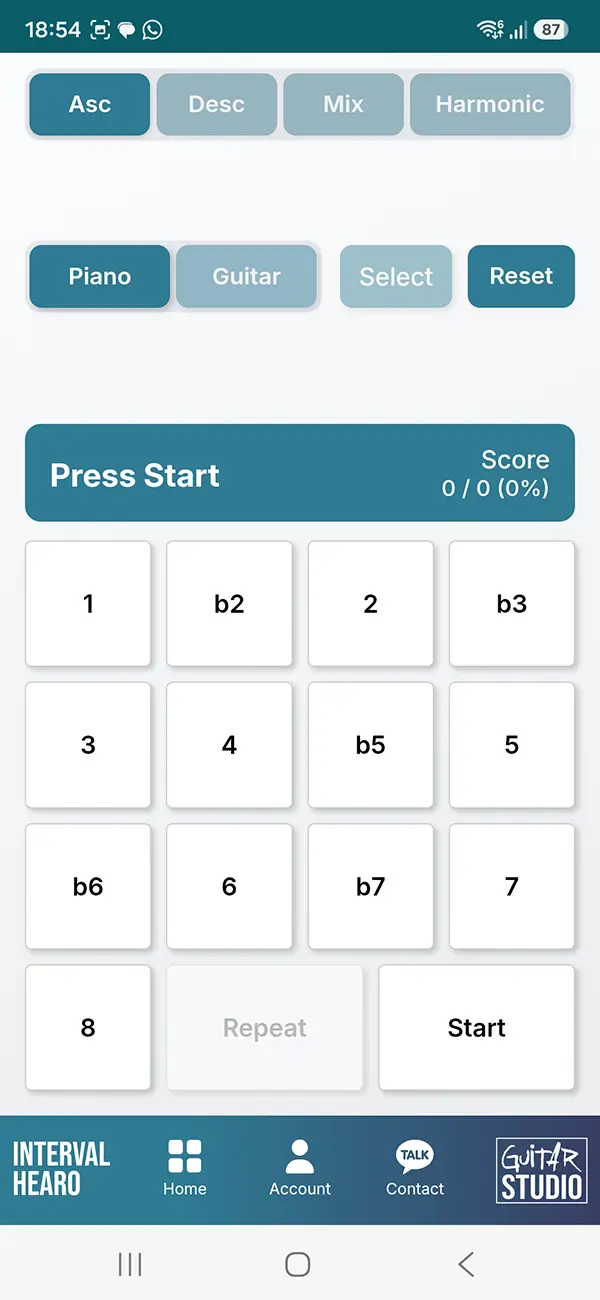
What Scale Hearo Trains
Scale Hearo trains you to recognize the sound and character of scales and modes instead of identifying them only from theory, notation or fretboard patterns.
You can use it to practice:
- Ionian / Major, Dorian, Phrygian, Lydian, Mixolydian, Aeolian and Locrian
- major and minor pentatonic scales
- harmonic minor and melodic minor
- whole tone and diminished scales
- ascending, descending and combined scale playback
- random or fixed starting notes
- DoReMi or ABC note display
- piano and guitar sounds
The goal is to make different scale sounds increasingly familiar, so you begin to hear their musical character without first calculating the notes or intervals.
Why Scale Ear Training Matters
Scale ear training helps you hear the difference between tonal colors instead of recognizing scales only from note names or fretboard patterns.
This is useful for improvisation, songwriting, transcription, arranging and learning music by ear. When scale sounds become familiar, it is easier to hear which tonal language a melody or solo is using.
Want to apply that listening skill to melodic movement? Train it with MeloArc.
For guitarists, scale ear training helps connect fretboard patterns with sound. Instead of seeing a scale as a shape under your fingers, you begin to hear its character and musical function.
To connect those sounds with their positions on the guitar neck, use FRETTR to visualize scales, modes, roots and scale degrees across the fretboard.
Training scales and modes by ear also improves interval awareness, melodic memory and your ability to recognize subtle differences between closely related tonal sounds.
Want to isolate those interval relationships more directly? Train them with Interval Hearo.
How to Recognize Scales and Modes by Ear
Start with major and minor. These give you two clearly different tonal colors and create a strong reference point before you begin comparing modes.
Listen for the overall character. Do not try to calculate every note while listening. First notice whether the scale sounds bright, dark, tense, open or unresolved.
Compare similar scales directly. Modes often differ by only one or two scale degrees. Hearing them side by side makes those characteristic notes easier to recognize. For a visual and theoretical overview of how those modes are built, see Diatonic Scales & Modes for Guitar.
Practice both directions. A scale can feel different when heard ascending or descending, so train both rather than relying on one familiar pattern.
Connect the sound with real music. Once a scale or mode becomes recognizable in the trainer, listen for the same tonal color in riffs, melodies, solos and chord progressions.
Common Scale Ear Training Mistakes
Training too many scales and modes at once. If everything starts to sound similar, reduce the exercise to a smaller group and build recognition gradually.
Only memorizing scale formulas. Knowing the interval structure is useful, but ear training only improves when you also learn to recognize the actual sound of that structure.
Ignoring the characteristic notes. Many modes differ by only one scale degree. Listen for the notes that give each scale or mode its distinctive color.
Practicing only ascending scales. Include descending and both-direction playback so recognition does not depend on one familiar sequence.
Not applying the sound to real music. Use the scale sounds you train to identify tonal colors in riffs, melodies, solos and chord progressions.
Scale Ear Training FAQ
What is scale ear training?
Scale ear training teaches you to recognize the sound and character of different scales and modes by ear.
How do I get better at recognizing scales by ear?
Start with a small number of clearly different scales, compare them directly and add more similar scales and modes as recognition improves.
Should I learn major and minor scales first?
Yes. Major and minor provide two strong tonal reference points and make it easier to hear more subtle differences between modes later.
What is the difference between a scale and a mode?
A scale is an ordered collection of notes. A mode is a specific tonal organization of those notes that creates its own characteristic sound.
Can guitarists use scale ear training?
Yes. Scale ear training helps guitarists connect fretboard patterns with the musical sound and character of each scale or mode.
Should I practice scales ascending and descending?
Yes. Practicing both directions helps prevent recognition from depending on only one familiar melodic sequence.
Explore More Guitar Training Tools
Train timing, rhythm, ear, fretboard knowledge, tuning, pitch and music theory with the interactive tools from Guitar Training Studio.
Explore All Tools →
Guitar Training Studio
Ready to Make Real Progress on Guitar?
Build better technique, timing and musicianship with structured guitar training, practical tools and personal coaching.