
How to Play Zombie by Yungblud on Guitar
Learn how to play Zombie by Yungblud on guitar with a capo on the 4th fret. Discover the chord shapes, strumming patterns and complete song structure, including the verse, pre-chorus and chorus. Follow this step-by-step guitar lesson and learn how to play the song from beginning to end.

What Guitar Chords Do You Need for Zombie by Yungblud?
To play Zombie by Yungblud on guitar, place a capo on the 4th fret. You'll use five chord shapes: Am, G, F, Dm and C. The song is in C# minor, with a 4/4 time signature and a tempo of approximately 80 BPM. The intro follows Am – G – F – Am, while the main chorus progression is C – G – Am – F.
1. Capo on the 4th Fret
Place the capo just behind the 4th fret. This raises the pitch of your familiar chord shapes by four semitones without changing their fingerings. Always check your tuning after placing the capo. The strings should now sound as G#–C#–F#–B–D#–G#. Make small tuning adjustments if necessary.
2. Guitar Chord Shapes
Play the chord shapes Am – G – F – Dm – C. The intro and verses mainly use Am, G and F, with Dm appearing towards the pre-chorus. The chorus follows C – G – Am – F. Practice these changes slowly, especially when switching to the F chord.
3. Actual Sounding Chords
With the capo on the 4th fret, the chord shapes Am – G – F – Dm – C actually sound as C#m – B – A – F#m – E. Without a capo, for example on piano or guitar, you can play these concert-pitch chords to produce the same harmony.
Remember: A capo changes the sounding pitch, not the chord shape you're using. The complete chord chart below will help you follow the intro, verses, pre-chorus, chorus and outro. For more advice on using a capo and keeping your guitar in tune, read our guide on tuning your guitar with a capo.
Song Info – Zombie by Yungblud
Key: C# minor
Time Signature: 4/4
Tempo: 80 BPM
Guitar: Acoustic or electric
Tuning: E–A–D–G–B–E (standard)
Capo: 4th fret
Capo Tuning: G#–C#–F#–B–D#–G#
Tone/Effects: Clean or slightly overdriven
Note: This lesson uses a simplified arrangement with a capo on the 4th fret. The original guitar parts are played without a capo, allowing for lower barre chord positions and different voicings.
Important: Check and adjust your tuning after placing the capo. The pressure may cause the strings to go slightly out of tune.
Zombie by Yungblud – Guitar Chords
To play Zombie by Yungblud, you'll need five chord shapes in this simplified arrangement: Am, G, F, Dm and C. Place your capo on the 4th fret and use the chord diagrams below as a reference while practising.
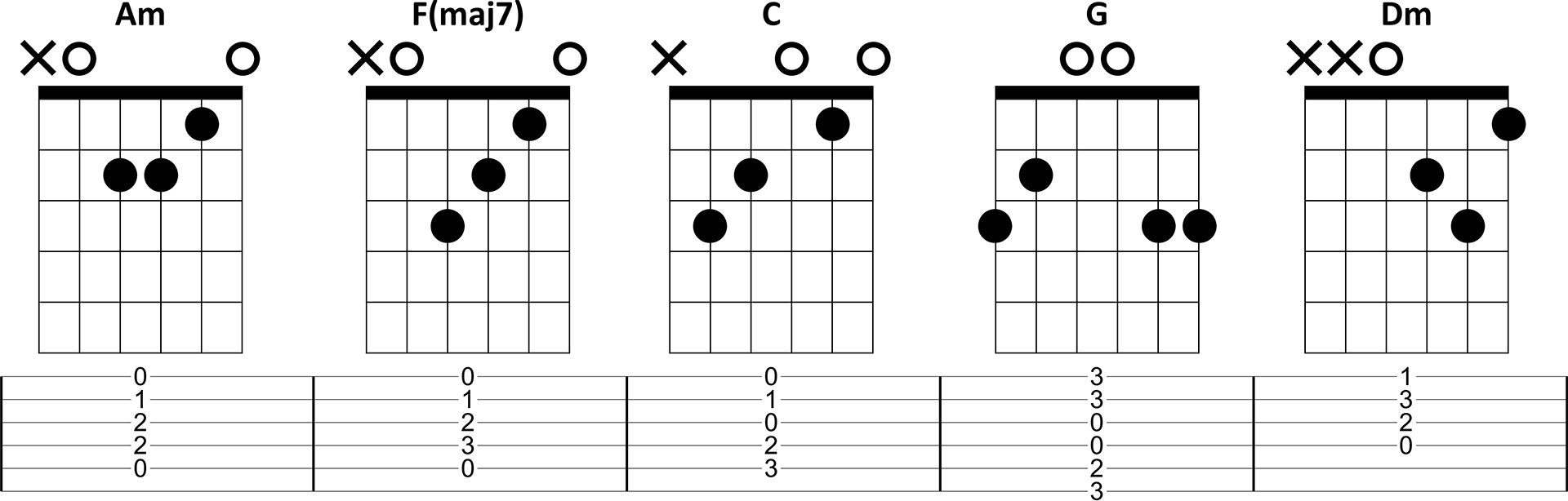
Zombie – Complete Guitar Chord Chart
Play Zombie by Yungblud with a capo on the 4th fret, or switch to the actual sounding chords for piano or guitar without a capo. The beginner-friendly Capo 4 arrangement simplifies several suspended chord variations, including Amsus2, Gsus4, Fsus2 and Csus2, to familiar Am, G, F and C shapes. The No Capo version shows the more detailed chord variations at concert pitch. Note: I always use "s" to make suspended chord notation more compact. So Fs2 means Fsus2, and Gs4 means Gsus4.
Time Signature: 4/4
Tempo: 80 BPM
Yungblud – Zombie Guitar TAB (Advanced Arrangement)
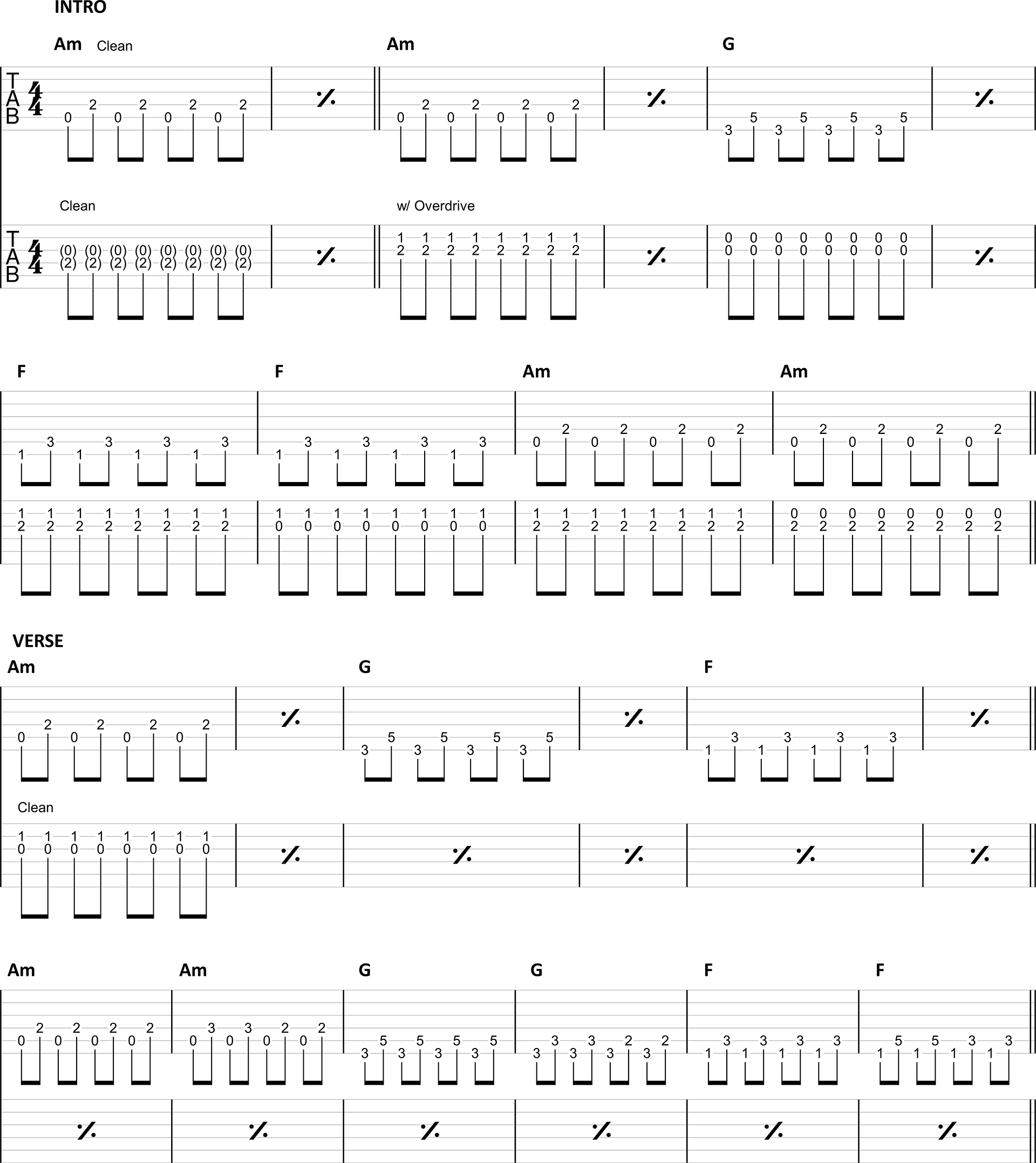
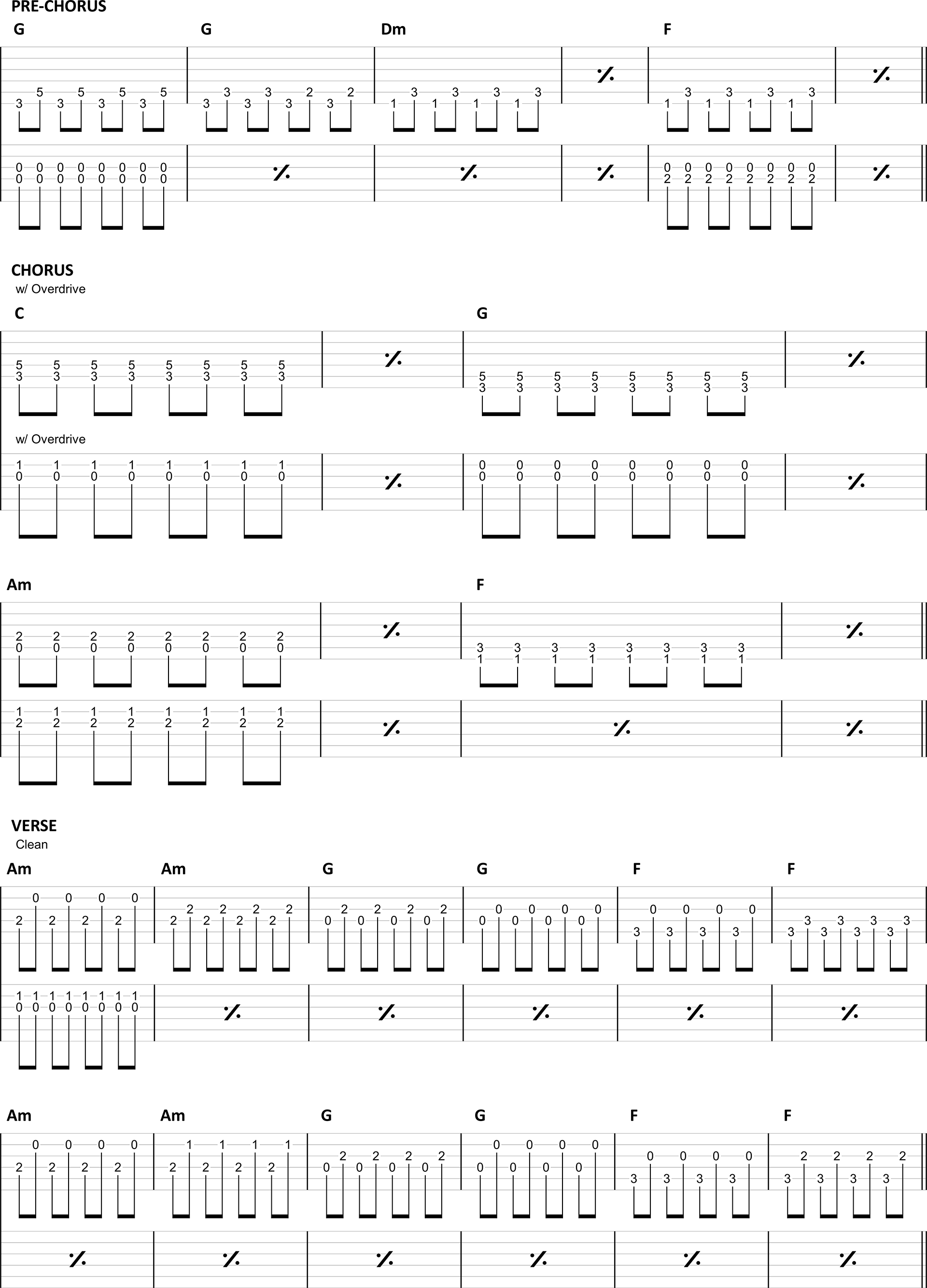
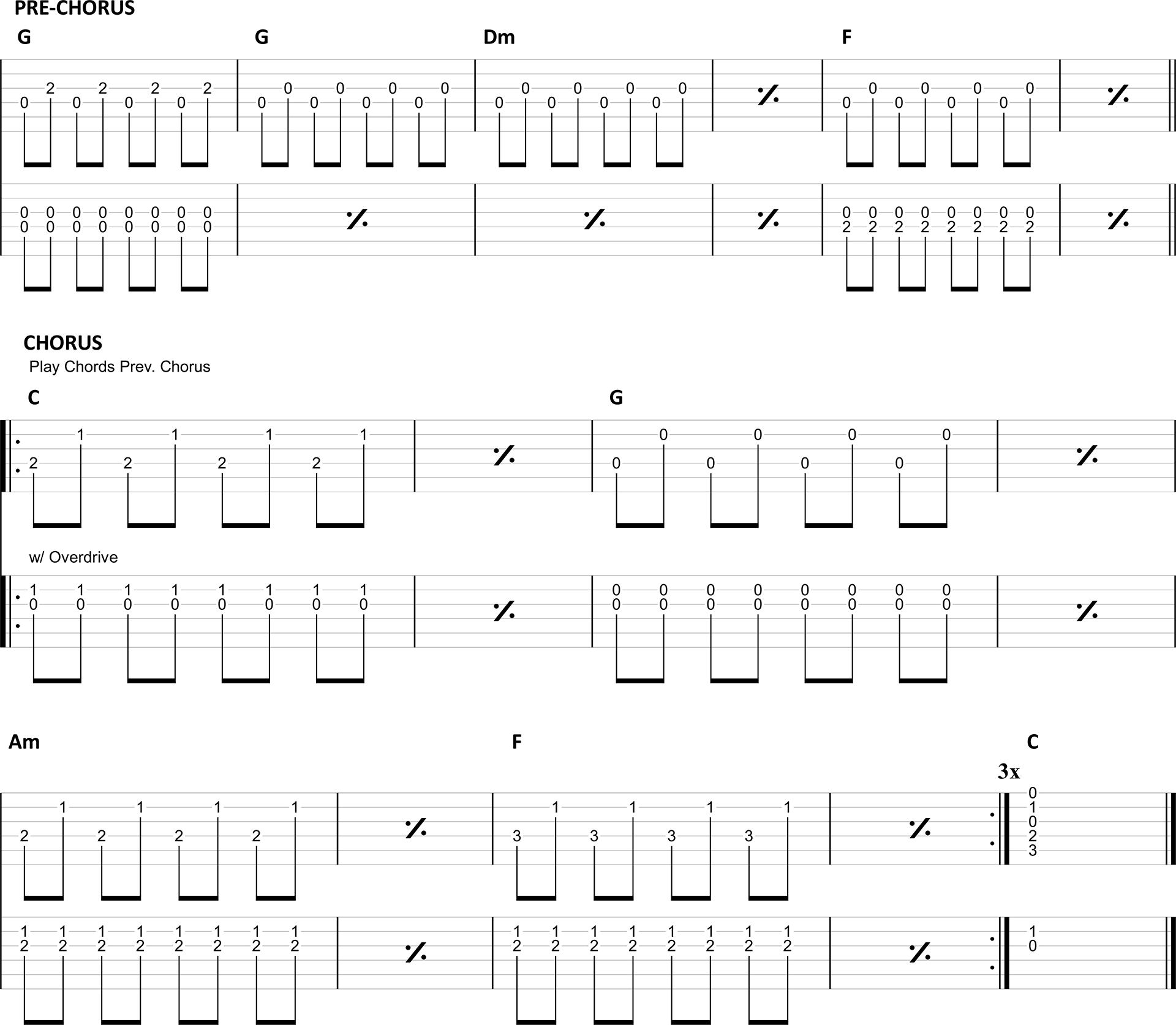
This advanced guitar TAB for Zombie by Yungblud goes beyond our simplified chord chart. The arrangement combines three guitar parts: the chord accompaniment and two separate guitar parts written in tablature. Together, they create a fuller sound with alternating notes, different chord voicings and layered guitar textures.
The arrangement uses standard tuning with a capo on the 4th fret. The fret numbers in the TAB are relative to the capo. The three pages below form one continuous arrangement, from the intro through to the final chord.
Understanding the Guitar Parts and TAB Notation
The chord symbols above the notation identify the underlying harmony. The two TAB staves represent separate guitar parts, with their own notes, voicings and rhythms. Read them independently: they are intended to complement each other rather than duplicate the same part.
The TAB also includes clean and overdrive indications to show changes in guitar tone. A % symbol means repeat the previous measure of that particular guitar part. Section repetitions are indicated separately, including the final chorus played three times.
This is a layered arrangement, not a requirement to play everything simultaneously on one guitar. You can perform the chord accompaniment independently or combine the additional parts by playing with other guitarists or recording separate tracks. The playing guide below explains how to practise the song step by step.
How to Play Zombie by Yungblud on Guitar
Zombie by Yungblud is a great song for practising chord changes, steady rhythm and musical dynamics. Our simplified arrangement uses five familiar chord shapes with a capo on the 4th fret. The challenge is not just learning the chords, but following the song structure, maintaining a consistent tempo and creating the right contrast between the quieter verses and powerful choruses.
Listen and Follow the Chord Chart
Start by listening to the original recording while following the complete chord chart without playing your guitar. Count four beats per measure and try to recognize the transitions between the intro, verse, pre-chorus and chorus.
Pay particular attention to the repetitions. Each verse progression is played twice, while the final chorus is played three times before the song ends on a single C chord shape. Your first goal is to follow the entire arrangement without losing your place.
Practise the Five Chord Shapes
Place your capo on the 4th fret and practise the chord shapes Am, G, F, Dm and C. Start with the verse progression Am – G – F, followed by the pre-chorus G – Dm – F and the chorus C – G – Am – F.
Pay particular attention to the F barre chord and the transitions to and from it. Practise these changes separately until you can move between the chord shapes without stopping. Make sure every chord sounds clean before increasing your speed.
Having trouble changing chords smoothly? Read our lesson on How to Change Guitar Chords Faster.
Play Along With One Strum per Measure
Before adding a strumming pattern, play the recording using only one downstroke at the beginning of each measure. Let the chord ring until the next bar. This allows you to concentrate on accurate chord changes and following the song structure.
In the verse and pre-chorus, each chord lasts for two measures. The same applies to the main chorus progression. Even when the chord remains the same, continue counting the measures correctly so you know exactly when to change.
If the changes feel too fast, reduce the playback speed. Try to play along with the entire song, including the repeated sections and final ending chord, without stopping.
Add a Strumming Pattern
Once you can follow the chord changes comfortably, introduce a strumming pattern. Start by practising the rhythm on open strings without changing chords. Memorise the pattern before combining it with the complete progression.
In 4/4 time, divide each measure into eight eighth-note positions, counted as 1 & 2 & 3 & 4 &. Here are two different ways to accompany the song.
Version 1 – Down-Up Strumming
Use a steady down-up movement with your strumming hand. Keep your hand moving even when you skip a stroke. This creates a flowing rhythm with a little more space between the strums.
↓ = downstroke, ↑ = upstroke, – = no strum while your hand keeps moving.
Count:   1  +  2  +  3  +  4  +
Strums:  ↓  –  ↓  ↑  ↓  ↑  ↓  –
Version 2 – Mechanical Downstroke Strumming
For a more mechanical and driving rock rhythm, play eight consecutive downstrokes per measure. Every eighth note receives a downstroke, with no upstroke strums. Lift your picking hand between strokes and keep the movement relaxed and consistent. This creates a tighter, more insistent rhythmic feel.
Count:   1  +  2  +  3  +  4  +
Strums:  ↓  ↓  ↓  ↓  ↓  ↓  ↓  ↓
These are suggested accompaniment patterns for our simplified arrangement, not exact transcriptions of the original recording.
Practise both versions separately and listen to how they change the character of the song. Version 1 gives you a more open, flowing accompaniment, while Version 2 creates a stronger, mechanical rock feel. Once you can play a pattern smoothly from memory, introduce the chord changes.
For more guidance, see our lesson on Guitar Picking and Strumming Technique.
Build the Dynamics Between Verse and Chorus
One of the most important musical elements in Zombie is the contrast between the different song sections. Play the verses more softly, using a lighter touch and allowing the chords to breathe. Gradually increase the intensity during the pre-chorus and play the choruses with more energy.
If you're playing electric guitar, you can experiment with a clean tone during quieter passages and a controlled overdrive sound for the more powerful sections, as indicated in the advanced TAB. On acoustic guitar, create the same contrast by changing your strumming intensity.
Important: Playing louder doesn't mean playing faster. Keep the tempo steady while changing the dynamics and overall energy of your performance.
Practise from 50 BPM and Build Up to 80 BPM
The final step is to play Zombie without the original recording. Follow the complete chord chart from the intro to the ending, using accurate chord changes, a steady strumming pattern and the musical dynamics you've practised.
Start at 50 BPM in 4/4 time using Smart Click or a simple drum groove in GROOVR. Practise the chord changes and your chosen strumming pattern at this slower speed until you can play them comfortably and without mistakes.
Then increase the tempo in 5 BPM steps: 50 → 55 → 60 → 65 → 70 → 75 → 80 BPM. Only move to the next tempo when you can play the progression accurately, with relaxed movements and consistent timing. If mistakes start appearing, return to the previous tempo and practise a little longer.
At 80 BPM, practise the complete song with Smart Click or GROOVR. Follow the correct repetitions, maintain the contrast between the different sections and finish on the final C chord shape. Your goal is to play the entire arrangement without stopping, with clean chord changes and a steady rhythmic feel.
7 Common Mistakes When Playing Zombie by Yungblud on Guitar
Even with simplified chord shapes, Zombie by Yungblud requires accurate timing, smooth chord changes and control over your strumming technique. Avoid these seven common mistakes when learning our capo-based arrangement.
Playing Too Fast Before Mastering the Chord Changes
Trying to play immediately at 80 BPM often results in rushed chord changes, unnecessary tension and inconsistent timing. Solution: start at 50 BPM with Smart Click or GROOVR and increase the tempo in 5 BPM steps. Only move to the next speed when you can play the progression cleanly and without stopping.
Confusing Down-Up Strumming with Mechanical Downstrokes
Our lesson includes two different strumming approaches. In the first, your hand moves continuously down and up, even during skipped strokes. In the second, you play eight consecutive downstrokes to create a mechanical rock rhythm. Solution: practise each pattern separately. Don't accidentally introduce upstrokes into the mechanical version, and keep the rhythm steady regardless of which pattern you choose.
Struggling with the F Barre Chord
The F major barre chord can be challenging for beginners because it requires strength, finger control and proper technique. Solution: use an open F chord instead of the full barre chord, as we do in this simplified arrangement. This makes the song more accessible without changing the basic harmony.
Losing Track of Repeated Song Sections
You may know all five chords but still lose your place in the arrangement. Both verse sections are played twice, while the final chorus is repeated three times before the single ending chord. Solution: follow the complete chord chart while listening to the recording. Count the measures and repetitions carefully instead of relying entirely on memory.
Confusing the Simplified Arrangement with the Original Guitar Parts
Our version uses a capo on the 4th fret and simplifies several suspended chords to familiar Am, G, F and C shapes. However, the original arrangement contains additional voicings and guitar parts that may sound different from a simple chord accompaniment. Solution: learn the simplified version first. Once you can play the entire song comfortably, explore the suspended chords and additional guitar parts in the advanced TAB.
Playing Every Section with the Same Intensity
Playing the verse, pre-chorus and chorus with identical strumming intensity makes the arrangement sound flat. Solution: play the verses more softly, build tension during the pre-chorus and give the choruses greater energy. On electric guitar, experiment with clean and overdriven sounds. On acoustic guitar, create the contrast through your picking and strumming dynamics.
Practising Only Individual Sections
You might play the verse and chorus perfectly in isolation but struggle when connecting them into the complete arrangement. This is especially common when the song contains several repetitions and changes in intensity. Solution: combine focused exercises with regular full-song practice. Use a metronome or drum groove and play from the intro through to the final C chord without stopping. Focus on continuity, accurate timing and following the complete song structure.
Frequently Asked Questions About Playing Zombie by Yungblud on Guitar
What Guitar Chords Do You Need for Zombie by Yungblud?
Our simplified arrangement uses the five chord shapes Am, G, F, Dm and C, with a capo on the 4th fret. The verse follows Am – G – F, the pre-chorus uses G – Dm – F, and the chorus follows C – G – Am – F. We use an open F chord instead of a full F barre chord to make the accompaniment more accessible.
Can You Play Zombie by Yungblud Without a Capo?
Yes. Without a capo, the corresponding sounding chords are C#m, B, A, F#m and E. These preserve the harmony of our arrangement but require different fingerings, including barre chords. The original guitar approach also uses lower chord positions and different voicings that cannot all be reproduced with a capo on the 4th fret. Use the Capo 4 / No Capo switch in our chord chart to see both versions.
Is This the Exact Original Guitar Arrangement?
No. This lesson provides a beginner-friendly interpretation. The song uses suspended chord variations such as Amsus2, Gsus4, Fsus2 and Csus2. We've simplified most of these to familiar Am, G, F and C chord shapes. This preserves the basic harmony while making the song easier to accompany. For a more detailed version, see our advanced three-part guitar TAB, which includes the chord accompaniment and two additional guitar parts.
What Are the Key, Time Signature and BPM of Zombie?
Zombie by Yungblud is in C# minor and uses a 4/4 time signature. For this lesson, we use a tempo of approximately 80 BPM. With the capo on the 4th fret, an Am chord shape sounds as C#m, G sounds as B, F sounds as A, Dm sounds as F#m and C sounds as E.
What Strumming Pattern Should You Use for Zombie?
We suggest two accompaniment patterns. The first uses a combination of downstrokes, upstrokes and skipped strokes: ↓ – ↓ ↑ ↓ ↑ ↓ –. The second uses eight consecutive downstrokes for a more mechanical rock feel. Both patterns are based on eighth notes in 4/4 time. They are practical suggestions for our simplified arrangement, not exact transcriptions of the recording.
Is Zombie by Yungblud Suitable for Beginner Guitarists?
Yes. Our simplified version is suitable for beginners who already know a few basic open chords. Using a capo and an open F chord avoids the more demanding barre chord fingerings. Start practising at 50 BPM with Smart Click or GROOVR and increase the tempo in 5 BPM steps until you reach 80 BPM. Once you can play the full song comfortably, you can explore the more advanced guitar TAB with its additional picking patterns and layered guitar parts.

Guitar Training Studio
Ready to Make Real Progress on Guitar?
Build better technique, timing and musicianship with structured guitar training, practical tools and personal coaching.
www.guitarstudio.be (Belgium)
www.guitartrainingstudio.com (International)
c/o Wouter Baustein
Driehoekstraat 1, BE-3891 Gingelom
+32.(0)476.666.300
info@guitarstudio.be
CoC: 0872.862.121
VAT: BE0872862121
IBAN: BE33-7350-0967-6746
BIC: KREDBEBBXXX
© 2000 – 2026 All Rights Reserved
Web apps & development by Baustein.digital