fb-pixel Skip to main content

Guitar Training Studio

Free Guitar Lesson · Scales

Learn the Pentatonic Scale on Guitar: A Minor for Beginners

Learn the five notes of the A minor pentatonic scale and discover how to play them on your guitar.

With clear fretboard diagrams, proper fingerings, guitar TAB, and practical exercises, you'll learn how to play the pentatonic scale step by step. Start at the fifth fret, develop your technique, and build your confidence with our free video workouts.

Explore the Exercises →
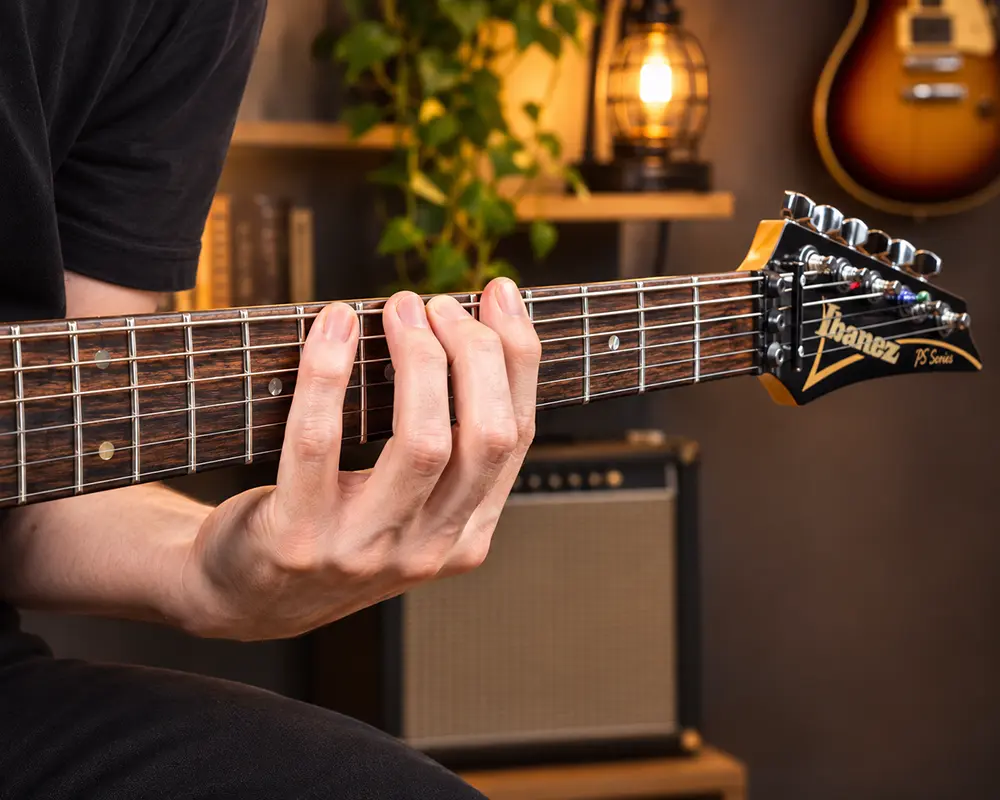
Guitarist demonstrating finger placement for the A minor pentatonic scale on an Ibanez electric guitar fretboard
The A minor pentatonic scale: five notes and one essential fretboard pattern to get started.
Quick Answer

What Is the Pentatonic Scale and How Do You Learn It on Guitar?

A pentatonic scale consists of five different notes per octave. The minor pentatonic scale is widely used for melodies, riffs, and guitar solos in rock, blues, and pop music. In this lesson, you'll learn the A minor pentatonic scale (Mode VIm).

1. Understand the Five Notes

We start with the diatonic C major scale (do, re, mi). Begin on its sixth note (A) and leave out B and F. This gives us A, C, D, E, and G.

2. Learn the Correct Fingering

Start on the fifth fret of the low E string. Learn the pattern across all six strings and focus on playing every note cleanly and accurately.

3. Practice with a Metronome

Play the scale ascending and descending. Start at 50 BPM and increase the tempo by 5 BPM each time you can play it without mistakes.

Remember: The A minor pentatonic scale contains five notes: A, C, D, E, and G. This movable fretboard pattern provides the foundation for your first guitar riffs and solos.

From Do, Re, Mi and A, B, C to the Pentatonic Scale

The pentatonic scale can be derived from the familiar diatonic scale: do, re, mi, fa, sol, la, si, do, or C, D, E, F, G, A, B, C. This is the C major scale, which contains seven different notes. Penta means five. A pentatonic scale uses just five of these seven notes. Let's see how it works in three simple steps.

Step 1 – The Diatonic Scale: We start with the seven familiar notes: do, re, mi, fa, sol, la, and si. The table below shows this sequence twice, using both Italian solfège syllables and English note names.

Step 2 – Mode VIm: We begin on the sixth note of the C major scale: la (A). Modes can be identified by their scale degrees using Roman numerals. In this notation, VI means 6 and m stands for minor. We call this Mode VIm, corresponding to A natural minor (the Aeolian mode). Play from A up to the next A. The gold-colored cells in the table highlight these seven notes.

Step 3 – Mode VIm Pentatonic: Remove the second and sixth notes from this A minor sequence: si (B) and fa (F). The five remaining notes form the A minor pentatonic scale.

White Piano Keys12345678/12345678/1
Notes (Italian Solfège)doremifasollasidoremifasollasido
Notes (English)CDEFGABCDEFGABC
Mode VImABCDEFGA
Mode VIm PentatonicACDEGA

Swipe horizontally to view the full table.

Why Do Guitarists Use the Pentatonic Scale?

By removing B and F from the A natural minor scale, we eliminate its two half-step intervals. This leaves a five-note scale that's easy to use for creating melodies, riffs, and guitar solos.

The pentatonic scale appears in a wide variety of musical styles, from classical music to metal, as well as pop, rock, blues, funk, and soul. You can hear pentatonic melodies and riffs in music by artists such as ZZ Top, Red Hot Chili Peppers, and Rage Against the Machine.

Remember: Start on the sixth note (A) of the C major scale and continue up to the next A. Then remove si (B) and fa (F). You're left with A, C, D, E, and G: the A minor pentatonic scale (Mode VIm pentatonic).

How to Play the A Minor Pentatonic Scale on Guitar

Now that you understand how the pentatonic scale is constructed, let's learn to play its five notes: A, C, D, E, and G. We'll start with the correct fingering at the fifth fret.

1. Learn the Correct Fingering

Use the appropriate finger for each fret. This allows you to play the scale without constantly shifting your fretting hand.
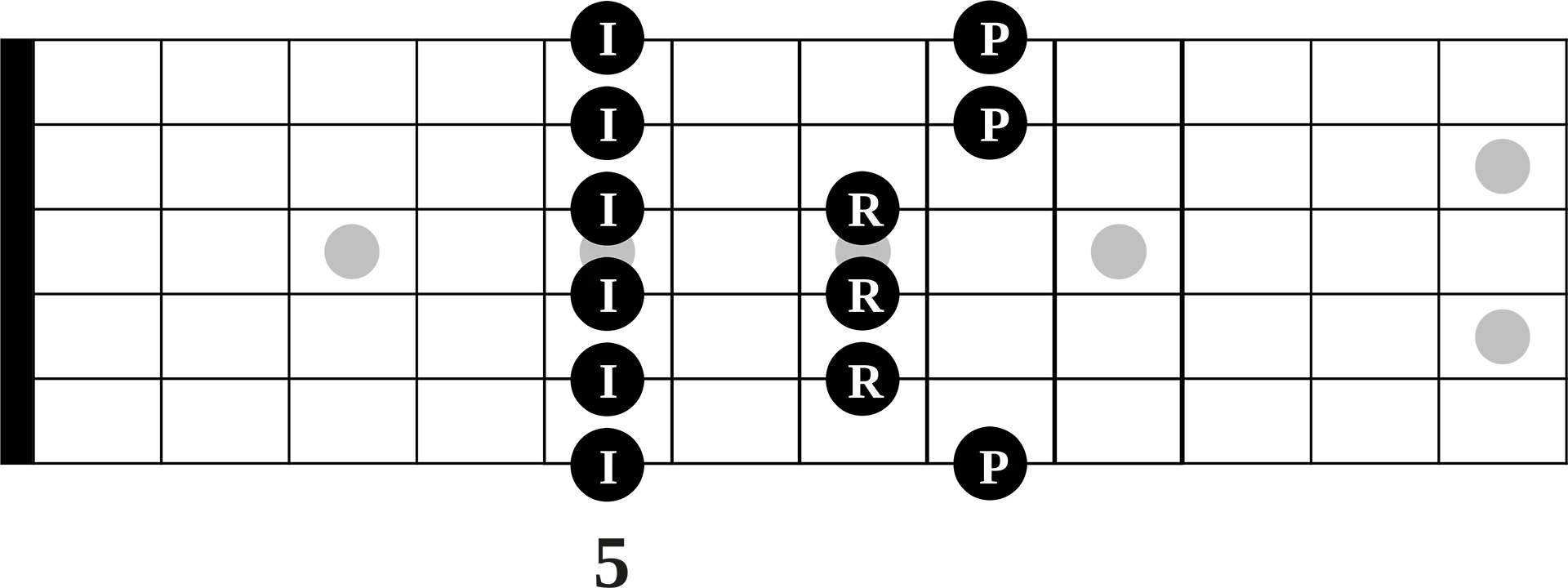
A minor pentatonic scale fingering with the index finger on fret 5, ring finger on fret 7, and pinky on fret 8
Correct fingering for the A minor pentatonic scale pattern starting at the fifth fret.

I = Index: index finger on fret 5. R = Ring: ring finger on fret 7. P = Pinky: pinky finger on fret 8.

Keep your thumb behind the guitar neck and focus on playing every note clearly. Your index finger covers fret 5, your ring finger covers fret 7, and your pinky covers fret 8.

2. Find the Pentatonic Scale Pattern on the Fretboard

The fretboard diagram below shows where the notes of the A minor pentatonic scale are located. The pattern starts on the fifth fret of the low E string, where you'll find the note A.
A minor pentatonic scale fretboard diagram showing the pattern at the fifth and seventeenth frets
A minor pentatonic scale: the same fretboard pattern at frets 5 and 17.

Swipe horizontally to view the full diagram.

You'll see the same pattern in two positions: fret 5 and fret 17. These positions are one octave apart. We'll begin by practicing at the fifth fret.

3. Play the Pentatonic Scale Using Guitar TAB

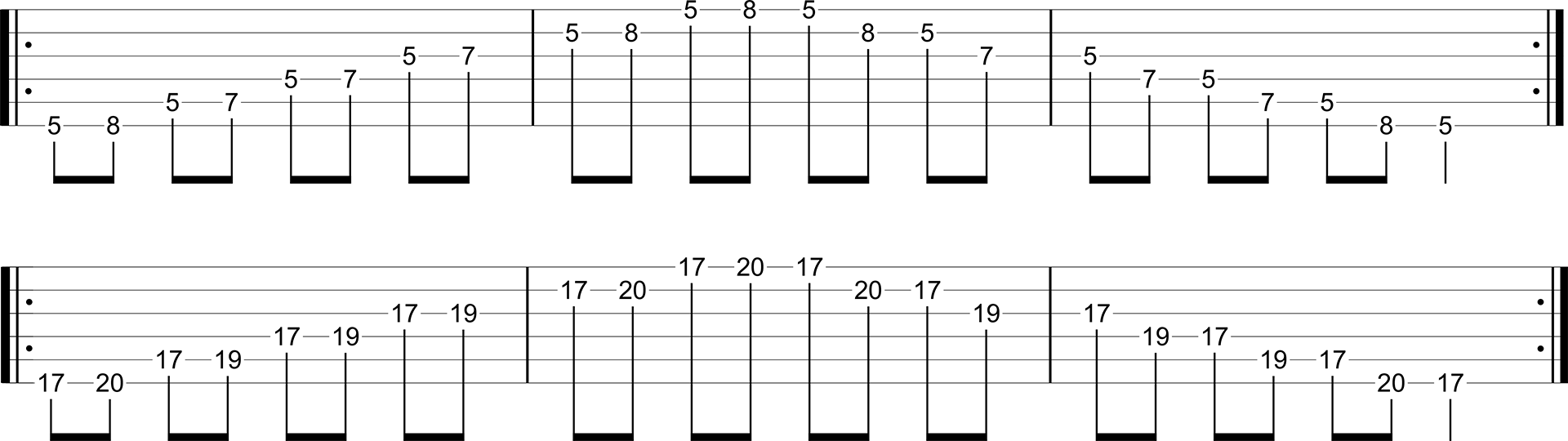
The following guitar tablature (TAB) shows you how to play the complete scale. The numbers indicate which fret to play on each string.

Guitar TAB for the A minor pentatonic scale ascending and descending at frets 5 and 17
A minor pentatonic scale: guitar TAB for ascending and descending exercises starting at frets 5 and 17.

Swipe horizontally to view the complete TAB.

4. Practice the Scale Step by Step

  1. Start on the low E string. Play fret 5 with your index finger and fret 8 with your pinky.
  2. Move to the A, D, and G strings. Play fret 5 with your index finger and fret 7 with your ring finger on each string.
  3. Play the B and high E strings. Use your index finger for fret 5 and your pinky for fret 8.
  4. Play the scale descending. Start on the highest note and work your way back down, following the same pattern shown in the TAB.
  5. Practice with a metronome. Start at 50 BPM and increase the tempo by 5 BPM each time you can play the complete exercise without mistakes.

Important: Speed isn't the goal. Focus first on correct fingering, clean notes, and consistent timing. Only increase the tempo once you can play the scale smoothly and with full control.

From the Pentatonic Scale to Your First Guitar Riffs and Solos

Now that you can play the A minor pentatonic scale, it's time to make music with it. Using just five notes, A, C, D, E, and G, you can create countless melodies, riffs, and guitar solos. The following two examples from my book Modes Mastery – Essential Edition show you how to use these five notes in a musical context.

1. Play Your First Pentatonic Guitar Riff

A guitar riff is a short, recognizable musical phrase that's usually repeated. Riffs often form the foundation of rock, blues, and metal songs. Start by playing the example below slowly, focusing on the correct notes and finger placement. Repeat the riff until you can play it smoothly and confidently.
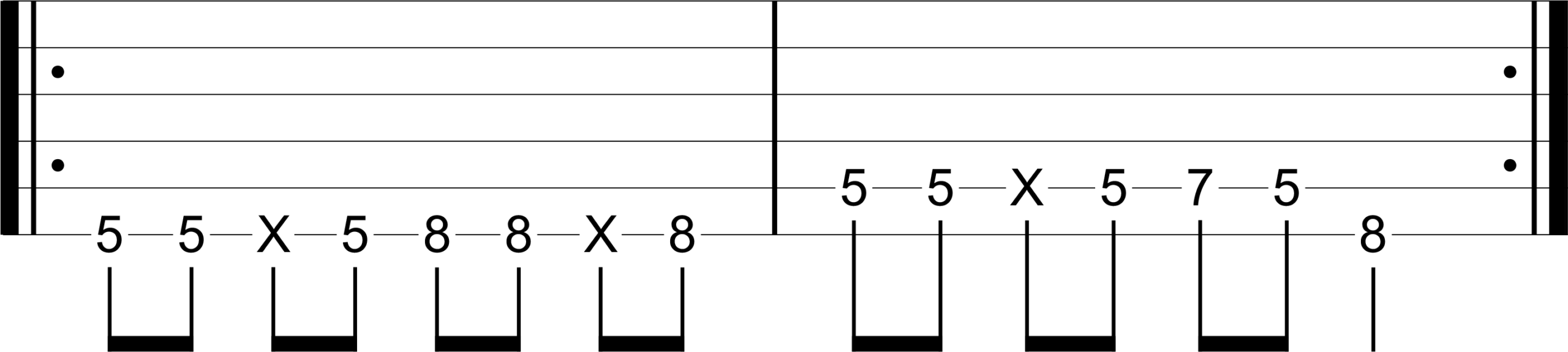
A minor pentatonic guitar riff with TAB and X symbols indicating notes that should not be played
Example 1: A guitar riff using the A minor pentatonic scale.

Swipe horizontally to view the complete exercise.

Pay attention to the X symbols in the TAB: In this exercise, these indicate notes you should not play. Skip the notes, but continue counting their positions in the rhythm. This helps you maintain the correct rhythmic pattern without playing a note at those moments.

2. Play a Pentatonic Guitar Lick

A guitar lick is a short melodic phrase that you can use in a solo or improvisation. Unlike a riff, a lick doesn't necessarily need to be repeated throughout a song. Practice the example below slowly, paying close attention to the correct notes and fingering. Then work toward playing the entire phrase smoothly.
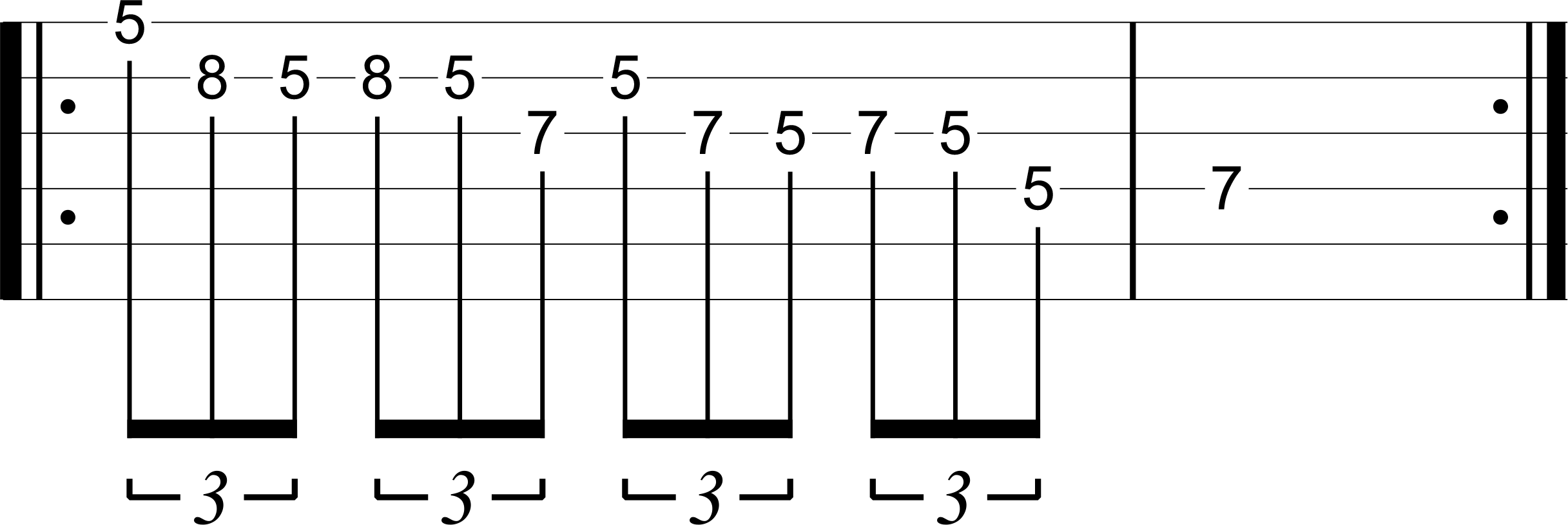
A minor pentatonic guitar lick with standard music notation, guitar TAB, and triplets
Example 2: A guitar lick using the A minor pentatonic scale.

Swipe horizontally to view the complete exercise.

You'll also notice triplets in this lick: groups of three notes played within the space of one beat. Start slowly and make sure you understand the notes and fingerings before focusing more closely on rhythm and speed.

3. Create Your Own Pentatonic Guitar Melody

Now it's your turn. Use the five notes of the A minor pentatonic scale to create a short melody of your own. Start with just three or four notes, change their order, and experiment with different rhythms. Repeat short phrases, add occasional rests, and try ending your melodies on the root note A.

You can also take a short section from the riff or lick above and create your own variation. Write your ideas down in guitar TAB so you can practice them again later. For this, you can use my free blank music sheets and guitar TAB paper .

Remember: A great guitar solo isn't about playing as many notes as possible. A short melody with accurate fingering, recognizable repetition, and musical expression can sound far more interesting than a long sequence of fast notes. You'd be surprised how much music you can create with just five notes.

Video Workout: A Minor Pentatonic Scale at 60 BPM

Time to play along! In this Guitar Workout Club video, you'll practice the A minor pentatonic scale for five minutes. You'll use the same fretboard pattern you learned above, starting at the fifth fret.

Scales 2.2.1 – VIm Pentatonic – 60 BPM – 5 Min. Watch on YouTube.

How Does This Pentatonic Scale Workout Work?

The workout consists of five phases. You'll play the same scale pattern throughout, changing the direction and number of repetitions. This helps you develop your fingering, coordination, and control without constantly learning new patterns.

  1. Ascending – 4 repetitions: play the scale from low to high, followed by a short pause.
  2. Descending – 4 repetitions: play the scale from high to low, followed by a short pause.
  3. Ascending and Descending – 4 repetitions: play the scale from low to high and immediately back down, followed by a short pause.
  4. Descending and Ascending – 4 repetitions: start on the highest note, play down the scale and immediately back up, followed by a short pause.
  5. Continuous Exercise – 8 repetitions: play the scale ascending and descending without pauses between repetitions.

What Should You Focus on While Practicing?

This workout runs at 60 BPM, with two notes played per beat. Focus first on correct fingering and clean, accurate picking. You can start by using only downward pick strokes (downpicking), then progress to alternating downstrokes and upstrokes (alternate picking).

Made a mistake? Just keep playing along. You don't need to restart the video every time something goes wrong. The goal is to improve your finger coordination and learn to play the pattern smoothly with relaxed hands.

Practice tip: Repeat this workout regularly and aim to complete all five phases without stopping. Pay particular attention to correct fingering, relaxed hands, and consistent movements. Accuracy always comes before speed.

6 Common Pentatonic Scale Mistakes (and How to Fix Them)

The A minor pentatonic scale contains just five different notes, but playing it correctly still takes practice. Pay particular attention to your fingering, picking technique, and hand position. Here are six common mistakes beginners make when learning the pentatonic scale on guitar, along with ways to avoid them.

1. Using the Wrong Fingers

Many beginners use their index and middle fingers for almost every note, resulting in unnecessary hand movements. Use your index finger on fret 5, ring finger on fret 7, and pinky on fret 8. This keeps your fretting hand stable and makes switching between strings easier.

2. Trying to Play Too Fast

Practicing at high speeds right away often leads to mistakes in fingering and picking. Start slowly and play every note with control. Increase the tempo only when you can play the entire scale cleanly and without mistakes.

3. Lifting Your Fingers Too Far

Excessive finger movements waste time and energy, making smooth playing more difficult. Keep your fingers as close to the strings as possible and avoid unnecessary movement when transitioning to the next note.

4. Playing Buzzing or Muted Notes

A note that buzzes or doesn't ring clearly may be caused by incorrect finger placement or insufficient pressure. Place your fingertip just behind the fret and apply only enough pressure to produce a clean note. Check each note individually.

5. Picking the Wrong String

Your fretting hand might be playing the correct notes while your picking hand accidentally hits the wrong string. Practice string changes slowly and keep your pick movements small. Start with downpicking if necessary, then gradually introduce alternate picking.

6. Only Practicing the Scale Ascending

Many beginners know the pattern from low to high but lose their way when playing it backward. Practice the scale both ascending and descending. Use the combinations from the Guitar Workout Club video to develop control in both directions.

Remember: Correct fingering, clean picking, and a relaxed hand position matter more than speed. Keep your movements as small as possible and practice the scale regularly in both directions. Precision, control, and relaxation are the foundation of great guitar riffs, licks, and solos.

Practice the Pentatonic Scale with Our Guitar Tools

Explore scale patterns across the guitar fretboard, improve your fingering and timing with a metronome, and play your first pentatonic riffs and solos along with drum grooves. These three Guitar Training Studio tools help you put the A minor pentatonic scale into practice.

Recommended for This Lesson

FRETTR

Discover where notes and scale patterns are located on the guitar fretboard. Explore the scale grids and Mode VIm to locate the notes A, C, D, E, and G. Learn to recognize their positions and see how scale patterns extend across the guitar neck.

Open FRETTR →

Improve Your Technique

Smart Click

Use our online metronome to practice the pentatonic scale ascending and descending. Start at 50 BPM and increase the tempo by 5 BPM whenever you can play the exercise without mistakes. Develop better control, consistent picking, and accurate finger placement.

Open Smart Click →

Play Along with Drums

GROOVR

Turn your scale exercises into real music. Choose a drum pattern, set the tempo, and play your pentatonic riffs, licks, and original solos along with the drums. Experiment with different grooves and learn how your melodies fit into the rhythm.

Open GROOVR →

Frequently Asked Questions About the Pentatonic Scale

1. What Is a Pentatonic Scale?

A pentatonic scale consists of five different notes. It can be derived from a seven-note scale by removing two notes. Pentatonic scales are widely used for melodies, riffs, and guitar solos across many musical styles.

2. What Notes Are in the A Minor Pentatonic Scale?

The A minor pentatonic scale contains A, C, D, E, and G. These five notes repeat across different octaves on the guitar fretboard. You can use them to practice scales, improvise, and create simple melodies.

3. What Does Mode VIm Pentatonic Mean?

VI is the Roman numeral for six, and m stands for minor. In this system, we start on the sixth note (A) of the C major scale and remove B and F. This gives us the A minor pentatonic scale.

4. What Fret Do You Start the A Minor Pentatonic Scale On?

The pattern taught in this lesson starts on the fifth fret of the low E string. Play the note A with your index finger. You can also play the same pattern starting at fret 17, one octave higher.

5. Can You Move the Pentatonic Scale Pattern Around the Fretboard?

Yes. The minor pentatonic pattern is movable. When you play the same pattern starting on a different root note, you change the key. For example, starting on the eighth fret of the low E string (C) gives you the C minor pentatonic scale.

6. What Tempo Should Beginners Practice the Pentatonic Scale At?

Start slowly, for example at 50 BPM, and focus on correct fingering and clean picking. Increase the tempo by 5 BPM whenever you can play the entire exercise accurately and with relaxed hands. Use a metronome to maintain consistent timing.

7. How Can I Use the Pentatonic Scale for My First Guitar Solo?

Start with three or four notes from the scale and create a short melody. Experiment with note order, rhythm, and occasional rests. Try ending your phrases on the root note A. Then play your melody along with a drum groove using GROOVR.

Wouter Baustein - Guitar Coach

Guitar Training Studio

Ready to Make Real Progress on Guitar?

Build better technique, timing and musicianship with structured guitar training, practical tools and personal coaching.