
Free Guitar Lesson · Warm-Up · Right Hand
Right Hand Guitar Warm-Up: 4 Picking Exercises
These right hand guitar warm-up exercises help you develop picking technique, pick control, coordination, and timing. You'll practice downstrokes, upstrokes, and alternate picking on a single string, focusing on a relaxed pick grip, minimal movement, and consistent picking accuracy.
In this free guitar lesson, you'll learn four practical picking exercises with TAB and video. You'll follow a 5-minute workout at 60 BPM, using eighth and sixteenth notes. The focus is entirely on your picking hand: your fretting hand doesn't need to play any notes.
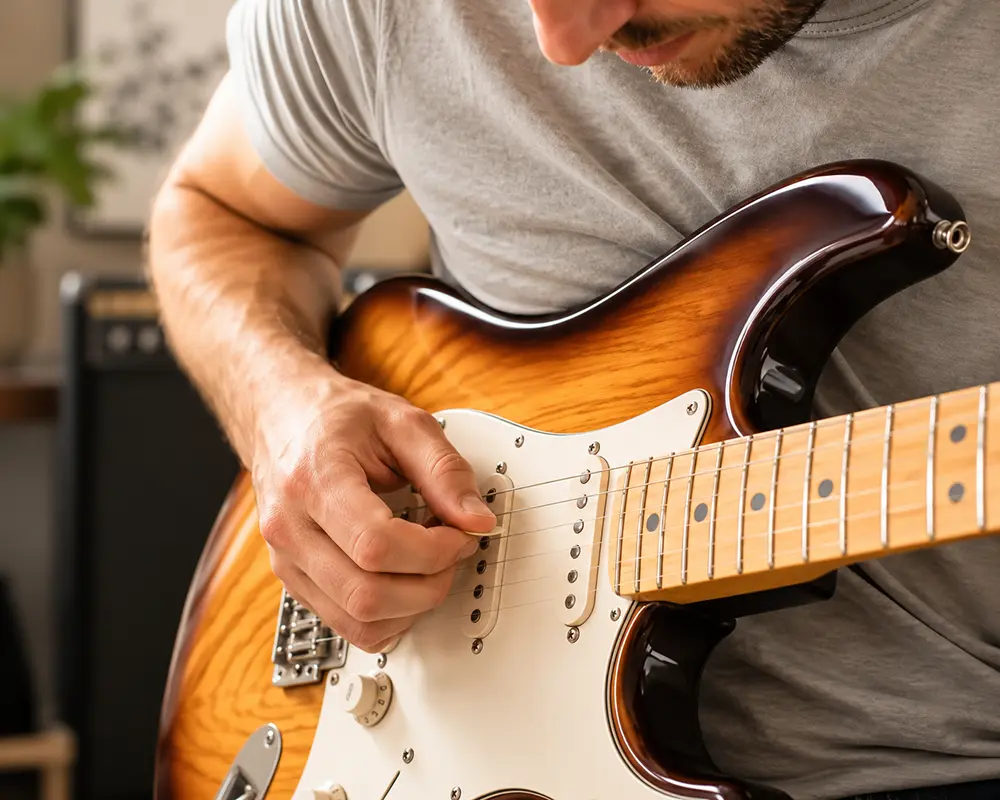
Right-Hand Guitar Warm-Up: 4 Picking Exercises at 60 BPM
These right-hand guitar picking exercises focus on pick control, fine motor skills, picking accuracy, and consistent timing. You'll learn to perform downstrokes, upstrokes, and alternate picking accurately on individual strings before moving on to more advanced picking techniques.
The workout includes four exercises and takes approximately 5 minutes. The first three exercises use eighth notes. In the fourth exercise, you'll play a longer sixteenth-note alternate-picking loop.
Play with a steady pulse at 60 BPM. Eighth notes mean two pick strokes per beat, while sixteenth notes mean four pick strokes per beat. You can practice with our Smart Click metronome.
GuitarWorkout – Warmups 1.2.1: Single String Picking · 60 BPM · 5 Min.
Important: This is exclusively a picking-hand workout. Your fretting hand doesn't play any notes. In the video, the fretting hand is only used to mute the strings and keep the sound controlled. All your attention should be on your pick grip, picking movement, and timing.
1. Eighth Notes – Downpicking
Start with eighth notes on open strings. In this first exercise, you'll play every note with a downward pick stroke (downstroke).
- Start on the string indicated in the TAB.
- Play all open-string notes using downstrokes.
- Keep your strokes even and follow the eighth-note subdivision.
- Move to the next string as indicated in the TAB.
Because you're using downstrokes only, you need to bring your pick back above the string after each note. Use a small, relaxed movement rather than lifting your entire hand unnecessarily.
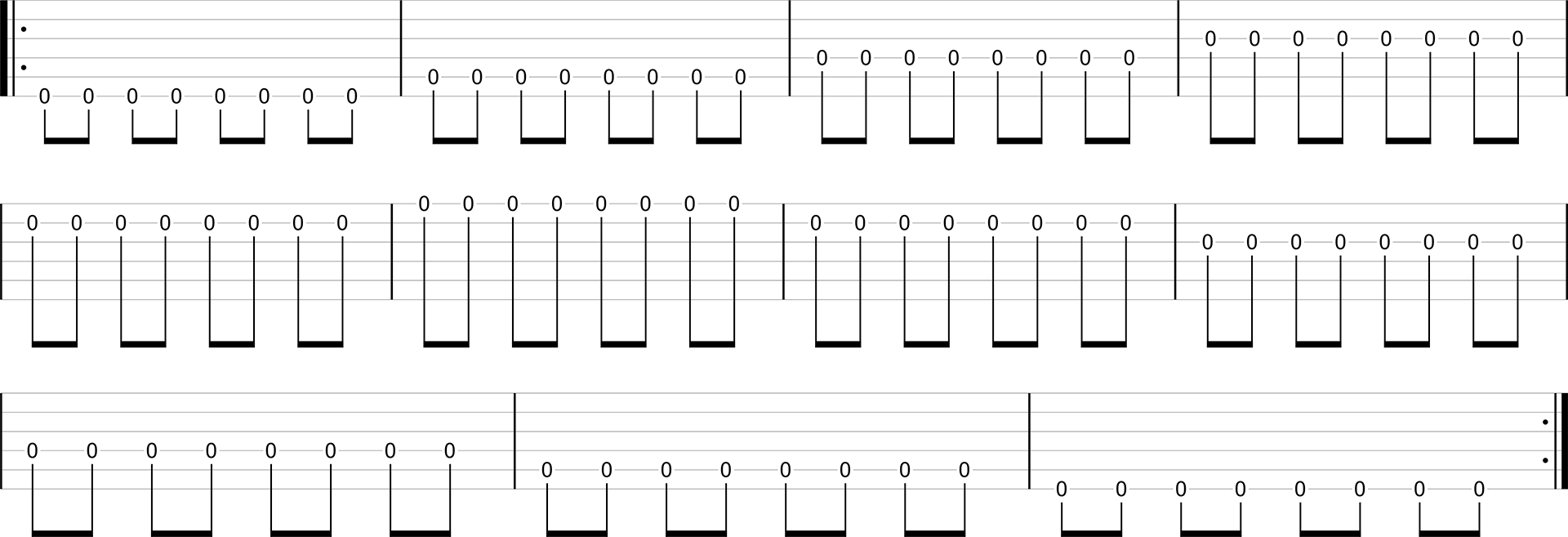
Remember: Don't dig too deeply into the strings with your pick. Focus on a consistent attack, relaxed pick grip, and even timing.
2. Eighth Notes – Upstroke Picking
The second exercise uses exactly the same eighth-note TAB, but this time you'll play every note with an upward pick stroke (upstroke).
- Start again with the eighth-note TAB from exercise 1.
- Play every open-string note using upstrokes only.
- Check that your upward strokes are just as accurate and consistent as your downstrokes.
- Keep the movement small and avoid unnecessary tension in your hand and forearm.
Upstroke picking requires a different type of movement control from downpicking. Try to maintain the same timing, dynamics, and precision as in the first exercise.
Remember: Don't pull the pick excessively upward or grip it harder to gain more control. A relaxed pick grip is just as important when playing upstrokes.
3. Eighth Notes – Alternate Picking
In the third exercise, you'll combine downstrokes and upstrokes. Use the same eighth-note TAB once again, but alternate your strokes on every note: down–up–down–up.
- Start with a downstroke (V).
- Play the next note with an upstroke (Λ).
- Keep alternating: V Λ V Λ.
- Maintain a steady pattern as you move between strings according to the TAB.
With alternate picking, you create a continuous down-and-up movement. Unlike downpicking, you don't need to return the pick to the same starting position after every note.
Want to develop this technique further? Read our lesson on guitar pick technique.
Focus: Try to perform downstrokes and upstrokes with the same level of control and a comparable picking strength. Your timing shouldn't change when you switch directions.
4. Sixteenth Notes – Alternate-Picking Loop
The fourth exercise builds on the same alternate-picking technique, but now you'll play sixteenth notes. This means playing four pick strokes per beat instead of two.
The exercise consists of a continuous two-bar loop on open strings. You'll stay on the same string for a longer period before moving to the next string.
- Start on the open string indicated in the TAB.
- Play four sixteenth notes per beat at 60 BPM.
- Continuously alternate between V and Λ.
- Maintain an even picking movement throughout the entire two-bar pattern.
- Repeat the pattern on the next string as indicated in the TAB.
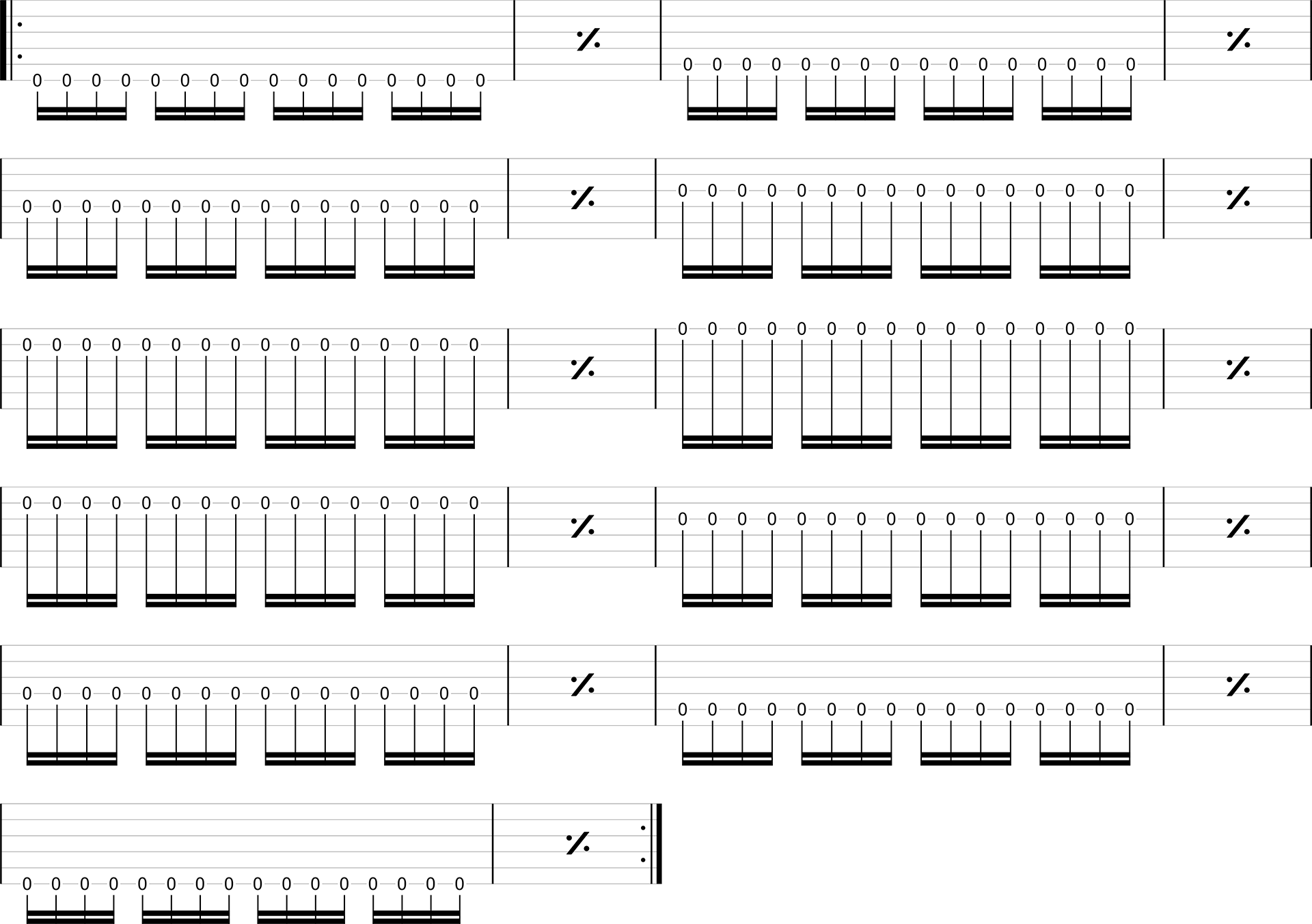
This exercise requires greater picking endurance, fine motor control, and rhythmic accuracy. By staying on the same string for longer, you can focus entirely on maintaining a consistent movement and even pick attack.
Remember: Sixteenth notes at 60 BPM mean four pick strokes per second. Don't move harder or farther than necessary. Stay relaxed and keep your timing consistent.
What Should You Focus On During This Picking Warm-Up?
- Keep your pick grip relaxed. Avoid squeezing the pick unnecessarily hard.
- Use small movements. Don't move farther than needed to strike the string.
- Control your pick attack. Downstrokes and upstrokes should sound as even as possible.
- Focus on timing. Play eighth and sixteenth notes with a consistent subdivision.
- Don't force anything. Relax your hand and forearm. Stop if you experience pain.
These exercises help develop picking-hand control, coordination, fine motor skills, and efficient picking movements. Regular, accurate repetition makes these movements feel increasingly natural and familiar.
