
Free Guitar Lesson · Warm-Up · Both Hands
Guitar Hand Synchronization: 3 Exercises for Both Hands
These guitar warm-up exercises for both hands help improve synchronization between your fretting and picking hands. You'll develop finger control, picking technique, coordination, and timing so that every note sounds at exactly the right moment.
In this free guitar lesson, you'll practice three recognizable guitar passages with TAB: Thunderstruck, a Ritchie Blackmore guitar lick, and Paint It Black. You'll combine alternate picking, accurate finger changes, and string changes to develop better coordination between both hands.

Guitar Hand Synchronization: 3 Warm-Up Exercises with TAB
These guitar warm-up exercises for both hands improve synchronization between your fretting and picking hands. You'll develop finger control, alternate picking, accurate note attacks, string changes, and rhythmic precision.
We'll use three musical exercises: Thunderstruck by AC/DC (Angus Young), a Ritchie Blackmore guitar lick, and Paint It Black by The Rolling Stones. Each exercise introduces a new technical challenge, from basic finger changes to pedal tones and string skipping.
How Do You Practice Guitar Hand Synchronization?
Start each exercise at a slow, comfortable tempo. First, study the notes and suggested fingering in the TAB. Then play the pattern using downstrokes only (downpicking). Once both hands are working together accurately, repeat the same exercise using alternate picking, alternating between downstrokes and upstrokes.
The TAB images also include fretting-hand finger numbers. These indicate which fingers to use: 1 = index finger, 2 = middle finger, 3 = ring finger, and 4 = pinky. Not familiar with these numbers? Start with our lesson on guitar finger numbers and fingering.
Practice with our Smart Click metronome or play along with drum patterns from GuitarWorkout. Choose a tempo at which every note sounds clear and rhythmically accurate. Only increase the BPM once you can play the exercise several times correctly and without tension.
Important: The goal is synchronization, not speed. Your fretting hand must press down the correct note at the right moment, while your picking hand must strike the string at exactly the same time. Use small, controlled movements. Always start with downpicking and introduce alternate picking once your fingering and timing are under control.
1. Thunderstruck – AC/DC (Angus Young)
We'll begin with a recognizable passage from Thunderstruck by AC/DC. This exercise is excellent for developing coordination between your fretting and picking hands.
You'll continuously alternate between an open string and fretted notes. Your picking hand maintains a steady pattern while your fretting hand must repeatedly place and release the correct finger at the right time.
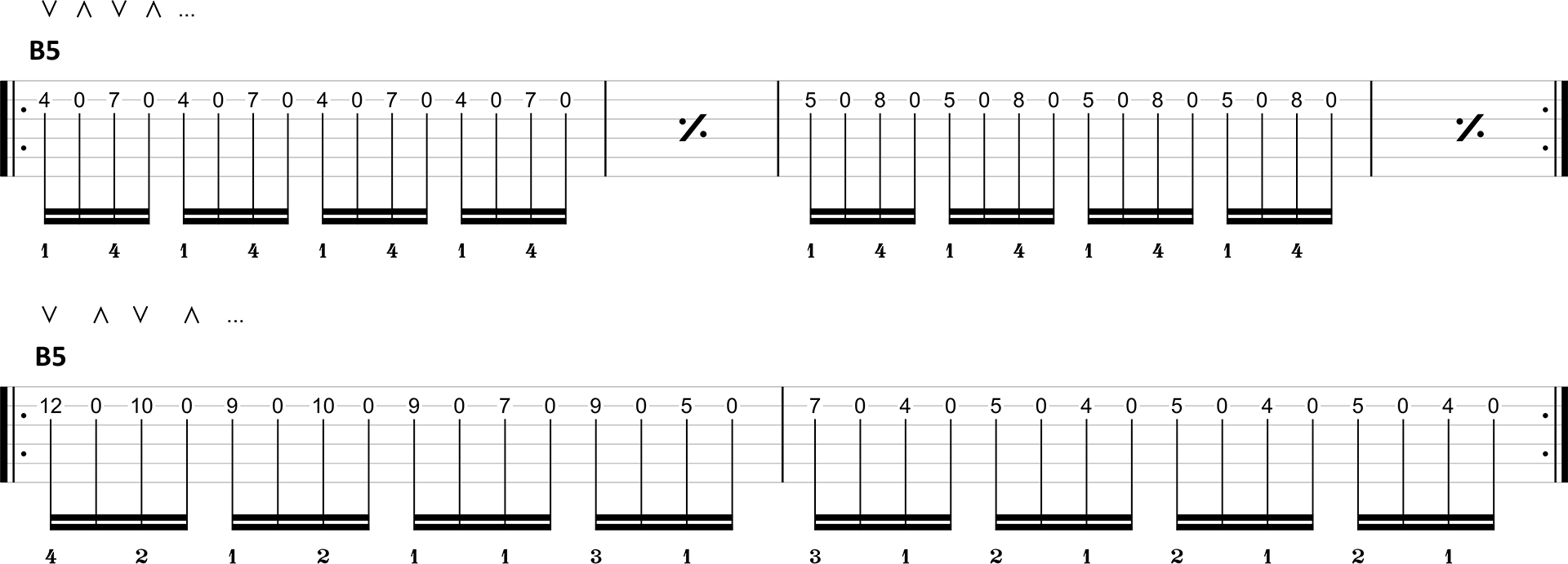
How to Practice Thunderstruck
- Start slowly. First, learn the pattern and the finger numbers indicated in the TAB.
- Play every note with downpicking. Use downstrokes only and make sure your fretting hand plays the correct notes at the right moment.
- Switch to alternate picking. Alternate between downstrokes and upstrokes without changing the timing.
- Pay attention to the open string. Open and fretted notes must follow a consistent rhythmic subdivision.
- Practice with a metronome or drums. Repeat the complete passage at a steady tempo and check whether every note is evenly spaced.
The biggest challenge in Thunderstruck is rhythmic consistency. Don't let the open string tempt you to speed up. Every note must fall on the correct rhythmic subdivision. When the TAB indicates equal note values, your pick strokes must also be evenly spaced.
Use the Smart Click metronome to practice this. Choose a suitable subdivision and listen carefully to whether every note sounds at the right moment. You can also practice the same exercise with a drum groove from GuitarWorkout.
Remember: Don't lift your fingers excessively far away from the fretboard when playing an open string. Keep your fretting hand relaxed and minimize unnecessary movement. Above all, make sure that the open and fretted notes sound equally clear and rhythmically accurate.
2. Ritchie Blackmore – Finger Changes and Synchronization
The second exercise features a Ritchie Blackmore guitar lick. Blackmore is best known for his work with Deep Purple and Rainbow. This exercise focuses on accurate finger changes, finger control, and hand synchronization.
Unlike Thunderstruck, you'll now play several consecutive fretted notes. Each finger must press down the correct string at exactly the right moment while your picking hand strikes the next note.
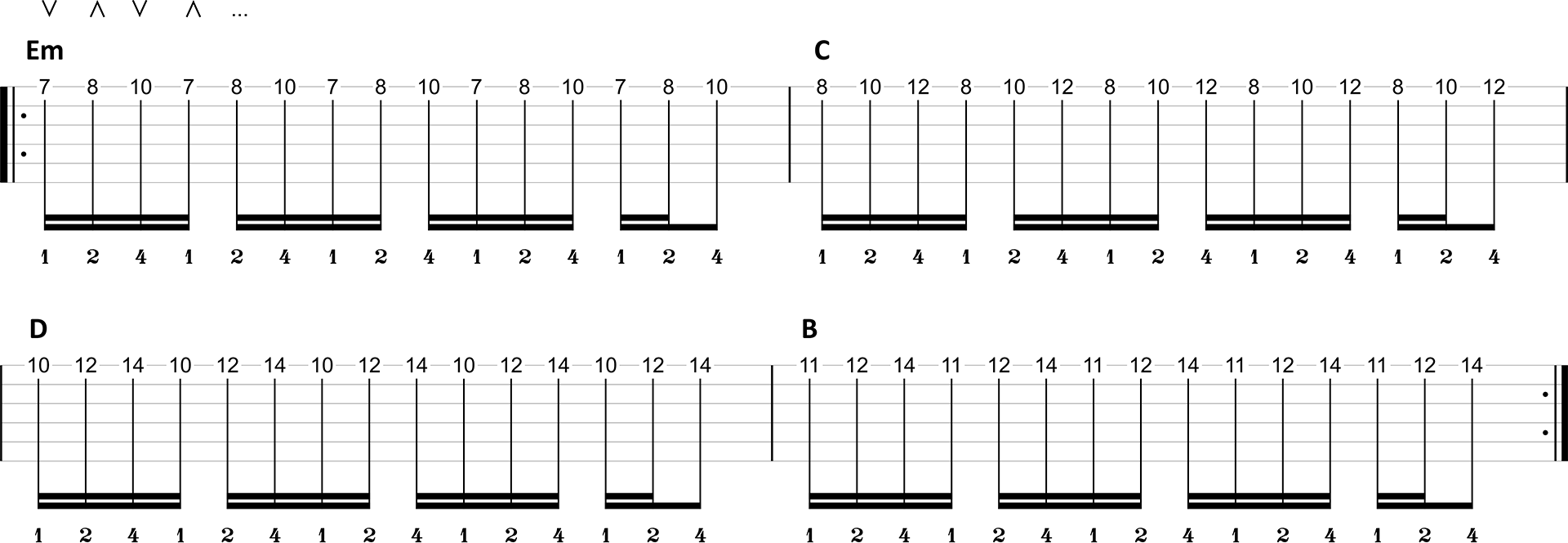
How to Practice the Ritchie Blackmore Lick
- Study the finger numbers. Follow the fingering indicated in the TAB and try to use it consistently.
- Use one finger per fret. Within a comfortable hand position, assign each finger its own fret. Avoid unnecessarily shifting your entire hand.
- Keep your fingers as upright as comfortably possible. Use your fingertips and press the string just behind the fret without unnecessary tension.
- Start with downpicking. Pick every note separately and make sure your fretting hand presses the correct fret at the right moment.
- Switch to alternate picking. Alternate between downstrokes and upstrokes while maintaining the same fingering and rhythmic subdivision.
- Gradually increase the tempo. Play the pattern several times cleanly and without tension before increasing the BPM.
Pay particular attention to finger independence. Each finger should be able to move without the others lifting unnecessarily far away from the strings. Keep your fingers close to the fretboard and try to make each movement as small as possible.
Finger pressure is also important. Use only enough pressure to produce a clear note. Squeezing too hard creates unnecessary tension and makes fast finger changes more difficult.
Want to improve your fretting-hand technique further? Check out our left-hand guitar warm-up and finger control exercises.
Remember: A common mistake is picking the string before the next finger is correctly positioned on the fretboard. This produces a muted or unclear note. Slow down and try to synchronize every finger movement precisely with the pick stroke.
3. Paint It Black – The Rolling Stones
The third exercise is based on Paint It Black by The Rolling Stones. This passage combines melodic playing, pedal tones, string changes, and string skipping. Your picking hand faces an additional challenge here.
You'll play a melody while repeatedly returning to a pedal tone. A pedal tone is a recurring note that continues to appear while the other melody notes change.

Part 1 – Pedal Tones and String Changes
In the first part, you'll alternate between melody notes and a recurring pedal tone on another string. In this arrangement, the pedal tone changes from D to A. Your picking hand must continue finding the correct strings while your fretting hand plays the melody.
- Learn the melody first. Study the notes and finger numbers, then play the melody slowly.
- Add the pedal tone. Follow the TAB and alternate between melody notes and the recurring pedal tone.
- Start with downpicking. Play all notes using downstrokes and concentrate on accurate string changes.
- Try alternate picking. Play the pattern using down-up first, then up-down.
- Compare both directions. Listen to your timing and notice which picking direction makes the string changes easier and more efficient.
Which Alternate-Picking Direction Should You Use?
When using alternate picking, guitarists often start with a downstroke followed by an upstroke. However, this exercise is an excellent opportunity to deliberately reverse the picking direction.
Experiment with both variations. During these string changes, up-down (Λ V) may feel easier than the usual down-up movement. The direction in which your pick leaves a string can affect how easily it reaches the next string.
The TAB includes suggested picking directions. Try these first, but also compare them with the opposite direction. The goal is to discover which movement feels most relaxed, accurate, and efficient for you.
Part 2 – String Skipping
In the second part, the exercise becomes more challenging through string skipping. This means skipping one or more strings when changing from one string to another. Your pick must travel directly to a more distant string without accidentally striking the strings in between.
- Practice the string skips slowly. Start by picking the correct strings using downstrokes only.
- Use small movements. Move your pick only as far as necessary to reach the next string.
- Add alternate picking. Again, experiment with both down-up and up-down patterns.
- Pay attention to picking direction. Follow the markings in the TAB and compare how both directions feel when skipping the strings in between.
- Combine both parts. Play the complete passage at a steady tempo, without interruptions during string changes.
By experimenting with both picking directions, you'll learn how your pick moves between the strings. This is especially useful for string skipping, arpeggios, melodies, and more complex picking patterns.
Remember: With Paint It Black, the challenge isn't only playing the correct notes, but especially making efficient string changes. Reverse your alternate-picking direction and compare both approaches. A different starting stroke can make the entire passage easier to play. Avoid large movements and mute unused strings if they ring unintentionally.
What Should You Focus On During These Synchronization Exercises?
- Always start slowly. Choose a tempo at which you can play every note clearly and accurately.
- Start with downpicking. Practice each exercise with downstrokes first, then introduce alternate picking.
- Follow the finger numbers. Use the suggested fingering in the TAB and avoid unnecessary hand movements.
- Synchronize both hands. Make sure every finger placement coincides precisely with the correct pick stroke.
- Keep your fingers close to the strings. Use one finger per fret whenever practical and avoid excessive finger pressure.
- Experiment with picking directions. Especially in Paint It Black, up-down picking may feel easier than down-up.
- Practice with consistent timing. Use a metronome or drum groove to maintain the correct rhythmic subdivision.
- Increase the tempo gradually. Play each exercise correctly several times before increasing your speed.
- Stay relaxed. Use small movements, avoid unnecessary tension, and stop if you experience pain.
These three exercises combine finger control, hand synchronization, alternate picking, string changes, and timing. Regular practice helps you move more efficiently and develop better control when playing melodies, riffs, scales, and guitar solos.
