
Fretting Hand – Guitar Technique
Guitar Left-Hand Position & Technique
There are many important aspects of left-hand technique on guitar, and every guitarist develops a slightly different approach over time. Hand size, finger length, flexibility, previous injuries and general mobility can all influence how a comfortable fretting-hand position feels.
Instead of forcing one rigid position on every player, this guide gives you clear, practical guidelines for developing relaxed and efficient left-hand technique. The goal is cleaner notes, accurate fretting, better control and less unnecessary tension while playing.
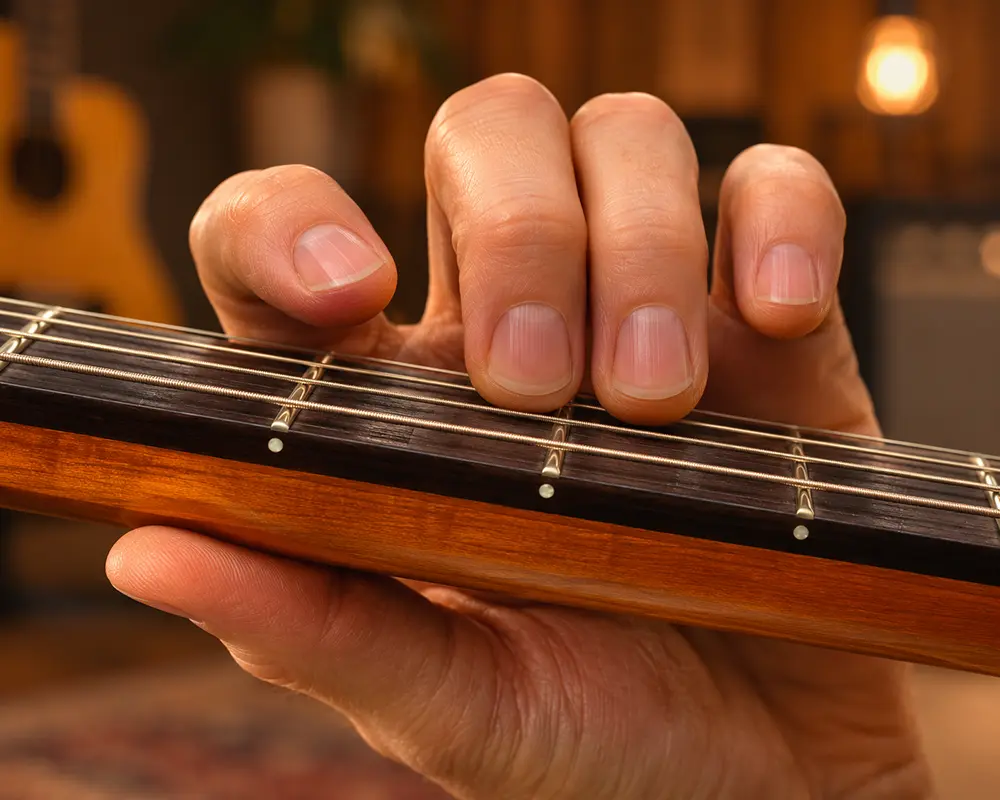
Guidelines for Developing and Improving Left-Hand Technique on Guitar
Pain, Tension or Discomfort? Stop and Take a Break
If you feel pain in your fingers, wrists, hands, elbows, back or neck while playing guitar, stop and take a break. At music school, physiotherapists advised us to use a simple 50 minutes playing / 10 minutes break routine during longer practice sessions.
Do not treat pain as something you simply have to play through. Persistent or recurring discomfort deserves attention, and reducing unnecessary tension is an important part of good technique. A short routine of guitar warm-up exercises can also help you prepare before more demanding practice.
Correct Finger Placement for Clear Notes
When learning guitar, clean notes depend heavily on proper left-hand finger positioning. Place your thumb behind the neck, roughly around the middle, so your hand can stay relaxed and flexible. Thumb position can change later with different techniques, but for beginners and intermediate players this is a useful starting point.
Keep fingers 1–2–3–4 as perpendicular to the strings as comfortably possible so you press the intended string without unnecessarily touching neighbouring strings. If you are unsure which finger each number represents, see the guide to guitar finger numbers.
Thumb Placement
The thumb should stay relaxed, straight or slightly curved rather than folded inward. For basic fretting, keeping it behind the neck gives the fingers room to move and helps you avoid unnecessary gripping.
The thumb does not always have to stay in exactly the same place. More advanced techniques can use different positions, including thumb-over grips. You can see one example in Jimi Hendrix chord and playing technique.
The Fingering Can Be Considered a Three-Dimensional Placement

Good fretting is not only about putting the correct finger on the correct fret. Think about each finger in three dimensions: where it sits along the string, how much pressure it uses and the angle at which it contacts the string.
1. Length of the String – Position Close to the Fret
Place the finger just behind the fret. If it is too far back, the note may buzz, rattle or fail to sound clearly. Move the finger closer to the fret until you can produce a clean note without using unnecessary pressure.
2. Pressure – Pushing the String Down
If you do not press hard enough, the note can buzz. Pressing much harder than necessary wastes energy and can also affect pitch, especially on guitars with high frets or scalloped fretboards. Use only enough pressure to produce a clean note.
3. Vertical Angle – Avoid Pulling the String Sideways
For normal fretting, the finger should press the string toward the fretboard without unintentionally pushing or pulling it sideways. Moving the string sideways changes its pitch—the same basic principle deliberately used in guitar bending technique.
Practice & Consistency
When you start playing guitar, placing the fingers correctly takes conscious effort. It can feel unnatural at first, but with consistent practice the movements become much more automatic.
Mastering these basic left-hand movements gives you a stronger foundation for chords, scales, bends, vibrato and faster playing. The goal is not to force every guitarist into exactly the same hand shape, but to develop a position that is relaxed, efficient and repeatable.
For chord work, apply the same principles when practising faster and cleaner chord changes. They also make it easier to move power chord shapes cleanly around the neck.
Once the movement feels clean and relaxed, practise simple fretting exercises at a controlled tempo with Smart Click.
To develop the other side of your technique as well, continue with Right-Hand Guitar Technique: Picking & Strumming.
