Alternate picking means using a continuous down-up picking motion instead of repeatedly attacking the strings in the same direction. It is one of the most important picking techniques for developing speed, accuracy and control on guitar.
In this lesson, you’ll learn how to build efficient alternate picking from the start: how to coordinate downstrokes and upstrokes, keep the motion small and relaxed, stay in time and gradually increase your speed without sacrificing accuracy.

Alternate picking means continuously switching between downstrokes and upstrokes: down, up, down, up. The goal is to make both directions feel controlled, relaxed and rhythmically even.
Main rule: build a clean and even down-up movement first. Speed comes from making the motion more efficient—not from forcing the pick faster.
Alternate picking is not only about moving down and up. The angle of the pick against the string, the direction in which it travels and even the shape of the pick tip affect how easily the pick clears the string. These small details influence both efficiency and tone.
When the pick moves relatively flat and parallel through the string, the movement can stay very short and direct. The pick only needs to travel far enough to cross the string before reversing direction. This makes it easier to keep the picking motion compact, controlled and efficient.
Holding the pick at a slight angle often feels more natural because of the way the wrist and forearm naturally sit over the guitar. The edge of the pick glides across the string instead of hitting it completely flat, producing a warmer, softer and slightly scraping attack. The trade-off is that the movement often becomes a little wider.
The shape of the pick tip also changes how easily it passes through the string. A sharper point has a smaller contact area and usually feels more precise and efficient for fast picking. A rounder tip makes broader contact with the string, which can feel softer and produce a smoother attack, but may create slightly more resistance. Even a worn pick can noticeably change the feel of your picking.
There is no single perfect combination of pick angle and tip shape. A flatter position with a sharper point can make the movement extremely short and direct, while a slightly angled or rounder pick may feel more natural and produce a warmer attack. The best setup is the one that allows both downstrokes and upstrokes to clear the string comfortably without unnecessary movement or tension.
Main principle: pick position, pick shape, efficiency and tone are connected. Use the smallest comfortable movement you can while keeping the attack and feel you want.
Alternate picking looks simple: one downstroke, one upstroke, repeated over and over. But beginners often discover that the two directions do not feel equally natural. The downstroke usually feels stronger and more controlled, while the upstroke may feel weaker, slower or less accurate. At the same time, your picking hand has to stay synchronized with your fretting hand and keep the notes evenly spaced in time.
Most players naturally trust the downstroke more. The upstroke often needs more deliberate practice before it feels equally strong, relaxed and predictable. Alternate picking becomes much easier once both directions feel like part of the same continuous motion.
The pick and fretting finger need to arrive at almost the same moment. If the fretting hand moves too early or too late..., you may hear muted notes, buzzing or small gaps between notes even when the picking motion itself looks correct.
Picking repeatedly on one string is relatively simple. Moving to another string changes the distance and direction of the movement, while the down-up sequence still has to continue without interruption.
When players try to go faster too soon, they often grip the pick harder, stiffen the wrist or make larger movements. That usually makes alternate picking less efficient instead of faster. Clean notes and relaxed movement should come first.
This is why alternate picking should first be practised slowly enough that every note sounds clear and controlled. In Mode Mastery Essentials, the same principle is used throughout the fingering exercises: play slowly, use controlled fingering and make sure every note rings clearly before increasing the tempo.
Main principle: alternate picking is not difficult because your hand cannot move fast enough. It is difficult because both directions, both hands and the timing still need to become one coordinated movement.
Before you add scales, string changes or speed, practise the basic alternate-picking movement on a single string. Pick one open string and play a continuous sequence of down-up-down-up strokes at a slow, steady tempo.
The goal is to make the two directions feel as similar as possible. The downstroke should not feel like the “main” stroke with the upstroke simply returning the pick. Both strokes should produce a clear note with a similar volume, attack and timing.
Keep the movement relaxed and continuous. Do not stop the pick between strokes or deliberately prepare each direction separately. Alternate picking should gradually feel like one repeating motion rather than a series of individual downstrokes and upstrokes.
Using one open string removes the fretting hand from the exercise, so you can focus completely on the picking motion. Start with steady 8th notes:
↓ ↑ ↓ ↑ ↓ ↑ ↓ ↑
Listen carefully. Are the upstrokes quieter? Does one direction arrive slightly late? Does the pick catch the string differently on the way back? These small differences are much easier to correct at a slow tempo than after you start playing faster.
The same practice principle appears throughout Mode Mastery Essentials: play slowly first and make sure every note sounds clear before increasing the tempo.
Main principle: do not practise speed yet. First make the basic down-up motion even, relaxed and repeatable.
Efficient alternate picking depends on how far the pick travels. The pick only needs to move far enough to pass through the string and clear it before changing direction. Any extra distance adds time to every stroke and makes fast, accurate picking more difficult.
Beginners often make the movement too large because a bigger motion feels easier to control at slow tempos. The problem appears when the tempo increases: the hand has to cover much more distance for every note, so the movement becomes harder to maintain.
Try to keep the pick close to the string after every stroke. You should not see the hand making large up-and-down movements away from the strings. Think of the pick moving through the string, not away from the guitar.
Speed should come from a smaller and more efficient motion, not from gripping the pick harder or forcing the wrist to move faster. If your thumb, fingers, wrist or forearm begin to tighten as the tempo rises, reduce the tempo and regain control.
The pick should feel secure enough that it does not move around in your fingers, but not so tight that the picking hand becomes rigid. A relaxed hand can change direction more easily and makes it much easier to keep the downstroke and upstroke even.
Main principle: use the smallest movement that still produces a clear note. Less unnecessary movement means more control, better timing and more room to increase speed later.
Once the down-up motion feels controlled on an open string, add the fretting hand. This is where alternate picking becomes a coordination exercise: the pick and the fretting finger need to arrive at almost the same moment for every note.
If the fretting finger lands too early, the note may sound muted or unclear before the pick arrives. If the pick arrives first, you may hear the previous note, an open string or a small gap. Clean alternate picking depends on both hands moving together.
A simple way to train this is with a four-fret pattern such as 5-6-7-8. Use your index, middle, ring and pinky for the four frets and combine them with continuous down-up-down-up picking.
This keeps the exercise predictable and lets you focus on timing between both hands instead of thinking about a complicated scale or lick. The same fingering principle is used throughout Mode Mastery Essentials: one finger per fret, thumb behind the neck, and clear notes before increasing speed.
Start slowly enough that every note is clean and evenly spaced. Do not let the fretting hand rush ahead of the pick, and do not compensate for mistakes by pressing harder. The goal is precise synchronization, not force.
Main principle: every picked note is a two-hand action. Train the fretting finger and pick to arrive together before you try to increase speed.
Alternate picking becomes more difficult as soon as you move from one string to another. On a single string, the pick travels back and forth over the same point. During a string change, the hand also has to move sideways while keeping the down-up-down-up sequence intact.
The important thing is not to restart the pattern every time you reach a new string. If the last note on one string is an upstroke, the next note should be a downstroke. If the last note is a downstroke, continue with an upstroke. The picking sequence should keep flowing regardless of which string you are playing.
Move only far enough to reach the next string. Large jumps make it harder to stay accurate and increase the chance of hitting an unwanted string. The same principle applies here as with the basic picking motion: unnecessary distance makes the movement slower and less predictable.
Practise the transition between two neighbouring strings first. For example, play a short pattern on the low E string and continue immediately on the A string without stopping or changing the alternate-picking sequence. Once that feels controlled, extend the exercise across more strings.
You may notice that some string changes feel easier than others depending on whether the pick is moving toward or away from the next string. That is normal. At this stage, do not overcomplicate the exercise with advanced picking terminology. The goal is simply to keep the movement relaxed, accurate and continuous.
Main principle: the string changes, but the picking sequence does not. Keep the down-up motion continuous and make the smallest possible movement to the next string.
Now combine the previous principles in one simple exercise. The pattern itself is deliberately easy so that you can focus on picking accuracy, synchronization and efficient movement instead of thinking about notes or scales.
Play frets 5-6-7-8 using one finger per fret: index, middle, ring and pinky. Use strict alternate picking:
5 ↓ 6 ↑ 7 ↓ 8 ↑
Repeat the pattern slowly until every note is clean, the volume stays even and the downstroke and upstroke feel equally controlled.
Play the same 5-6-7-8 pattern on the A, D, G, B and high E strings. Keep the picking sequence continuous as you change strings. Do not stop the hand or deliberately restart the pattern when you reach a new string.
Because this exercise uses four notes per string, each new string begins with the same picking direction when you start the exercise with a downstroke. This makes it a good first exercise for learning clean string changes without making the picking sequence unnecessarily complicated.
Once you reach the high E string, reverse the fretting pattern and work back across the strings using 8-7-6-5. Keep the alternate-picking motion running continuously and listen for any string change where the timing becomes uneven or the pick hits an unwanted string.
This follows the same practice approach used in Mode Mastery Essentials: correct fingering, clear notes and controlled alternate picking first; tempo comes later.
Main principle: the exercise is simple on purpose. Your goal is not to master the 1-2-3-4 pattern, but to make both hands and every string change behave consistently while the down-up motion continues.
The exercises below gradually make the picking movement more demanding. Start with predictable scale patterns, then move to recognizable musical examples that introduce single-string picking, string changes, arpeggios, string skipping and movement across the full set of strings. Use strict alternate picking throughout unless stated otherwise. If you haven't learned tablature yet, our guitar TAB lesson for beginners explains how to identify strings, frets and note sequences.
Start with the Mode VIm pentatonic shape in A minor, the relative minor of C major. This pattern has two notes per string, which gives you a very predictable picking sequence.
Start with a downstroke and play the scale as a continuous loop. Each string follows the same down-up pattern, so every new string begins with another downstroke. This makes it an ideal first exercise for learning to cross strings while keeping the picking motion consistent.

Now use the full Mode VIm diatonic shape, again in A minor / C major. Unlike the pentatonic pattern, the number of notes is not the same on every string. Some strings contain two notes, while others contain three.
That makes the string changes less predictable. Instead of relying on every new string beginning with the same stroke, keep the alternate-picking sequence running and pay attention to which direction the pick is moving when you change strings.

A single-string pattern removes string crossing from the equation and lets you concentrate completely on the alternate-picking motion and the synchronization between both hands.
The recognizable Thunderstruck pattern by AC/DC works extremely well for this. For this exercise, play every note with the pick and maintain a strict, continuous down-up motion.

The intro pattern from Hypnotize by System of a Down introduces controlled movement between two strings. You now have to maintain the alternate-picking sequence while the picking hand changes strings.
Keep the hand close to the strings and avoid making a large jump every time the pattern moves from one string to the other.
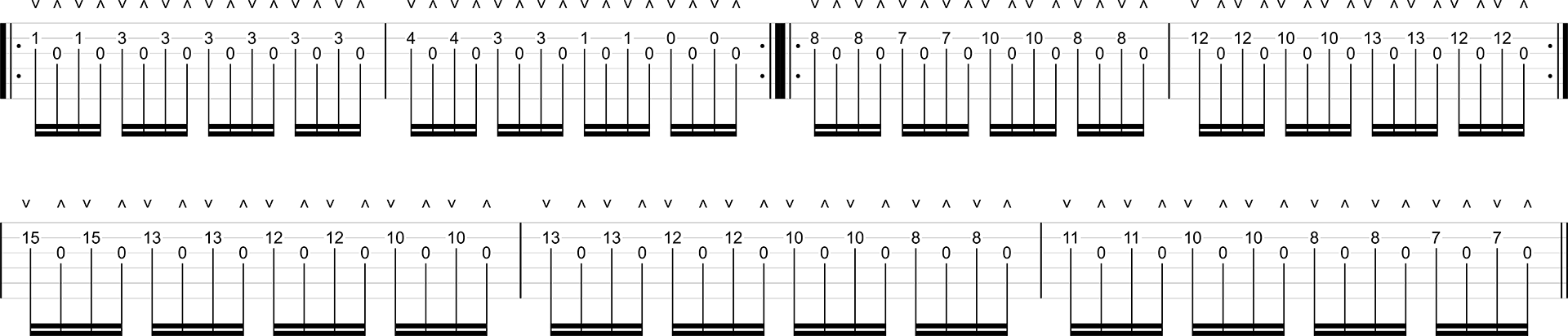
This pattern from Hotel California by Eagles gives you a useful three-string exercise. The picking hand moves across several strings and changes direction again, making the relationship between picking direction and string movement less predictable.
For this exercise, concentrate specifically on maintaining strict alternate picking. The goal is not to reproduce every articulation or picking choice from the original recording, but to use the musical pattern to train controlled movement across three strings.
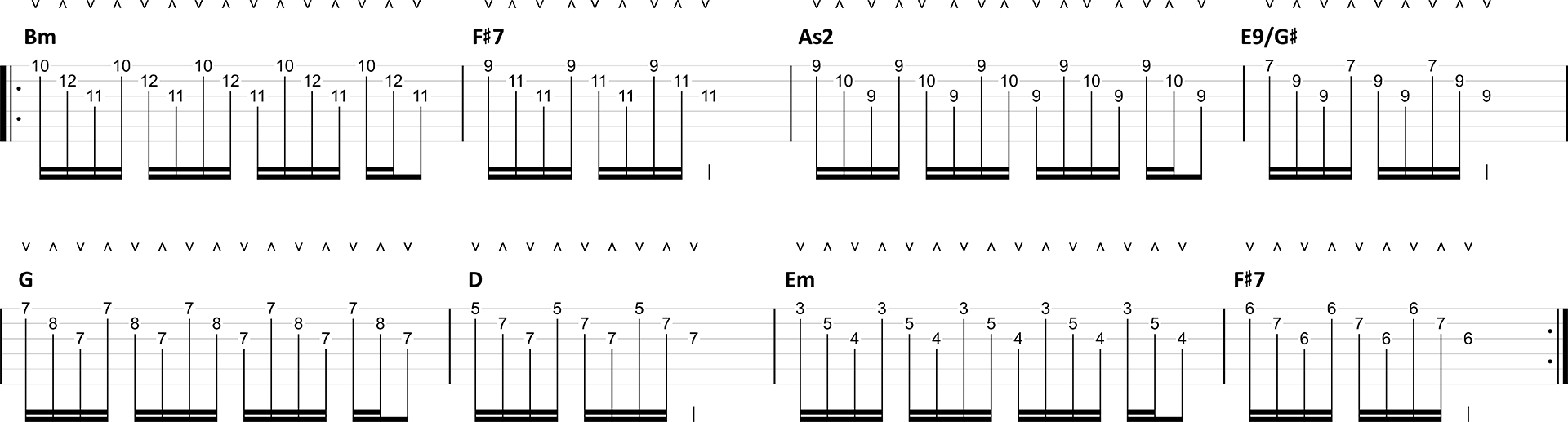
The intro pattern from These Days by Foo Fighters introduces string skipping. Instead of always moving to an adjacent string, the picking hand has to cross a larger distance while the alternate-picking sequence continues.
Keep the movement controlled and resist the temptation to reset the pick whenever the next note appears on another string.

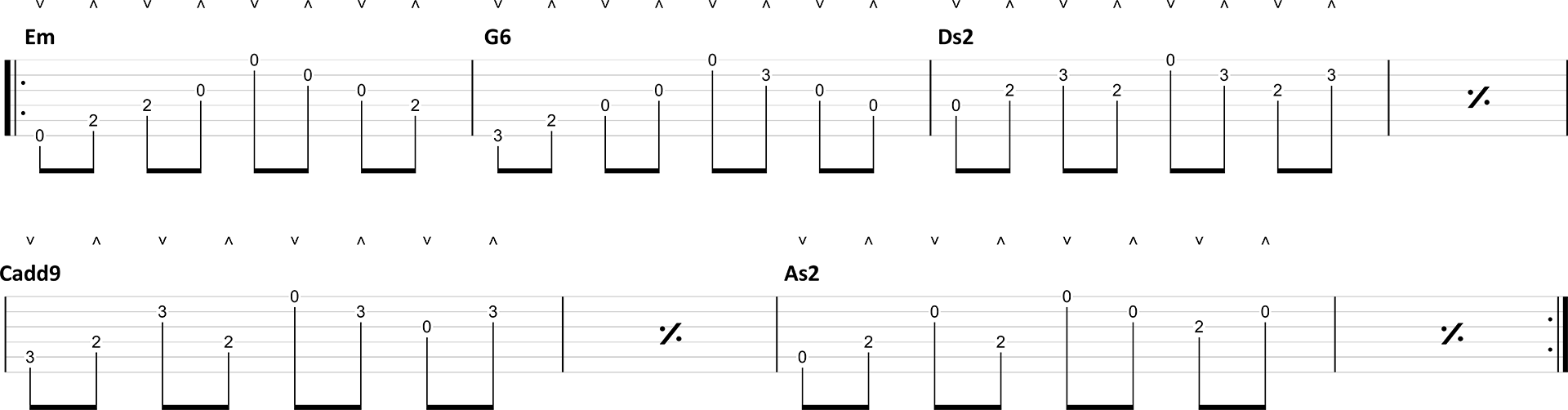
The Limp Bizkit version of Behind Blue Eyes gives you a useful full-range picking exercise because the right hand has to move across a large part of the string set while maintaining consistent timing.
This is another deliberate technical adaptation. In normal playing, I would use economy picking for parts of a pattern like this because some of the string changes can be played more efficiently that way. Here, however, play the entire exercise with strict alternate picking.
Practice rule: start each exercise slowly enough that the picking sequence, timing and string changes remain completely controlled. Once you can repeat the exercise cleanly several times, increase the tempo in small steps rather than trying to force speed immediately.
Once your alternate picking feels clean and controlled at a slow tempo, use a metronome to add time pressure. The goal is not simply to reach a higher BPM, but to keep the same relaxed movement, clear articulation and accurate synchronization as the tempo increases.
Start at a tempo where you can play the exercise comfortably without tension or mistakes. In Mode Mastery Essentials, the exercises often start around 50 BPM and increase in small steps of 5 BPM. That same approach works well for alternate picking.
Do not raise the BPM because you managed one lucky repetition. Play several clean repetitions first. The timing should remain even, the pick movement should stay small and neither hand should become noticeably more tense.
If your upstrokes become weaker, your string changes become sloppy or your picking hand starts making larger movements, the tempo is probably too high. Drop back a few BPM, regain control and build up again.
A useful tempo is the fastest tempo at which your technique still looks and feels almost the same as it does when you play slowly. If increasing the BPM changes the movement completely, you are no longer training the same technique.
Later, you can use BPM together with the number of notes per beat to measure your actual picking speed in notes per second. That makes progress easier to track than judging speed only by feel.
Main principle: increase speed in small steps while protecting the movement you already built. If technique changes when the BPM rises, reduce the tempo before continuing.
Alternate picking is not the only efficient way to move a pick across the strings. Another common approach is economy picking. Both techniques can work extremely well, but they use a different logic when you change strings.
With alternate picking, the picking direction keeps alternating: down-up-down-up, regardless of which string you are playing. That makes the motion predictable and is why it is such a useful technique to learn first.
With economy picking, the pick may continue in the same direction when moving to an adjacent string if that creates a shorter path. Instead of forcing a strict alternate stroke, the movement follows the direction in which the pick is already travelling.
In Mode Mastery Essentials, both approaches are used in the fingering exercises: the instruction is to play with correct fingering using economy or alternate picking.
For this lesson, however, the focus is deliberately on strict alternate picking. Learning to maintain a consistent down-up sequence builds timing, control and awareness of both picking directions before you start choosing different picking strategies for specific phrases or string changes.
Main principle: economy picking is not “better” than alternate picking and alternate picking is not “better” than economy picking. They are different tools. First learn to control strict down-up picking; later you can choose the movement that best fits the phrase you want to play.
Speed hides coordination problems. If the tempo is too high, it becomes difficult to hear whether the upstroke is late, the hands are out of sync or the pick is moving too far. Start at a tempo where every note is clearly controlled.
Large movements may feel comfortable at slow tempos, but they become inefficient as the speed increases. Keep the pick close to the string and remove any movement that does not help produce the next note.
Holding the pick too tightly often creates tension in the fingers, wrist and forearm. The pick should feel secure, but the hand should remain relaxed enough to change direction easily.
Many beginners treat the downstroke as the real note and the upstroke as the return movement. In alternate picking, both directions matter. Listen for differences in volume, timing and attack and practise until the two strokes feel equally reliable.
Do not automatically restart with a downstroke whenever you move to another string. Keep the down-up sequence continuous. Breaking the pattern makes the motion less predictable and prevents you from developing true alternate-picking control.
Clean picking does not help if the fretting hand arrives too early or too late. Listen for small gaps, muted notes and buzzing. These are often signs that the two hands are no longer working together.
One clean repetition does not mean the movement is stable. Repeat the exercise several times without mistakes before increasing the tempo. In Mode Mastery Essentials, the same gradual approach is used: start slowly and increase the tempo in small steps once the exercise remains controlled.
Main principle: if speed makes the movement bigger, tighter or less accurate, you are progressing the tempo faster than the technique.
Use these Guitar Training Studio tools to practise alternate picking at a controlled tempo, measure your actual picking speed and build accuracy with a metronome or groove.
Best for this lesson
Set a precise BPM, practise your alternate-picking exercise with steady subdivisions and increase the tempo gradually while keeping every note clean.
Open Smart Click →Measure your speed
Convert BPM and rhythmic subdivisions into notes per second so you can measure your actual picking speed and compare progress across different tempos.
Open NPS Calculator →Practice with drums
Practise your picking exercises with drum grooves instead of a dry click and keep technical speed connected to real timing, pulse and musical feel.
Open GROOVR →You do not need a long technical workout to improve alternate picking. Five focused minutes are enough to train the basic down-up motion, hand synchronization, string changes and controlled speed progression.
Choose one open string and play steady 8th notes using continuous down-up-down-up strokes. Keep the movement small and relaxed and listen for equal timing and attack in both directions.
Use a simple four-note fingering pattern on one string. Focus on making the pick and fretting finger arrive together. Every note should sound clear before you move on to the next part of the routine.
Take the same pattern across several strings. Keep the alternate-picking sequence continuous and make the string changes as small and controlled as possible. Do not reset the picking direction simply because you move to another string.
Start at a comfortable tempo, for example 50 BPM, and play the exercise in steady 8th notes. This follows the same gradual practice approach used in Mode Mastery Essentials: controlled picking first, then increase the tempo in small 5 BPM steps.
Increase the tempo slightly and find the fastest speed at which the picking motion still feels relaxed and every note remains clean. If the movement becomes larger, the upstroke becomes weaker or your hands fall out of sync, reduce the tempo again.
Do not treat the final minute as a maximum-speed test. The goal is to discover the highest tempo at which your technique still behaves the same way it does when you play slowly.
Main principle: five minutes of controlled, repeatable practice is more useful than five minutes of forcing speed. Build accuracy first and let speed increase from the same efficient movement.
Understanding alternate picking is one thing. Developing accurate, controlled picking movements with consistent timing takes focused practice. Now it's time to put your picking skills to work!
Follow this free 5-minute guitar picking workout at 60 BPM and practise your picking-hand control, accuracy and timing on a single string. Grab your guitar, press play and follow along.
One workout is just the beginning! Develop better picking accuracy, coordination, speed and control with our structured Picking Control workout collection. Progress from 60 BPM to faster tempos and explore string-crossing and string-skipping exercises with GuitarWorkout.club.
Explore Picking Control Workouts →These are some of the most common questions beginners have when learning alternate picking on guitar.
Alternate picking means continuously switching between downstrokes and upstrokes: down-up-down-up. The sequence continues while you play notes on the same string or move across different strings.
No. Starting with a downstroke is convenient for many exercises, but the important skill is being able to control both directions. Depending on the phrase, an upstroke may also be a perfectly valid starting point.
Start at a tempo where every note sounds clean and the movement stays relaxed. Around 50 BPM can be a useful starting point for structured exercises, but accuracy matters more than the exact number.
Reduce unnecessary pick movement, keep both hands synchronized and increase the tempo gradually. Small increases of around 5 BPM work better than jumping immediately to a much faster speed.
This is common when you are learning. Many players naturally rely more on the downstroke. Practising slowly on one string helps you develop equal control, timing and attack in both directions.
Both can work. A flatter pick position can keep the movement very short and direct, while a slight angle often feels more natural and creates a warmer, slightly more textured attack.
Yes. A sharper tip usually has a smaller contact area and can feel more precise, while a rounder tip creates broader contact with the string and may feel softer but slightly less direct.
Alternate picking keeps switching direction regardless of the string change. Economy picking may continue in the same direction when moving to an adjacent string if that creates a shorter movement.
Even five focused minutes can be useful when the practice is controlled. Concentrate on clean notes, relaxed movement and gradual tempo increases rather than spending a long time forcing speed.

Guitar Training Studio
Build better technique, timing and musicianship with structured guitar training, practical tools and personal coaching.
www.guitarstudio.be (Belgium)
www.guitartrainingstudio.com (International)
c/o Wouter Baustein
Driehoekstraat 1, BE-3891 Gingelom
+32.(0)476.666.300
info@guitarstudio.be
CoC: 0872.862.121
VAT: BE0872862121
IBAN: BE33-7350-0967-6746
BIC: KREDBEBBXXX
© 2000 – 2026 All Rights Reserved
Web apps & development by Baustein.digitalWe use cookies to enhance your experience and analyze traffic. You can accept all, decline, or adjust your settings. Some features may not work without consent.